Maths for Kids / Maths is Not Boring: The Kids Maths Podcast
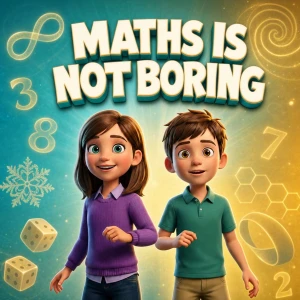
Maths for Kids / Maths is Not Boring is a podcast for curious children aged 4 to 12. Each episode explores one big mathematical idea, from infinity and prime numbers to chance, shapes and patterns. It is hosted by fictional AI characters Mira, a nine-year-old, and her seven-year-old brother Finn. The show avoids arithmetic drills and instead uses stories to show how maths explains the world. It aims to make mathematical ideas feel simple, beautiful and relevant to kids.
Episodes

What is the Collatz conjecture?
Have you ever heard of a math puzzle that acts like a wild weather storm? In 1937, a mathematician named Lothar Collatz invented a simple number machine with just two rules: if a number is even, cut it in half. If it is odd, multiply it by three and add one! Sounds easy, right? But what happens next is pure magic! Instead of acting normally, the numbers bounce wildly up and down like hailstones ca

What is Zeno's paradox?
Have you ever tried to walk across a room, but realized you have to go halfway first? And then half of that remaining distance? And half of that? Welcome to one of the most mind-bending puzzles in history! Over 2,500 years ago, an ancient Greek thinker named Zeno of Elea came up with a massive brain-teaser called Zeno's paradox. He imagined a race between the world's fastest hero, Achill

What was the first times table?
Have you ever wondered who invented times tables? Or why three times four is exactly the same as four times three? It's time to discover the quiet magic of multiplication! Imagine lining up your favorite wrapped sweets on a table in three rows of four. Now, walk around to the side of the table. Suddenly, it looks like four rows of three, but you haven't moved a single sweet! Mathematicia

Platonic Solids for Kids: Why There Are Only Five Perfect Dice
The story of the Platonic solids for kids: the five perfect shapes studied by Theaetetus and Plato in ancient Athens, and how Euclid proved around 300 BCE there can never be a sixth.• What makes a solid perfect: the same faces and the same corners• Why only five shapes work, worked out with triangles, squares and pentagons at a corner• Why each one makes a fair die, and where they turn up in salt

Averages for Kids: Why No One Is Average in Every Way
The story of averages for kids: how around 1950 Gilbert Daniels measured 4,063 United States Air Force pilots and found that not one was average in every way.• Why cockpits built for the average pilot fitted nobody• What an average tells you about a crowd, and what it cannot tell you• How the answer was seats and pedals that adjust, like the seats in a car• Quiz questions to answer along the wayMa

Binary for Kids: How Computers Count With Only 1s and 0s
The story of binary for kids: how Gottfried Wilhelm Leibniz wrote out a way of counting with only 0 and 1 in 1679, long before computers.• How to count one, two, three and four in binary• How Leibniz published his work in Paris in 1703• Why switches that are only off or on made binary perfect for computers• Quiz questions to answer along the wayMaths is Not Boring: rated 5★ on Apple Podcasts and 4

Triangles for Kids: Why the Strongest Shape Has Three Sides
The story of triangles for kids: why a triangle will not squash flat when a square does, and how Gustave Eiffel built his tower in Paris from triangles in 1889.• What engineers mean by rigidity• How more than 18,000 iron pieces in the Eiffel Tower are laced into triangles• Where triangles hold things firm, from bicycle frames to bridges• Quiz questions to answer along the wayMaths is Not Boring: r

Googol for Kids: What a Googol Is and Who Named It
The story of the googol for kids: how nine-year-old Milton Sirotta named the number one followed by a hundred zeros for his uncle, mathematician Edward Kasner, around 1920.• Why a googol is bigger than the number of atoms in the known universe• The even bigger googolplex that Milton dreamed up• How the word spread and gave a famous search engine its name• Quiz questions to answer along the wayMath

Fractions for Kids: How the Ancient Egyptians Shared Bread
The story of fractions for kids: how the Egyptian scribe Ahmes wrote down problems about sharing loaves of bread fairly about 3,500 years ago, in the scroll now called the Rhind papyrus.• How the Egyptians built fractions from pieces with a one on top• Why two thirds got a special sign of its own• Where the Rhind papyrus is kept today• Quiz questions to answer along the wayMaths is Not Boring: rat

Tessellation for Kids: How Tiles Cover a Floor With No Gaps
The story of tessellation for kids: shapes that cover a floor with no gaps, and how David Smith from Bridlington in Yorkshire found a tile in 2022 whose pattern never repeats.• Why squares, triangles and hexagons make repeating patterns• How Roger Penrose found a never-repeating pattern with two shapes in 1974• How David Smith's 13-sided hat was proved by a team of four in 2023• Quiz question

The Equals Sign for Kids: Who Invented It and What It Means
The story of the equals sign for kids: how Welsh doctor Robert Recorde drew two parallel lines in his 1557 book The Whetstone of Witte.• Why Recorde chose two lines of the same length• How his book was the first in English to use plus and minus signs too• Why equals means both sides balance, not the answer comes next• Quiz questions to answer along the wayMaths is Not Boring: rated 5★ on Apple Pod

The Law of Large Numbers for Kids: Why Coin Tosses Even Out
The story of the law of large numbers for kids: how John Kerrich tossed a coin 10,000 times during the Second World War, and how Jacob Bernoulli explained the result in a book published in 1713.• Why Kerrich's 5,067 heads is so close to half• Why a coin has no memory, and the next toss can still be anything• How the same idea lets a survey of many people tell us about a whole crowd• Quiz ques

Negative Numbers for Kids: How Numbers Go Below Zero
The story of negative numbers for kids: numbers below zero, from Chinese counting rods about 2,000 years ago to Brahmagupta's rules in India in 628 CE.• How Chinese mathematicians used red and black rods in The Nine Chapters• Why many European mathematicians refused them, and one called them absurd in 1544• Where negative numbers live today, from thermometers to lift buttons• Quiz questions t

Fractals for Kids: Why the Coastline of Britain Never Ends
The story of fractals for kids: why the coast of Britain gets longer the shorter your ruler, and how Benoit Mandelbrot asked the coastline question in 1967.• How Lewis Fry Richardson found two different lengths for the Spain and Portugal border• Helge von Koch's 1904 snowflake, with an endless edge inside a circle• Where fractals hide in ferns, broccoli, rivers and lightning• Quiz questions t

Place Value for Kids: Why We Count in Tens
The story of place value for kids: why ten fingers mean most of the world counts in tens, and how the system we use today grew up in India.• How the Babylonians counted in sixties, which is why an hour has 60 minutes• Why the Maya counted in twenties• How the same digit means one, ten or a hundred depending on where it sits• Quiz questions to answer along the wayMaths is Not Boring: rated 5★ on Ap

The Fourth Dimension for Kids: How to Picture a 4D Shape
The story of Flatland and the fourth dimension for kids: Edwin Abbott Abbott's 1884 book about a square who lives in a flat world and meets a sphere.• What a sphere looks like when it passes through a flat world• How the sphere lifts the square out of Flatland to show him up• Why the shadow of a four-dimensional cube looks like a cube inside a cube• Quiz questions to answer along the wayMaths

The Pigeonhole Principle for Kids: Why Two Pigeons Must Share
The story of the pigeonhole principle for kids: why two people in London must have the same number of hairs on their heads, and how Peter Dirichlet set out the rule in 1834.• Why more pigeons than pigeonholes means two must share• How a French puzzle book used the hairs example back in 1622• Why any 13 people include two born in the same month• Quiz questions to answer along the wayMaths is Not Bo

The Monty Hall Problem for Kids: Why Switching Doors Wins
The story of the Monty Hall problem for kids: three doors, one car and two goats, and how Marilyn vos Savant explained in 1990 why switching wins twice as often.• Why your first pick has only a one in three chance• How the host's open door is a clue that changes the chances• How even the great mathematician Paul Erdos only believed it after a computer test• Quiz questions to answer along the

The Four Colour Theorem for Kids: Why Maps Need Four Colours
The story of the Four Colour Theorem for kids: how student Francis Guthrie noticed in 1852 that four colours are enough for any map, and how it took until 1976 to prove it.• How Alfred Kempe's 1879 proof was believed until Percy Heawood found a mistake• How Kenneth Appel and Wolfgang Haken used a computer for about 1,200 hours• Why mathematicians argued over whether a computer proof counts• Q

The Seven Bridges of Königsberg for Kids: How Euler Solved It
The story of the seven bridges of Königsberg for kids: the Sunday walk nobody could finish, and how Leonhard Euler showed why in 1735 by drawing the first network.• How Euler swapped the city for dots and lines• Why every piece of land needs its bridges in pairs for the walk to work• How map apps and the internet use the same idea today• Quiz questions to answer along the wayMaths is Not Boring: r

Exponential Growth for Kids: How 42 Paper Folds Reach the Moon
The story of exponential growth for kids: why folding a sheet of paper 42 times would reach the Moon, and how Britney Gallivan set the folding record in California in 2002.• How Britney Gallivan folded a single sheet of paper in half twelve times• The old legend of rice doubling on every square of a chessboard• Why a pond half covered in lily pads is full the very next day• Quiz questions to answe

Zero for Kids: How People Invented a Number for Nothing
The story of zero for kids: how Brahmagupta in India wrote down the first rules for zero as a number in 628 CE, and how it travelled to Europe.• How the Babylonians and the Maya used a mark to hold an empty place open• Brahmagupta's rules for adding, taking away and multiplying with zero• How Arabic scholars and Fibonacci's 1202 book brought zero to Europe• Quiz questions to answer along

Symmetry for Kids: Why a Snowflake Has Six Matching Arms
The story of symmetry for kids: why a snowflake looks unchanged when you turn it, and how Emmy Noether showed in Germany in 1915 that symmetry hides the laws of physics.• How flips, turns and slides show up in butterflies, starfish and honeycombs• How Noether linked symmetry in time to the rule that energy never disappears• Why water freezing into hexagons gives every snowflake six arms• Quiz ques

The Mobius Strip for Kids: How a Shape Can Have Only One Side
The story of the Mobius strip for kids: how one twist in a loop of paper makes a shape with only one side, and how August Mobius described it in Germany in 1858.• How to make a Mobius strip and trace its one side with a finger• Why Johann Listing found the same shape in the same year• How the strip opened the door to topology and turned up in conveyor belts• Quiz questions to answer along the wayM

Prime Numbers for Kids: What Primes Are and Why They Never End
The story of prime numbers for kids: numbers like 2, 3, 5, 7 and 11 that only split into ones, and how Euclid of Alexandria proved around 300 BCE that they never run out.• How Euclid's argument shows there can never be a biggest prime• The giant prime found in October 2024 that would fill about 20,000 printed pages• Why prime numbers lock our messages and help cicadas come out every 13 or 17

Permutations for Kids: Why Every Card Shuffle Is Brand New
The story of permutations for kids: why a well shuffled pack of 52 cards is almost certainly in an order no one has ever held before, and how Dave Bayer and Persi Diaconis studied shuffling in 1992.• Why seven riffle shuffles are enough to mix a pack properly• How 52 cards can be ordered in about as many ways as there are atoms in the Milky Way• How Persi Diaconis went from card tricks with a magi

Infinity for Kids: What Infinity Is and Why Some Are Bigger
The story of infinity for kids: why there is no biggest number, and how Georg Cantor showed in the 1870s that some infinities are bigger than others.• How the even numbers pair up with all the whole numbers, one to one• Hilbert's Hotel, where a full hotel always has room for one more guest• Why other mathematicians mocked Cantor, and why he kept going• Quiz questions to answer along the wayMa

The Birthday Paradox for Kids: Why 23 People Share a Birthday
The story of the birthday paradox for kids: why in a room of just 23 people it is more likely than not that two share a birthday, and how Richard von Mises published the idea in 1939.• Why the question is about any two people, not about matching you• How counting pairs of people makes the chances grow so fast• What the maths of chance tells us about coincidences• Quiz questions to answer along the

Pi for Kids: What Pi Is and Why Every Circle Has It
The story of pi for kids: why the distance around any circle is always a little more than three times the distance across, and how Archimedes of Syracuse pinned the number down around 250 BCE.• How Archimedes trapped pi between shapes with up to 96 straight sides• Why the digits of pi go on forever without repeating• Where pi turns up, from bike wheels and coins to ripples on a pond and the orbits