The World in Question
King's Global Affairs | King's College London Research 80 episodes Mar 29, 2026
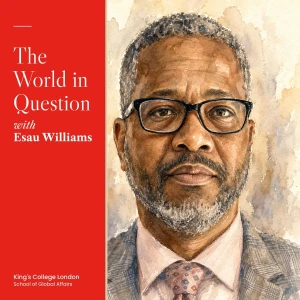
The World in Question is a global affairs podcast from King's College London that explains geopolitics through world events and international politics. Hosted by Esau Williams, it brings expert guests into conversation to analyze some of the biggest and most neglected stories shaping global politics today. The show was formerly known as WORLD: we got this.
Episodes
Sacrificing the Ocean to Save the Planet
Beneath the vast expanse of the Pacific Ocean lies an unseen world: deep seabeds dotted with metal-rich nodules that some claim are vital for the green transition. As demand grows for minerals used in renewable technologies and batteries, governments and companies are increasingly turning their eyes toward the deep ocean.In this episode, King’s College London academics Dr Ben Tippet and Dr Rowan G
Future-Proofing the UK
In this episode, host Esau Williams explores how the UK can prepare for a future shaped by rising temperatures, heavier rainfall, and rapidly shifting social and environmental pressures. From heatwaves and flooding to community resilience and communication strategies that genuinely resonate, this conversation examines what “future-proofing” really looks like - not as a distant political ambition,
The Future of Overseas Aid
In this episode of The World We Got This, host Esau Williams explores how international development is being reshaped as governments cut budgets, multilateral institutions restructure, and aid becomes increasingly tied to national interest. Recorded in the wake of the International Development Committee’s inquiry into UK aid, the discussion brings together leading scholars to unpack what these shi
Invisible Water
When you pick up a packet of food in the supermarket, you can see the calories, protein and fibre listed clearly. But there’s one ingredient you’ll never find on the label, even though it’s essential to producing almost everything we eat: water. And not just the water you can see in a juicy tomato or crisp lettuce, but the vast, hidden volumes used to grow crops, feed animals and process food.Glob
Dust Storm Diplomacy
In March 2021, Seoul woke up under a thick yellow haze - the worst dust storm in a decade. South Korea blamed China, who promptly blamed Mongolia. Fingers were pointed, narratives emerged, and what seemed like a weather event quickly became a diplomatic one.Since then, dust storms have continued to blight the region, and have emerged as a source of continual transborder tension.Joining Esau in thi
Too hot to live
A recent assessment found that the area of Earth's landmass that will be too hot for even healthy adults to keep a safe core body temperature will approximately triple - to an area almost the size of the US – if global warming reaches 2°C above the preindustrial average. We've already reached 1.5°C.This week Esau asks: what does 'too hot' actually mean? What will happen to the people who live in t

Dam clever: is world's biggest hydro scheme a good idea?
The proposed Grand Inga dam in the Democratic Republic of Congo would be the largest power station in the world - if its ever built. With twice the output of China's Three Gorges, the dam could potentially bring electricity to those 600 million in sub-Saharan Africa currently without.But after decades of delay, investors withdrawing, environmental concerns, and its ballooning $80bn price tag, does
A deep dive into DeepSeek
What is the new app DeepSeek? How does it differ from other LLM providers? And why has it caused such a significant impact on the US AI industry? In this episode, Esau is joined by Sean Starrs and Juan Grigera, from the Department of International Development, King's College London to discuss all things AI. Hosted on Acast. See acast.com/privacy for more information. This is a public episode. If y
Forty years on from Band Aid, what is the UK-Africa relationship? And what happened at COP29?
As the 40th anniversary version of 'Do They Know It's Christmas?' hits the charts, and with Ed Sheeran igniting a row over whether it and similar charity initiatives reinforce African poverty stereotypes, Esau and guests discuss the current state of the UK-African relationship. Plus, what the heck happened in Baku, as COP29 negotiations overran and left many feeling let down? Is the developing nat
What Trump 2.0 means for Ukraine, India, China and the world
Donald J Trump is set to make a historic comeback as the 47th US President after a decisive electoral victory over Democratic candidate Kamala Harris. In this episode, host Esau Williams talks to Dr Sean Starrs, an expert in international development, and Dr Anastasia Piliavsky, a Ukrainian who studies Indian politics, on what to expect when Trump takes office in January 2025. They discuss the imp
Should we super tax the super rich? And what happened at the BRICS+summit
In the wake of the UK budget, and a report from Greenpeace on the feasibility of a wealth tax on the super rich, the panel discuss whether such a measure is possible or even likely. Plus, what happened at the BRICS+ summit, and was it a success for Putin and his allies?Joining Esau this episode are Sean Kenji Starrs, Barnaby Dye, and Benjamin Tippet from the Department of International Development
Spotlight on China – SEZs in Africa, China’s ghost cities and China in the US elections
In this special episode for the Lau China Institute’s China Week, Esau is joined by Dr Charlotte Goodburn to discuss her new report on the impact of China-linked economic development zones in Africa, Dr Jane Hayward explains China’s many vacant cities, and Professor Astrid Nordin and Dr Sean Kenji-Starrs discuss the China question in the US elections. Learn more about the Lau China Institute's Chi
Nuclear energy; Modi in US; September flooding
With Esau this episode: Prof Frans Berkhout talks about the pledge by the big banks to triple nuclear energy by 2050; Dr Anastasia Piliavsky digs deeper into Narendra Modi's visit to the US; and PhD candidate Teyah Payne discusses recent flooding in the global north and south. Hosted on Acast. See acast.com/privacy for more information. This is a public episode. If you would like to discuss this
In conversation about studying loneliness and ageing in Southeast Asia
When Samia Akhter-Khan spent a year in Myanmar with older adults, she became curious to understand how loneliness operates in such social contexts where communities are tight knit. So for her PhD project, she chose to conduct research into loneliness in later life in Thailand and Myanmar. In this episode, Samia talks to her supervisor Dr Rosie Mayston about the challenges of studying loneliness i
The far-right and the changing politics of Europe
The far-right has seen its popularity grow across Europe in recent years and is expected to gain a quarter of the seats in the European Parliamentary elections this year. In this episode, Dr Georgios Samaras, Assistant Professor in Public Policy at King’s College London’s International School for Government, looks at what is behind the rise of the far-right, its wider implications and what society
In conversation about the disruptive potential of Argentina’s feminist movements
What can feminist movements worldwide learn from Argentina? A lot it seems.In this episode, Lea Happ, PhD student in the Department of Global Health & Social Medicine talks to her supervisor Dominique Béhague about her research on the feminist activist networks in Argentina. She studies how the movement to legalise abortion transformed when that goal was realised in December 2020. Lea shares t
What do current conflicts tell us about the world today and our prospects for peace?
As the war in Ukraine enters its third year, there is also ongoing fighting in Gaza, attacks on cargo ships in the Red Sea and subsequent US and UK air strikes. This has prompted some to warn we are a moving from a post-war to a pre-war world.In this latest episode, Dr Marina Miron, a post-doctoral researcher in the Department of War Studies at King's College London, explores whether we are in a t
Can we really rely on planting trees to help limit climate change?
In this episode, researcher Ol Perkins explores whether land-based carbon dioxide removal schemes such as reforestation can live up to their promises and help us meet global pledges to limit climate change.Ol outlines some of the challenging implications of this approach and why experts and policymakers also need to consider the socio-cultural, environmental, and institutional factors that seem to
In conversation about Nigeria's strategic role in West Africa
What strategic role has Nigeria played on issues of peace and security in West Africa? What do Nigeria's past interventions in Liberia and Sierra Leone tell us about its role in the region today? In this episode, Dr Folahanmi Aina, who recently completed his PhD from the African Leadership Centre at King's, talks to Dr Olawale Ismail, Senior Lecturer at ALC, about the findings of his PhD research
The impact of colourism on people and societies around the world
This episode looks at how colourism affects people and their life chances, plus how research is helping to fill the gaps in our knowledge around this pervasive, but perhaps not widely known form of discrimination.Featuring Dr Aisha Phoenix, a social justice lecturer from the School of Education, Communication & Society at King’s College London, the episode also explores what lies behind colour
In conversation about the Dravidian movement's transition into party politics
How does a movement for social justice transform into a viable political party? How are the ideas of the movement reshaped in the process? In this episode, Dr Vignesh Rajahmani, who completed his PhD from the King's India Institute, speaks to Professor Christophe Jaffrelot, Professor of Indian Politics and Sociology, about his thesis on the Dravidian movement in Tamil Nadu in southern India. He sh
How Russia is outmanoeuvring Western sanctions
The international community imposed far-reaching sanctions on Russia following its invasion of Ukraine in a bid to weaken its economic base and curtail its ability to wage war. However, the war continues. So, what has happened? Have the sanctions not worked as hoped? And if not, why not?In this episode, Dr Alexander Kupatadaze, Senior Lecturer at King’s Russia Institute, shares his new research wh
In conversation about Brazil’s defence agenda in the South Atlantic
What life skills can one learn from doing a PhD?In this episode, Dr Maísa Edwards who recently completed a joint PhD from the King’s Brazil Institute and the University of São Paulo talks about her research on Brazil’s diplomatic and defence relations in the South Atlantic region. Speaking to Dr Andreza de Souza Santos, Maísa also shares the challenges she faced in completing her PhD during the Co
What is the world’s problem with migration?
Migration is a topic that preoccupies many countries around the world and this new episode looks at some of the current global challenges around migration including exploring what impact immigrants have on jobs and public services, whether politicians are in step with public attitudes towards migrants and refugees, plus what it is like for those trying to move in search of a better life. It featur
In conversation about China and UK relations through film
Why aren't mainland Chinese films box office hits in the UK? Do Chinese people watch films produced in the UK? PhD student, Giulia D'Aquila researches an agreement between China and the UK on film production and distribution.In this episode, she reflects on how films from mainland China are received in the UK, what is considered propaganda in each country and why other foreign-language exports are
In conversation about digitalisation and welfare entitlements in India
Is technology really helping people in India to receive their welfare entitlements? Or is digitalisation affecting their agency? And how does it affect local state actors? These are some of the questions PhD student, Vanita Leah Falcao is exploring in her thesis. In this episode, she speaks with Professor Louise Tillin about her time as a policy worker in India, her experiences doing research fiel
Guest episode - A year of war in Ukraine: what have we learned?
As we recently marked a year since Russia invaded Ukraine, we are sharing an episode of The War Studies Podcast produced by our Department of War Studies looking back at what we have learned over the past year of fighting and what it might mean for the future.It features Dr Marina Miron, who uses her knowledge of Russian military strategy, information warfare, and technology to explore what has ha
Are public protests challenging authoritarian regimes around the world?
This new episode looks at recent large-scale public protests in Russia, China and Iran including what has sparked them and what they tell us about the balance of power of these regimes.The episode, featuring academics from the Faculty of Social Science & Public Policy, looks at the effects of the protests, the response of those in power to the public dissent, and asks whether they are a sign t
In conversation about state-society relations and studying at King's
Master's alumna Linette Lim's focused her dissertation looked at why some Indian states far out-perform others in the Human Development Index (HDI). In this episode, she shares how she came up with this research puzzle and her journey post-master's degree. This includes her life as a foreign correspondent in China and how her experience with censorship led to her PhD thesis. Hosted on Acast. See a
In conversation about sand dunes, climate change and Mars
What can the life of sand dunes on Mars tell us about climate change on Earth? In this episode, PhD student Lucie Delobel shares her love of sand dunes and how she went from studying them on Earth to studying them on Mars.Her master's dissertation became a leading article for Nature Climate Change and is shaping the discussion on using wind patterns to examine climate change. Now doing a PhD at Ki
Are we at a pivotal moment in the climate crisis?
This episode looks at where we are in the climate crisis, how recent events including war and economic crises have affected the priority of environmental issues and whether we still have time to make a difference.It features two academics from the Faculty of Social Science & Public Policy at King’s College London who explore whether we are at a pivotal moment in the climate crisis.Professor Fr
In conversation about decolonising sexual reproductive health
What shapes and enables women's rights to be fully enacted in a world where sexual reproductive health is politicised? What exactly is the reproductive justice movement? And how important is it to understand our past when it comes to making informed decisions about women's bodies?In this episode, PhD student Annabel Sowemimo shares how she first got into sexual reproductive health, more about her
The political consequences of the pandemic
This podcast episode looks at the huge political consequences of the COVID-19 pandemic and how its effects are still being felt at every level around the world today.It explores how the pandemic affected the standing of global leadership organisations, as well as challenging previously held ideas about effective leaders and political systems.It also looks at how the pandemic caused the downfall of
In conversation about marine conservation
What can we do to protect our oceans? Are 'Marine Protected Areas' an effective method of ecosystem management? These are some of the questions that PhD Candidate, Constance Schéré, aims to answer through her research. Hear Constance discuss her research with Kate Schreckenberg, Head of King’s Department of Geography and Professor in Environment and Development.You can find out more about the orga
Facing up to the energy crisis
This episode explores the important role of energy in the geopolitical order on our planet. It explores how China can meet its energy needs and climate commitments, the potential impact of the war in Ukraine on Russia's role as an energy superpower, plus why we are still so reliant on fossil fuels to power our daily lives.It features Dr Thomas Froehlich, Kalina Damianova and Isabel Hilton, all of
In conversation about the war on drugs in Guatemala
With the mass incarceration of women quintupling in Guatemala as a result of the 'war on drugs', Gloriana Rodriguez Alvarez, PhD candidate and human rights advocate, asks how the country's policies and institutions perpetuate social prejudices and impact marginalised communities.In this episode, Gloriana speaks with David Mwambari, Lecturer in African Security and Leadership Studies at King’s Afri
The role of space in modern-day warfare
The invasion of Ukraine has shown how new technologies are now used alongside more traditional means of waging war. This episode, the second on the Changing Face of War, looks at how space has become an integral part of military and security operations today, how countries around the world and private individuals are expanding their activities into space, and how closely these are linked to what i
How cyber operations, social media and artificial intelligence are changing warfare
In this episode Dr Tim Stevens and Dr Kenneth Payne, both based in the School of Security Studies in the Faculty of Social Science & Public Policy at King's College London, explore the role of cyber operations, social media and artificial intelligence in modern warfare.They explain how our reliance on digital systems is creating new vulnerabilities, look at the ways that social media is broade
In conversation about how foreign policy interacts with health
How does foreign policy interact with health? And how is power intertwined with health policy?In this episode, Maria Berta Ecija Salgado, PhD alumnus, discusses her research on soft and hard power in Brazil foreign affairs. This included conducting field work in Mozambique to explore the role of Brazil in establishing a factory for antiretroviral drugs.Hear Maria Berta discuss her research with An
Why does global poverty exist and could we share wealth more evenly?
The latest episode of the ‘WORLD: we got this’ podcast explores how poverty affects people around the world and hears what could be done to distribute wealth more evenly.In the episode, Dr Eduardo Ortiz-Juarez, Dr Liz Fouksman and Otto Lehto, who are all part of the Faculty of Social Science and Public Policy, share research on what lies behind global poverty including the effects of the pandemic
In conversation about a future with no humans as we know them
Last year, Sara Dahlen won King’s Biotechnology & Society Essay Contest on the theme: "In the future there will be no humans as we know them. So what?” Her essay, “Notes to No-One”, imagines a future after an ecological collapse where humanity has almost been destroyed by climate change, wildfires and endocrine disruptions.In this episode, Sara Dahlen, a PhD candidate and Dr Silvia Camporesi,
In conversation about communicating the risk of COVID
During the pandemic, how have governments’ approach to communication impacted our sense of risk? Have our governments helped us to feel safe and alert or just confused?In this episode, George Warren, a King’s PhD candidate, takes a look at different governments’ communications strategies around the risk of COVID and some of the best and worst practices. Hear George explore his research with Ragnar
How gender inequality impacts society
The latest episode of the WORLD: we got this podcast explores how gender inequalities are having an impact on different societies across the globe and hears what could be done to create a more equal world. In the episode, Dr Ye Liu, Professor Cathy McIlwaine and Dr Aleida Borges, who all work in the Faculty of Social Science & Public Policy at King's College London, share research on what lies
In conversation about corporate accountability
What is the role of companies in complex crises, such as pandemics, inequality and climate change? How responsible are they for their impact on society and the environment? And what about the CEO – what is their role in the corporate response to crises? In this episode, Marc Lepere explores these questions, including whether the COVID-19 pandemic has led to companies becoming more responsible. Hea
Our divided society
This episode looks at division and polarisation in society and explores what could help create a greater sense of unity in the future. It features Professor Bobby Duffy, Paula Surridge and Dr Jack Brown who all work within the Faculty of Social Science & Public Policy at King's College London, talking what lies behind generational, cultural, political and geographical divisions. They also shar
In conversation about gender bias and climate
Are women climate scientists judged for speaking out about climate change? After all, women have often, and still are, dismissed as dramatic or emotional in the public sphere. Hear from master's graduate, Lauren Armstrong as she explores her research on the topic with Dr George Adamson, Senior Lecturer in Geography.'In Conversation' episodes of the WORLD: we got this podcast showcase the research
Inaction on climate change
This episode, released ahead of the COP26 climate summit, looks at why we aren’t doing more to tackle climate change and what society, governments and individuals can do turn current inaction into action. It features Dr Kris de Meyer, Dr James Porter and Dr Anshu Ogra from the Faculty of Social Science & Public Policy at King's College London. Hosted on Acast. See acast.com/privacy for more in
A public health approach to online abuse with Seyi Akiwowo
We speak with campaigner, activist and CEO Seyi Akiwowo about the impact of online abuse, and why taking a public health approach might be a way forward. Seyi founded and now runs the charity 'Glitch'. You can find out more by heading to https://fixtheglitch.org/ Hosted on Acast. See acast.com/privacy for more information. This is a public episode. If you would like to discuss this with other sub
Feminist International with Veronica Gago
How has the feminist movement been democratised? What differentiates the feminist strike front from the conventual labour strike? And how do we bring feminist activism into the everyday? In a special WORLD: we got this takeover, we hand the podcast over to the Gender Studies Network at King’s. Professor Jelke Bose, lead for the network, and Phoebe Martin, PhD candidate and editor of the Feminist P
Water diplomacy with Dr Naho Mirumachi
What is water diplomacy? Will Climate Change result in increased conflict over water access? And what should countries and organisations be doing to make sure the world be doing to make sure the world works together on water access? We speak to Dr Naho Mirumachi on World Water Day about Water Diplomacy. King's Water Hub - https://www.kcl.ac.uk/research/kings-water Hosted on Acast. See acast.com/pr
How democracies die with Prof Steven Levitsky
What is populism? Does it threaten the foundations of democracy? Does Donald Trump’s defeat represent the high point for populism globally? And what should Democrats do next? In today’s episode we discuss these questions and much more with Professor Steve Levitsky, Professor of Government at Harvard University and leading scholar on populism. Register for Populism in Latin American and Beyond: htt
Post pandemic cities with Prof Phil Hubbard
We speak to Prof Phil Hubbard about how the pandemic has altered our urban environment and why these changes may be permanent. But why cities this moment presents an opportunity to reimagine how we use our urban space, in turn helping tackle climate change and inequality. Hosted on Acast. See acast.com/privacy for more information. This is a public episode. If you would like to discuss this with o
Reclaiming the internet for civil society with Prof Ronald Deibert
We discuss the need to ‘RESET’ and rethink how we manage the internet in the age of mass surveillance with Professor Ron Debit. As director of the Citizens Lab at the University of Toronto Ron and his team have been at the forefront of helping understand the internets impact on society, helping uncover human rights abuses and pull back the curtain to help teach us understand what’s really going on
A global approach to the vaccine with Dr Ann Kelly
We speak with Dr Ann Kelly about the need for a truly global approach to the vaccine rollout. We discuss the need to build vaccine production and development capacity, including within developing countries, helping speed up vaccination and new variant detection. We also explore why the pandemic demonstrates the need to push for healthcare provision globally so that when pandemics hit, we can work
Adolescent mental health in a time of COVID with Dr Gemma Knowles
We speak with Dr Gemma Knowles, the about the ground-breaking research being undertaken to understand and support young people's mental health. Speaking during children's mental health week, Dr Gemma Knowles joined the podcast to discuss the emerging challenges for young people's mental health and the recent challenges posed by COVID-19.Link to Centres Website: www.kcl.ac.uk/csmhLink to support fo
The Natural Health Service with Isabel Hardman
We speak with political journalist Isabel Hardman about why her own experiences of mental health led her to write The Natural Health Service—in turn, helping to explore the benefits to our mental wellbeing of spending time in nature. Along the way, Isabel met others who had found the benefits of Nature to the health and spoke with researchers trying to understand the benefits of everything from fo
Brexit and beyond (plus a little bit of Billy Bremner)with Anand Menon
In our first podcast of 2021, we are joined by Professor Anand Menon, Director of the UK in a Changing Europe to discuss that most complex of challenges – Brexit. We also discuss what other political and economic challenges lay in wait for the UK, why language, process and explanation are crucial to understanding complex challenges. And why the Union may become the defining issue of 2021. To read
Christmas Special 2020 with Dame Louise Casey
In our end of year Christmas special, we speak to Dame Louise Casey about her time in government, taking on some of the biggest challenges, from tackling homelessness under Tony Blair to leading the troubled families programme under David Cameron. We discuss why sound policymaking is a mixture of the 'blindingly obvious' and the very complex. Furthermore, Dame Louise explains why she thinks Boris
Italy and the New Silk Road with Dr Alice Politi
We speak with Dr Alice Politi about her new paper 'Italy: a case study of the Silk Road Project in Europe'. The paper considers the recent bilateral agreement between Italy and China, examining what it can tell us about the role of Chinese foreign investment for Chinese trade and diplomacy.The paper is the first in a new Policy Series from the Lau China Institute titled 'China in the World'. To fi
A multiple pandemic with Dr Rosa Heimer
We speak with Dr Rosa Heimer about her essay and research, looking at the impacts of COVID-19 on black and minoritized women facing gender-based violence. We discuss how housing, immigration and policing are currently failing to support many women escaping violence. We discuss why these issues will outlive the pandemic but also what we can do to bring about change. Show NotesOrganisations Rosa w
Block bricks and unfree labour with Dr Nithya Natarajan and Dr Laurie Parsons
We speak with Nithya and Laurie about why the Brick industry in Cambodia has created a multigenerational workforce of adults and children trapped in debt bondage – one of the most prevalent forms of modern slavery in the world. This process of unfree labour has led them to coin the term 'blood bricks'. Working with other researchers they aim to highlight the injustices of modern day slavery, but a
The making of modern Brazil with Prof Anthony Pereira
Brazil sits at the heart of some of the worlds biggest challenges from deforestation to inequality. Its ability to overcome these issues are not only critical to its future, but to the future of the entire planet.We speak with Professor Anthony Pereira about his new book Modern Brazil: A Very Short Introduction and why to understand Brazil today we must understand its contemporary formation. Hoste
Bonus episode | The global housing crisis with Dr Deborah Potts and Prof Phil Hubbard
Bonus Episode. The podcast is taken from a live event we ran entitled 'Broken Cities: the Global Housing Crisis In Focus' in which Dr Deborah Potts and Prof Phil Hubbard spoke with Owen Hatherley, Editor at Tribune Magazine about the global housing crisis. Hosted on Acast. See acast.com/privacy for more information. This is a public episode. If you would like to discuss this with other subscribers
Minority persecution in India with Sudhir Selvaraj
We speak with Sudhir Selvaraj about the persecution of Christians in India. The 2008 Kandhamal violence and why minority communities in India continue to face threats. Hosted on Acast. See acast.com/privacy for more information. This is a public episode. If you would like to discuss this with other subscribers or get access to bonus episodes, visit kingsglobalaffairs.substack.com
Water access and inequality in the US with Dr Katie Meehan
Water access and inequality in the US with Dr Katie Meehan by King's College London Hosted on Acast. See acast.com/privacy for more information. This is a public episode. If you would like to discuss this with other subscribers or get access to bonus episodes, visit kingsglobalaffairs.substack.com
Fire in the tropics with Prof Martin Wooster
In the first episode in our new format we speak to Professor Martin Wooster about the importance of mapping wildfires, why not all wildfires are bad, and unique threat posed by fires in the tropics. Professor Martin Wooster is an expert on satellite Earth observation and the quantification of landscape fire. He was appointed Professor of Earth Observation Science at King's in 2005. He is currently
Best of | Summer special
We look back on our first season, exploring the global response to COVID-19. From testing to mental health we speak with the experts who have been responding to the COVID-19 pandemic. Hosted on Acast. See acast.com/privacy for more information. This is a public episode. If you would like to discuss this with other subscribers or get access to bonus episodes, visit kingsglobalaffairs.substack.com
Lockdown spaces (Live)
In this special event with the Centre for Society and Mental Health and Department of Geography we discuss how nature and our environment is critical to our mental and physical wellbeing. Why this crisis has given us an opportunity to reflect on the importance of our green space and environment to our wellbeing. And why this crisis has further demonstrated inequalities of access to space.We are jo
In Focus | Africa
In a special episode in partnership with the African Leadership Centre we put Africa In focus. We discuss the initial responses to the COVID-19; why representations of African leadership matter, the innovative approaches being taken to public health and the possible long-term impacts of COVID-19 on the political, economic, and cultural life of Africa.Our expert panel is chaired by Neil Munshi. He
Racism is a health risk (Part 2) with Mohamed Ali and Beauty Dhlamini
We speak with Mohamed Ali and Beauty Dhlamini, alumni of Global Health & Social Medicine, about the UK, and how COVID-19 has further highlighted how racism continues to be a health risk. They discuss their work to push for change in how global health is talked about and who gets to participate in the discussion. We also go on to speak about their podcast 'Mind The Health Gap', which acts as a sour
Racism is a health risk (Part 1) with Prof Anne Pollock and Dr Melissa Creary
We speak with Professor Anne Pollock (King’s College London) and Dr Melissa Creary (University of Michigan) about why racism is a health risk. And we ask whether COVID-19 and the protests led by the Black Lives Matter movement may have created a unique moment in which to tackle racial injustice in both health and wider society. In part two we will discuss the UK and why this COVID-19 crisis has o
In Focus | East Asia
As the COVID-19 pandemic continues to spread across the world, one region stands out for its comparatively effective prevention and management response: East Asia. As of late May, the number of reported deaths per capita from COVID-19 across East Asia is lower than in other regions – most notably Western Europe and the United States. In addition, with the exception of the city of Wuhan where the p
In Focus | Brazil
As cases continue to rise, an economy in decline and Bolsonaro's position looking fragile, we speak with our guests about how COVID-19 rocked Brazil. We discuss the initial response, the factors that led to the current crisis and what might happen next in South America's biggest economy.Chaired by Tom Phillips, Latin America Correspondent for The Guardian. With academic panel: Professor Anthony Pe
In conversation | Ethics and pandemics
How does a doctor know which patient to save during a pandemic, when resources can be limited? And how ethical is it to put everyone under lockdown? Does trust in our government predict whether we will socially distance ourselves? In this in conversation episode of WORLD: we got this, we speak with Dr Silvia Camporesi, Senior Lecturer in Bioethics and Society, and Caitlin Gardiner, an A&E doctor i
Social care in crisis with Prof Karen Glaser, Dr Ludovico Carrino and Prof Mauricio Avendano Pabon
We discuss the critical role social care is playing during COVID-19, particularly with the elderly. Our experts reflect on the current models of social care and their impact on care workers, as well as the unique challenges posed by COVID-19 and why we are seeing increased levels of mortality in care homes. Critically, we discuss we can do to improve our response and discuss what long-term changes
In conversation | Coronavirus and neoliberalism
In our first ‘WORLD: we got this | In conversation’ episode, we speak with Professor Alfredo Saad-Filho about his essay 'Coronavirus, Crisis, and the End of neo-liberalism'. We discuss why the COVID-19 crisis may bring about a radical shift in global economics but also how what comes next is far from certain. Alfredo is Professor of Political Economy and International Development in the Departmen
Mental health in the time of COVID with Profs Nikolas Rose and Craig Morgan
We talk with Professors Nikolas Rose and Craig Morgan from the Centre for Society & Mental Health about the challenges posed to our mental health by COVID-19.We explore how the pandemic and subsequent lockdown is demonstrating the importance of social networks and solidarity for wellbeing. And we discuss how this crisis demonstrates the need for a shift in wider government policy if we are to supp
A state of innovation with Dr Robyn Klingler-Vidra and Prof Kerry Brown
As governments grapple with the COVID-19 outbreak, we discuss the role innovation can play in helping tackle pandemics. We speak with Dr Robyn Klingler-Vidra from the Department for International Development about the success Viet Nam has had in tackling COVID-19. This includes an innovative approach to testing. We ask what lessons other governments can learn, and we go on to discuss with Robyn a
Trailer | Season 1 | WORLD: we got this
In our first season we look at pandemics, in particular the current COVID-19 global health crisis. This includes what we can learn from previous epidemics, the global response and policy measures. Hosted on Acast. See acast.com/privacy for more information. This is a public episode. If you would like to discuss this with other subscribers or get access to bonus episodes, visit kingsglobalaffairs.s
WHO got this? with Dr Ann Kelly, Prof Mauricio Pabon Avendano and more
We begin our first season by exploring the global challenges posed by pandemics. In our first episode, we discuss the organisation at the very heart of the current COVID-19 response – the World Health Organisation (WHO). We survey the landscape of global health and talk about the first stages in responding to a global pandemic, as well as how the current crisis may change the WHO and global health