Declarations: The Human Rights Podcast
A show about human rights coming to you every week from the Cambridge Centre of Governance and Human Rights. Tune in each week as we explore how the concept and practice of human rights can remain fit-for-purpose and co-evolve with the changing world order, joined by fascinating guests from the University of Cambridge and around the world.
Episodes
Resisting Algorithms: Human Rights in the Age of Platforms
In a digital age, where content creators are booming, shaping culture, influencing politics, and building entire livelihoods online, we find ourselves in a world governed by algorithms we didn’t design, and often can’t even see. So what does it mean to resist? From viral content that defies the odds, to artists and activists who quietly tweak the system to stay visible, today we explore the subtle
Justice in the Balance: Can the Law Save Democracy?
In this episode, we explore the European Court of Human Rights (ECHR) — often hailed as the “conscience of Europe” and one of the most successful human rights institutions in the world. But in an era of democratic backsliding, populist politics, and eroding faith in institutions, what does “justice” look like today?Drawing on eight years of fieldwork with advocates, lawyers, and judges at the ECHR
The Sociology of Humanity: Benjamin P Davis and “Another Humanity”
What does it mean to imagine another humanity in a century marked by war, displacement, and deep inequality? In this episode, we sit down with Benjamin P. Davis, author of Another Humanity: Decolonial Ethics from Du Bois to Arendt. Davis traces shifting ideas of “the human” through the works of W. E. B. Du Bois, Édouard Glissant, Sylvia Wynter, and Edward Said—thinkers who redefined human rights a
Shifting Tides: How the Media Landscape and Press Freedom Are Changing Worldwide
Welcome back to Declarations!In this episode, we’re joined by renowned journalist Kalpana Jain to explore how the media landscape has evolved and how press freedom is shifting across the globe. From the West to South Asia, we unpack the complex forces shaping what gets reported, whose voices are amplified, and how journalism is being redefined today. The media has undergone a seismic shift over th
Invisible Chains: How Censorship, Misinformation and Propaganda Shape Stockholm Syndrome in African States
Welcome back to the second episode of Season 9 of Declarations!We are often informed to the terrorising, oppressive and distressing effects of Human Rights abuses across the continent of Africa. However, what happens in the rare cases that citizens don't know they're being abused? By exploring the implicitly powerful weapon of censorship, misinformation and mass propaganda, we can observe
Human Rights and American Foreign Policy with Andrew Preston
Welcome back to Season 9 of Declarations!This season we are looking at the notion of Human Rights and The Polycrisis.In our first episode, Co-host Ed Parker sits down with Andrew Preston, an acclaimed historianof American foreign relations post 1890, to trace the role of human rights in American protest movements and foreign policy debates, asking whether humanitarian ideals have ever truly guided
Human Rights Volunteers: Lessons from Due Diligence during Qatar 2022
Join our host, Iman, in conversation with Lucy Amis from the University of Cambridge's Centre for Sport & Human Rights (CSHR), alongside our panellist and podcast lead Shubham Jain, as they discuss the need for mainstreaming human rights in sports, and how the CSHR's innovative initiative, the 'Human Rights Volunteer Programme', can help promote human rights during sports event
Advancing Rights Through Protest & Revolution in Syria
Join guest host, Dounia, in conversation with Omar Alshogre as they discuss the relationship between activism and human rights in the context of the Syrian revolution. What is the future of the Syrian revolution? Has it fallen into oblivion? Will Syrians ever succeed in getting rid of a regime which has been plaguing the country for more than 50 years?
Unlearning Gender-Based Violence
Join our guest host, Maryam, in conversation with special guest Salman Sufi, founder of the Salman Sufi Foundation, as they discuss gender-based violence in Pakistan. How can the systemic infrastructure perpetuate such violence, and what can human rights activists do to mitigate these harms and close some of these systemic gaps?
Prisons, Captivity & Justice in India
Join our host, Iman, in conversation with special guests, Uma Chakravarti and Suchitra Vijayan, and our panellist Jigisha Bhattacharya, as they discuss incarceration and its politics in contemporary India, focusing on addressing concerns such as human rights violations, democratic oversight and the silencing of dissident voices.
Protecting the Protector
In the 100th Episode of the Declarations Podcast, Iman is joined by special guest Lucia de los Angeles Diaz Genao and panellist Matias Volonterio to discuss: what can we do about violence against activists? How do we protect the marginalised who raise their voices?
Politics & Human Rights: With the Politics or Against the Politics?
In this episode of Declarations, our host Iman is joined by special guest Siri Gloppen and panellist Charlotte Abercrombie to discuss global democratic backsliding and its impact on human rights. They evaluate the role of courts in safeguarding human rights and the risks of politicising fundamental freedoms. This episode comes at a crucial period, where democracies appear to be in peril worldwide.
Human Rights: Of, By, For Which People?
In this episode, our host Iman is joined by special guest Tarah Demant and panellist Tess Hargarten to discuss the impact of Western hegemony on modern human rights and the development of human rights organizations worldwide. This topic is especially relevant at the current moment, when multiple contentious wars are raging with more and more human rights violations coming to light.
Season 8 Episode 1 - Introducing Horror, Hope & Human
Who are human rights for? Where is the 'human' in 'human rights'? What have we learned about human rights conceptually, as well as in practice, over the last 75 years? In this brief first episode, our host Iman introduces our theme for this season, and gives an overview of the questions we seek to probe while reflecting on the 75 years since the Universal Declaration of Human Right
Season 7 Episode 9: Prioritising Human Rights in the Green Transition
In episode 9 Declarations host Neema Jayasinghe is joined by panellist Aimee Hobley and guest speaker Kristin Hughes. Their discussion explores the potential human rights challenges raised by the ongoing green transition. Kristin offers insight and expertise on how the multistakeholder green transition can mitigate against the potential threats created by rare earth mining and resource insecurity,
Season 7 Episode 8: Voices from Across the Picket Lines
In this episode of Declarations, Neema Jayasinghe and panellist Isabella Todini sit down with Dr. Lorena Gazzotti, a research fellow at the University of Cambridge and Vice President of the Cambridge branch of the University and Colleges Union (UCU) to discuss the right to strike, why lectures across the UK have been striking this year, and why urgent action is needed. We focus on lecture strikes
Season 7 Episode 7: Women peacebuilders in a conflicted world order.
In our seventh episode, host Neema Jayasinghe joins panellist Yasmin Homer to discuss the work of women peacebuilders with guests Eva Tabbasam (GAPS UK) and Andrea Filippi (PeaceWomen Across the Globe). We discuss the importance of fostering and protecting civil society networks in peacetime and wartime, the challenges of political will, and how the Women, Peace, Security Agenda needs to expand it
Season 7 Episode 6: The Psychology of Border Violations in Mental Abuse
In our sixth episode, host Neema Jayasinghe is joined by previous podcast host and panellist, Dr Maryam Tanwir. With special guest, Professor Sam Vaknin, the episode unpacks discourses related to the psychology of personal border violations in mental abuse. The conversation questions how borders and boundaries are not only demarcated, violated, or transgressed in global politics, but also at the l
Season 7 Episode 5: ‘Woman, Life, Freedom’: Poetry and Protest in Iran
In this episode, panellist Clare Francis discusses the interplay of poetry and protest in the Iranian state with Dr. Fatemeh Shams, an activist, award-winning poet, and Persian literary scholar. They explore the boundaries of art and activism in Iran, where successive regimes have historically sought to enforce strict limitations around acceptable versus unacceptable forms of activism. Protest mov
Season 7 Episode 4: Lawfare: The Modern Version of Warfare
In this episode, host Neema Jayasinghe is joined by panelist Vanessa Dib to discuss developments of lawfare, the power of law being used as a weapon of conflict, with guest Mr. Jason McCue. In this day and age, wars can take place within and outside the traditional confines of borders and boundaries as wars are increasingly started, fought, and ended through lawfare. To better situate the discussi
Season 7 Episode 3: Privacy for Public Figures
In this episode, host Neema Jayasinghe is joined by panellist Olivia Chen and guest Professor Gavin Phillipson to discuss the legal connotations of privacy for public figures. Professor Phillipson provides a detailed insight into how the law utilises both objective and subjective criteria to assess whether a person has a ‘reasonable expectation of privacy’, as well as how the status of a public fi
Season 7 Episode 2: The policy that never took off: Assessing UK’s Rwanda Asylum Plan
This episode focuses on assessing the Rwanda Asylum Plan - UK’s most controversial migration policy in recent years. According to the proposal, 99 asylum seekers whose claims were declared “inadmissible” were scheduled to embark on a flight relocating them to Rwanda on the 14th of June 2022. While never enacted, the plan attracted widespread media attention and the criticism of many NGOs fighting
Season 7 Episode 1: The Race for Justice in Ukraine
In our first episode, host Neema Jayasinghe is joined by panellist Charlotte Duthie to discuss the contemporary race for justice in Ukraine with guest Dr. Felicity Gerry KC. The ongoing war in Ukraine has recently hit its year-long mark since the initial Russian invasion in February 2022. This episode will focus on discussing and evaluating the different avenues for achieving transitional justice
Season 7 Launch – Borders and Boundaries
In this first episode of Season 7, we gather our panelists to discuss the topics that will be on our minds this season. From boundaries of activism in the Iranian state to the right to privacy, we’re covering a global range of issues at the cutting edge of human rights advocacy, research and policy.

Deepfakes and Non-Consensual Pornography
The Deepfake detection platform Sensity came out with a report in 2019 that 96% of Deepfakes on the internet are pornographic and 90% of those represent women. Deepfakes are a modern form of synthetic media created by two competing AI’s with the goal of replicating hyper-realistic videos, images, and voices. Over the past five years this has led to major concerns of the technology being used to sp
Artificial Intelligence: The ultimate threat to workers’ rights?
In this episode, host Maryam Tanwir and panelist Archit Sharma discuss the impact of technology on employment with our guests, Martin Kwan and Dee Masters. This area is a complicated web of issues, but our guests have the expertise to help us better understand the stakes. Dee is a leading employment barrister at Cloister’s Chambers with extensive experience in the intersection of Artificial Intell
Freedom of Expression and Internet Shutdowns in Pakistan
In this week’s episode of the Declarations podcast, host Maryam Tanwir sat down with Munizae and Sulema Jahangir to discuss freedom of expression and internet shutdowns in Pakistan, and their implications for human rights in the country. Freedom of expression, attacks on civil society groups, a climate of fear continues to impede media coverage of abuses by both government security forces and mili
Biometrics and Refugees
In episode 5 of this season of the Declarations podcast, host Maryam Tanwir and panelist Yasar Cohen-Shah sat down with Belkis Wille, senior researcher at Human Rights Watch, and former UN official Karl Steinacker to discuss the collection of refugee biometric data. In summer last year, Human Rights Watch reported that a database of biometric data captured by UNHCR from Rohingya refugees had been
Empathy Games
For Episode 4 of this season’s Declarations podcast, host Maryam Tanwir and panelist Alice Horrell sit down with Karen Schrier, Associate Professor and Founding Director of the Games and Emerging Media program at Marist college, and Florent Maurin, creator of The Pixel Hunt, a video games studio with a focus on reality inspired games, to discuss empathy games.
Live Facial Recognition in the UK - The London Metropolitan Police’s trial
The third episode of this season of the Declarations Podcast delves into the topic of live facial recognition. Host Maryam Tanwir and panelist Veronica-Nicolle Hera sat down with Daragh Murray and Pete Fussey, who co-authored the “Independent Report on the London Metropolitan Police Service’s Trial of Live Facial Recognition Technology” in July 2019.
Live facial recognition (LFR) has been a widely
Fortress Europe
In this week’s episode, host Maryam Tanwir and panellist Yasmin Homer discuss the role of technology in the securitization of European borders with MEP Patrick Breyer and researcher Ainhoa Ruiz. It was 71 years ago that the 1951 UN Refugee Convention codified the rights of refugees to seek sanctuary and the obligation of states to protect them. In 2015 Angela Merkel famously declared, “Wir schaffe
Predictive Policing with Johannes Heiler and Dr Miri Zilka
For this week’s episode, host Maryam Tanwir and panelist Nanna Sæten speak about predictive policing with Johannes Heiler, Adviser on Anti-Terrorism Issues at the OSCE Office for Democratic Institutions and Human Rights (ODIHR) and Miri Zilka, Research Associate in the Machine Learning Group at the University of Cambridge. Predictive policing leverages the techniques of statistics and machine lear
Welcome to Season 6
The Declarations Podcast is back for its sixth season, where we will be exploring the relationship between new technologies and human rights! In this episode we provide an overview of the topics we will be discussing in each of the season’s episodes. Maryam Tanwir, this season’s host, discusses these themes with our panellists who present what is at stake.
Kathleen Schwind: Water Security and How to ‘Ignite Your Story’
In our final episode of the season we are delighted to be joined by Kathleen Schwind. A 2015 Coca-Cola Scholar, Kathleen focuses her research on the issues of water security in the Middle East and North Africa. She has studied at MIT and the University of Cambridge and joins our host, Muna Gasim, to discuss the problem of water shortage and its interaction with p
Foro Penal & Macro/Micro-Resistance in Venezuela, featuring Alfredo Romero
For this week's episode, host Muna Gasim and panelist Eddie Kembery speak to Alfredo Romero, one of the founding members of Foro Penal, a human rights organization that won the 2017 Robert F. Kennedy Human Rights Award for its work in Venezuela. Beginning with Alfredo’s own story, this episode is a masterclass in grassroots activism as we explore what has driven Foro Penal’s growth from four lawye
Reporting on Human Rights in Yemen with Afrah Nasser
This week, host Muna Gasim and panellist Akshata Kapoor welcome journalist Afrah Nasser for an in-depth discussion on human rights reporting, bias, gender inequity, and more in Yemen and the international community at large. Our discussion this week covers topics ranging from the role of objectivity in human rights reporting to both the benefits and pitfalls of technology and social media. Nasser
Counterterrorism & Human Rights in Conversation with Tom Parker
This week, host Muna Gasim welcomes guest Tom Parker, counterterrorism practitioner and former UN war crimes investigator, for a discussion about situating the fight against terrorism within a human rights framework. They discuss the power of language, justifications for the use of force, peace standard interrogation, Guantanamo Bay, the state of policing, and more.
Thai Protests & The Fate of the Future Forward Party
This week, host Muna Gasim and panellist Neema Jayasinghe speak with Chamnan Chanruang from Thailand’s Future Forward party about the anti-monarchy protests currently ongoing in the country. Chanruang is a former Political Science and Law lecturer at Chiang Mai University, and has a professional background as a human rights activist. He has taken a stand against coup d’états and was also a key dri
Existential Risk, Climate Crisis & Indigenous Rights with Natalie Jones
For this week’s episode, host Muna Gasim and panellist Eddie Kemberry are joined by Natalie Jones, Research Associate at the Centre for the Study of Existential Risk, to discuss existential risk, the climate crisis, indigenous rights, and the ways that all three intersect. Natalie shares insights into the nature of global, existential risks and how we can think ahead to protect the rights of futur
Human Rights in the Digital Space - A Conversation with Alina Utrata
For this week's episode, we are delighted to welcome Alina Utrata, a Ph.D. candidate in Politics and International Studies and a 2020 Gates Scholar at the University of Cambridge, whose research focuses on the influence of technology on state and corporate power. She joins our host Muna Gasim and producer Sam Baron to discuss how Big Tech companies are impeding and restricting our human rights in
We Need to Talk: Hate Crime Response and Prevention with Alex Raikes
For this week's episode, host Muna Gasim and panellist Ashling Williams are joined by Alex Raikes, the Strategic Director of Stand Against Racism & Inequality, for a discussion on the escalating and pervasive crisis of hate crimes in the United Kingdom. Alex discusses both the long-term prevalence and event-related spikes of hate-based crimes and incidents facing marginalized communities acros
Dalit Rights Matter: The Fight for Equality and the Long Road Ahead
Our conversation this week turns to the question of Dalit rights in India, assessing the progress that has been made and what further change must come. To discuss this, we are thrilled to be joined by Dr. Sumeet Mhaskar from Jindal Global University. An Associate Professor at the Jindal School of Government and Public Policy, Dr. Mhaskar’s research takes in
#NoRightsNoGames: The Uyghur Genocide & the Beijing 2022 Olympic Games
This week, host Muna Gasim and producer Sam Baron are joined by Zumretay Arkin, the Program and Advocacy Manager at the World Uyghur Congress, an umbrella organization based Berlin, Germany that advocates for the rights of Uyghur people, an ethnic group from Xinjiang in Northwest China. Despite the severe human rights abuses taking place against Uyghurs and other ethnic minorities in China, Beijin
The #EndSARS Protests, Part 2: Women in Activism, Social Media, and the Road Ahead in Nigeria
This week, for the second in our two-part series focusing on the #EndSARS Movement, we are joined by three powerful activists working to end police brutality and abuse of power in Nigeria: Aisha Yesufu, Vome Aghoghovbia-Gafaar, and Lola Omolola. Our guests share stories about living in fear under SARS, insights about the power of the #EndSARS protests, and their visions for Nigeria’s future
The Sudanese Revolution: Women’s Rights and the Power of Social Media
For our first episode of 2021, we return to the 2018-19 Sudanese Revolution that overthrew Omar al-Bashir and his National Congress Party. Joined by Dinan Alasad and Aida Abbashar, the conversation highlights the course of the revolution, the importance of international attention and the mobilizing and uprising of Sudan’s youth. Our guests identify
We Need to Talk: The Climate Crisis with Daze Aghaji
The topic of conversation this week is the ongoing climate crisis and our urgent need to act. We are joined by the remarkable Daze Aghaji, a university student and high-profile climate justice activist who has fought to combat the climate emergency at an international level. The climate crisis has the potential to impact all aspects of our lives and Daze urges us to tackle the
Understanding the #EndSARS Protests, Part 1: Anti-Corruption and Political Power in Nigeria
This week, in partnership with Global Integrity, we are joined by Dr. Jackie Harvey of Northumbria University and Dr. Pallavi Roy of SOAS University of London to discuss the structures of political power in Nigeria and the underlying systems of corruption that culminated in the protests of the #EndSARS movement. This episode is the first in a two-part series focusing on human rights abuses in Nige
“Call it Genocide”: The Rohingya Crisis in Conversation with Dan Sullivan and Tun Khin
In the second episode of Season 5, we are joined by Dan Sullivan, the senior advocate for human rights at Refugees international, and Tun Khin, President of the Burmese Rohingya Organisation UK to discuss the situation of the persecuted Rohingya minority in the context of Myanmar's second general election, an event overshadowed by electoral events in the United States.
Welcome to Season 5
In the first episode of Season 5, the new team of panellists sets the stage for a broader discussion of human rights under threat. Through their experience with human rights issues in NGO work, academia as well as their personal lives, they problematise some aspects of human rights while highlighting its immense potential for positive change. This season, the theme of the podcast is "In the Firing
We Need to Talk: Over-information
In the past few months, online activism has exploded, enabling us to build transnational solidarity and make cross-topical connections like never before. In this episode, we talk about the possibilities and sometimes fraught experience of online activism, the importance of doing due diligence, and guarding against burnout.
We Need to Talk: Difficult Conversations
For some of us, these few months have been punctuated by heavy conversations about race around dinner tables, living rooms, maybe even over calls and social media comment threads. They've been with friends, family, strangers. Some of them have gone well, and many have not. These conversations require all parties to reach across generations, cultures and other forces that shape our worldviews, in o
We Need to Talk: Abolish the Police?
Have you heard the phrase 'abolish the police' being thrown around, but you're not really sure what this demand actually entails?
In this episode, we break down the ideas and intellectual histories of arguments to abolish, defund, and reform policing as an institution. We hope our discourse is helpful to you in figuring out where you stand in conversations around race and the criminal justic
We Need to Talk: The Prison-Industrial Complex
The prison-industrial complex. What does it mean? Who does it benefit? Who suffers? This week, we discuss how systemic racism manifests in the United States in the form of the prison-industrial complex. From its historical origins in slave patrols to the war on drugs, the criminal justice system has systematically entrapped Black bodies and monetized their labour to serve corporate interests. This
We Need to Talk: How to Protest (Safely)
In this episode, we are giving you a quick crash-course in how to protest safely and effectively, in the UK and in the US. We will cover your legal right to protest in the US and UK, give you tips on how to protest safely considering the current coronavirus pandemic, and discuss protesting as a non-Black person and how to leverage your privilege to help and protect Black protestors.
We Need to Talk About Race
We need to talk about race.
Since its inception, Declarations has sought to shed light on some of the worst human rights violations across the globe. However right now, there is a specific violation that deserves all of our time, attention and effort - racism. Here at Declarations we are now solely committing ourselves to becoming a resource for anti-racist mobilisation, as we launch our new
Wet’suwet’en Strong: Indigenous Land Rights in Canada
In this episode we discuss the Unist’ot’en campaign to protect their land and preserve it for future generations. In 2010, the Unist’ot’en began constructing a cabin in the exact place where three companies, TC Energy, Enbridge, and Pacific Trails, intended to build pipelines. Their campaign has faced hostility and violence, including from the government of Canada, and its national police force, t
Forced Labour in China's Prisons: A Conversation with Peter Humphrey
Join us as we discuss what the viral story of a Christmas card plea from a prisoner inside Shanghai Qingpu Prison tells us about our participation as consumers in regimes of forced labour, as well as the role and responsibility of corporate social responsibility for preventing these human rights violations. We are joined by Peter Humphrey, who speaks first hand about his own experience within this
The Immigrant "Race": Part 2 with Jacinta Gonzalez
Join host Niyousha and panelists Matt and Muna as they interview Jacinta Gonzalez about her current work regarding hostile environments in the US, as well as discuss the Ellis Island legacy and the expansive infrastructures of technologies of oppression.
Declarations in Conversation: The University Strikes Back
From 25th November to 4th December 2019, lecturers in 60 universities across the UK went on strike. Declarations hit the picket lines of Cambridge to find out why academics were swapping their blackboards for banners.
The Immigrant “Race”: Part 1 with Maya Goodfellow
Join us as we interview Maya Goodfellow, author of 'Hostile Environment: How Immigrants Became Scapegoats', for Part 1 of our series about the racialization of immigration. In this enlightening and extremely topical episode, we discuss security discourses of the 'scary' migrant, racial capitalism and the racialization of citizenship.
Accessibility for Persons with Disabilities: A Right or a Privilege?
In this episode, we discuss the provision and effectiveness of existing laws aimed to protect the rights of persons with disabilities. Touching on issues of positive discrimination, intersectionality and 'invisible' disabilities, we are joined by prominent student disability advocates Ebenezer Azamati and Rensa Gaunt.
Kashmir: Caught in the Crossfire
In this episode we discuss the current human rights infringements taking place in the semi-autonomous state of Kashmir. From the Public Safety Act to the repealment of Article 370, we interview lawyer, activist, and member of the Kashmir solidarity movement Mirza Saaib Beg and Academic and historian Waseem Yaqoob.
The Politics of Exhaustion at the British Border
This episode focuses on the UK’s policy of deterring refugees and migrants from seeking asylum by extending the Home Office’s domestic “hostile environment” beyond state borders and into mainland Europe. We raise a number of questions on ethical and legal grounds. Our guest Marta Welander, founder of Refugee Rights Europe and PhD candidate and visiting lecturer in the Department of Politics and In
Investigating Raqqa: Amnesty’s inquiry into the coalition’s military campaign (Special Episode)
From June to October 2017, the US-led Coalition launched an aggressive and highly destructive military campaign in Raqqa, Syria to oust the so-called “Islamic State” from the city. More than 80% of the city was destroyed via aerial bombardments, leaving Raqqa the most destroyed city in modern times. And over 1,600 civilians were killed. Amnesty and the Digital Verification Corps came to Queens’ Co
Welcome to Season 4
In the first episode of this seasons' Declarations podcasts, the new team of panellists sets the stage for a discussion of some of the human rights issues that do not receive enough attention. The podcast gives rise to a dialogue around the very principles of human rights, informed by the panellists diverse geographical backgrounds and personal interests. Through their experience with human rights
Organ Harvesting and Trafficking of Chinese Minorities
Until 2015, China harvested organs from prisoners on death row. The State has adopted an official policy that all organs must come from voluntary donations. Yet research suggests that there is a large discrepancy between the official Chinese government’s statistics on organ transplant rates in China (10,000 per year) and reality (estimates of 60,000-100,000 per year). When combined with the ongoin
Bodies and Borders: Migration in the Digital Age
Technology is redefining the experiences of refugees and asylum seekers in this globalised world, whether it is artificial intelligence (AI) being used to screen their immigration applications or mobile applications designed to help them to access information and healthcare. The implications are far-reaching and complex, since such technological innovations could either strength or undermine human
Weaponizing Walls: Trump, the Border, and Its Scars (with Dr. Ieva Jusionyte)
In this episode we discuss how the infrastructure of the US-Mexico border wall has become a weapon in and of itself. Since Trump’s campaign promise, “the wall” has captured onlookers’ horror and imagination. It is a frontline for so-called wars on drugs, terror, and migrants, but resistance to it is also a frontline in the fight for human rights. We explore the impact of the wall as weaponised inf
Change in the Niger Delta: Oil Extraction, Greased Palms, and Petro-Capitalism
This week’s episode explores how the petroleum industry in the Niger Delta takes place at the intersection of contentious relations between multinational oil companies, the Nigerian nation-state, and local communities in the oil-producing regions. The guest on the show is Dr Elias Courson, a lecturer at Niger Delta University, Nigeria and a former postdoc fellow at the Centre of African Studies, U
Special Episode: Launching 'Rhetoric Versus Reality in the War in Raqqa' (with Amnesty International)
In this episode, we speak with Donatella Rovera, Senior Crisis Advisor at Amnesty, Milena Marin, Senior advisor for Tactical Research, and Katya alkhateeb a senior researcher at the Essex Human Rights Centre, about launching the immersive investigation titled 'Rhetoric Versus Reality in the War in Raqqa' project. The project set out to document US-led Coalition civilian harms in Raqqa in 2017, thr
Race, Political Representation and Human Rights in the United Kingdom (with Simon Woolley)
In this episode we discuss the notion of a human rights-based approach to the socio-economic and cultural development of the UK, particularly in relation to race. The discussion explores the relationship between political representation and racial equality, alongside the development of political literacy amongst young people from minority backgrounds. Our guest for the panel discussion was Mr Simo
What Can Maps, Twitter, and the Crowd do for Human Rights? (with Sam Dubberley)
In this episode we will be talking about the use of mapping and social media technologies to conduct human rights work, both outside the field and inside the field (what has come to be known as “Open Source Intelligence” or OSINT).
This kind of work increasingly supports how human rights workers know with certainty when something has happened, and is becoming an important part of denouncing
A Right to Sleep: Homelessness and Temporary Housing
The documentary “Cities of Sleep” explores the world of insurgent sleeper communities, as well as the infamous 'sleep mafia' in Delhi. Filmmaker Shaunak Sen and Cambridge PhD candidate Shreyashi Dasgupta join us to discuss the intersection between urban development, changing societies, city life and communities experiencing homelessness.
Lost in Europe: Missing Migrant Children
Over 10,000 migrant children have been lost after arriving in Europe. Where do they end up? What are their stories? And who is responsible for their increasing vulnerability and their being forgotten? Our guests are Cecilia Ferrara and Ismael Einashe, investigative journalists from Lost in Europe: an investigative network committed to recovering the stories of these missing children.
Bolsonaro and #NotHim: Something Old or Something New?
Everyone's asking, "How did he win? What does this mean for Brazil's future?" But Jair Bolsonaro's victory in the October presidential election also raises more systemic questions. Our guest, Dr Malu Gatto from the University of Zurich, joins us to explore the legacy of Brazil's not-so-dated dictatorship for Bolsonaro and for resistance movements like #NotHim.
Season 3: Memory, Community, Futures
Welcome to Season 3 of Declarations. This episode introduces our brand new team of regular panelists, as well as this year's three themes: Memory, Community, and Futures.
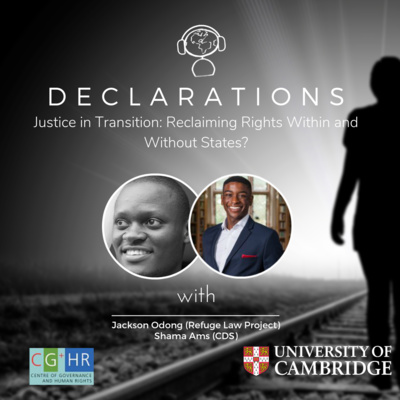
Justice in Transition: Reclaiming Rights Within and Without States?
In this special episode, we sat down with Jackson Odong of the Refugee Law Project, and Shama Ams from the Centre of Development Studies, to discuss justice in post-conflict and post-colonial contexts. Jackson describes the important role of documenting memory, while Shama speaks to the possibility for rights and weaponisation of citizenship. Are there alternative routes to justice and rights outs
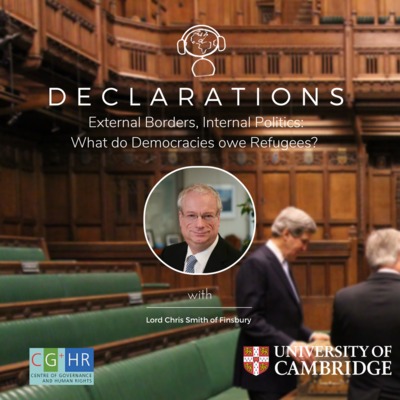
External Borders, Internal Politics: What do Democracies owe Refugees? (With Lord Smith of Finsbury)
In this episode we talked about external borders and internal politics, trying to get to grips with what democracies owe refugees. As a long-standing former policy-maker and MP, Lord Smith helped us shed light on the domestic dimensions of the politics of the Syrian refugee crisis.

PROFILE: Dr Alexa Koenig, Berkeley Human Rights Center
Declarations went to Washington DC earlier this year to talk to researchers and practitioners who are dealing with disinformation.
While there we met Alexa Koenig, Executive Director at the Berkeley Human Rights Center.
Alexa has had an illustrious career working in the arts, education and politics, before making the jump to a career in Law and Human Rights in particular. She's the author of the

What is the 'Copenhagen Declaration'?(with Prof. Başak Çalı)
The Copenhagen Declaration - adopted April this year - unveiled tensions about the relationship between democracy and human rights. If human rights are universal, then they are not only for voting citizens. The views of the citizen majority in any given nation might not be in support of protecting the rights of minorities – non-citizens who cannot vote are particularly vulnerable.
However, the al