London Futurists
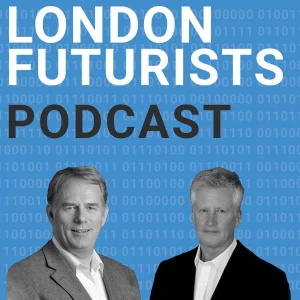
London Futurists is a podcast that explores the exponential impact of emerging technologies on society. Hosted by David Wood and Calum Chace, the show features discussions on artificial intelligence, superintelligence, and the future of jobs. Calum Chace is a keynote speaker and author of books on AI, including Surviving AI and The Economic Singularity. The podcast aims to anticipate and manage the transformative effects of technological progress.
Episodes

LFP 137: Perspectives on Machine Consciousness
Our topic in this episode is a new book that has just been published, “Perspectives on Machine Consciousness”. It contains 26 chapters written by a total of 31 authors, who include a wide range of distinguished neuroscientists, philosophers, technologists, AI specialists, science fiction authors, and futurists. One of the book’s co-editors is Calum, which is why David is asking the questions today

LFP 136: Steve Keen - Will economists destroy capitalism?
Our guest today is Professor Steve Keen, an economist and author best known for his long-standing critique of mainstream neoclassical economics. He was one of the relatively few economists to warn publicly, in advance, of the dangers that culminated in the 2008 Global Financial Crisis. In 2010 he received the Revere Award from the “Real World Economics Review” for that work.His books include “Debu

LFP 135: Pat Kane & Indra Adnan - If politics is broken, what's the alternative?
Our guests in this episode are Pat Kane and Indra Adnan, the co-convenors of The Alternative Global. That project was launched in 2017 with the question, “If politics is broken, what’s the alternative?” Pat and Indra will be speaking at the London Futurists and IEET event in London on 19-20 September, “The Technoprogressive Opportunity,” where they’ll giving an update on progress with their projec

LFP 134: Ewan McMillan - AI overhang and economics impact
We are continuing our investigation into the implications of the Economic Singularity, the time when we need a new economic system because full automation by AI means that people can no longer obtain the resources they need by doing jobs.Our guest today is Ewan McMillan, the founder of New Gradient, an Edinburgh-based consultancy that builds AI systems for a variety of industries, from biotech to

LFP 133: Oliver Ritchie - Waking up Economists
We are continuing our investigation into the implications of the Economic Singularity, the time when we need a new economic system because full automation by AI means people can no longer obtain the resources they need by doing jobs.Our guest today is Oliver Ritchie, the UK Policy Lead at the Future of Life Institute. Previously, he was a Senior Fellow at the Institute for AI Policy and Strategy,

LFP 132: Matteo Rossi MacDermant - Technoprogressive Worldbuilding
This is the first of a number of episodes on the broad theme of “the technoprogressive opportunity”. That’s the name of a conference taking place in London on the weekend of 19th and 20th September, co-organised by London Futurists and the IEET – the Institute for Ethics and Emerging Technologies. In these episodes, some of the speakers from that conference will be appearing as guests on this show

LFP 131: Ben Luong - The Discontinuity Thesis
AI-driven automation of cognitive labour is not merely another technological transition but a structural discontinuity that will end, sooner or later, the central role of wages in how society operates. This discontinuity can be called “The End of Postwar Capitalism”. That’s the conclusion of a tightly argued set of essays, “The Discontinuity Thesis”, written by our guest in this episode, Ben Luong

LFP 130: Gerry Tsoukalas and Brett Falk - The AI Automation Layoff Trap
This episode continues our investigation into the implications of advanced AI for jobs, and specifically, how to design an economic system that makes a huge success of full automation by AI.Back in 2017, Bill Gates mused that governments should address radical automation by taxing robots. Gates may not have known it at the time, but he was suggesting a Pigouvian tax. In a 1920 book called “The Eco

LFP 129: Ted Shelton - Post-labour economics and the future of capitalism
This episode continues our investigation into the potential wide-ranging implications of advanced AI for economics.Traditionally, value is said to be created by a combination of capital, which covers the cost of materials and equipment, and labour, whereby humans exercise skills, ingenuity, diligence, attention, and more. What has been a constant debate is the appropriate division of rewards betwe

LFP 128: Adrian Brown - Windfall Trust and the Economic Singularity
What happens if AI delivers major advances in capability and productivity, but also creates significant disruption to jobs, incomes, and public finances? That question sits at the heart of today’s episode.Our guest is Adrian Brown, the Founder and Chief Executive of Windfall Trust, a nonprofit focused on helping governments and societies prepare for the economic consequences of advanced AI. Windfa

LFP 127: Anticipating 2026
When we started this Podcast back in August 2022, we, Calum and David, announced the theme to be “Anticipating and managing exponential impact”. We talked about three sub-themes: Developing the skills of exponential foresight; Distinguishing between scenarios, whether they were plausible or implausible, and whether they were desirable or undesirable; and thirdly, Supporting the community of collab

The puzzle pieces that can defuse the US-China AI race dynamic, with Kayla Blomquist
Almost every serious discussion about options to constrain the development of advanced AI results in someone raising the question: “But what about China?” The worry behind this question is that slowing down AI research and development in the US and Europe will allow China to race ahead.It's true: the relationship between China and the rest of the world has many complications. That’s why we’re

Jensen Huang and the zero billion dollar market, with Stephen Witt
Our guest in this episode is Stephen Witt, an American journalist and author who writes about the people driving the technological revolutions. He is a regular contributor to The New Yorker, and is famous for deep-dive investigations.Stephen's new book is "The Thinking Machine: Jensen Huang, Nvidia, and the World's Most Coveted Microchip", which has just won the 2025 Financial

What's your p(Pause)? with Holly Elmore
Our guest in this episode is Holly Elmore, who is the Founder and Executive Director of PauseAI US. The website pauseai-us.org starts with this headline: “Our proposal is simple: Don’t build powerful AI systems until we know how to keep them safe. Pause AI.”But PauseAI isn’t just a talking shop. They’re probably best known for organising public protests. The UK group has demonstrated in Parliament
Real-life superheroes and troubled institutions, with Tom Ough
Popular movies sometimes feature leagues of superheroes who are ready to defend the Earth against catastrophe. In this episode, we’re going to be discussing some real-life superheroes, as chronicled in the new book by our guest, Tom Ough. The book is entitled “The Anti-Catastrophe League: The Pioneers And Visionaries On A Quest To Save The World”. Some of these heroes are already reasonably well k
Safe superintelligence via a community of AIs and humans, with Craig Kaplan
Craig Kaplan has been thinking about superintelligence longer than most. He bought the URL superintelligence.com back in 2006, and many years before that, in the late 1980s, he co-authored a series of papers with one of the founding fathers of AI, Herbert Simon.Craig started his career as a scientist with IBM, and later founded and ran a venture-backed company called PredictWallStreet that brought
How progress ends: the fate of nations, with Carl Benedikt Frey
Many people expect improvements in technology over the next few years, but fewer people are optimistic about improvements in the economy. Especially in Europe, there’s a narrative that productivity has stalled, that the welfare state is over-stretched, and that the regions of the world where innovation will be rewarded are the US and China – although there are lots of disagreements about which of

Tsetlin Machines, Literal Labs, and the future of AI, with Noel Hurley
Our guest in this episode is Noel Hurley. Noel is a highly experienced technology strategist with a long career at the cutting edge of computing. He spent two decade-long stints at Arm, the semiconductor company whose processor designs power hundreds of billions of devices worldwide. Today, he’s a co-founder of Literal Labs, where he’s developing Tsetlin Machines. Named after Michael Tsetlin, a So

Intellectual dark matter? A reputation trap? The case of cold fusion, with Jonah Messinger
Could the future see the emergence and adoption of a new field of engineering called nucleonics, in which the energy of nuclear fusion is accessed at relatively low temperatures, producing abundant clean safe energy? This kind of idea has been discussed since 1989, when the claims of cold fusion first received media attention. It is often assumed that the field quickly reached a dead-end, and that

AI agents, AI safety, and AI boycotts, with Peter Scott
This episode of London Futurists Podcast is a special joint production with the AI and You podcast which is hosted by Peter Scott. It features a three-way discussion, between Peter, Calum, and David, on the future of AI, with particular focus on AI agents, AI safety, and AI boycotts.Peter Scott is a futurist, speaker, and technology expert helping people master technological disruption. After rece

The remarkable potential of hydrogen cars, with Hugo Spowers
The guest in this episode is Hugo Spowers. Hugo has led an adventurous life. In the 1970s and 80s he was an active member of the Dangerous Sports Club, which invented bungee jumping, inspired by an initiation ceremony in Vanuatu. Hugo skied down a black run in St.Moritz in formal dress, seated at a grand piano, and he broke his back, neck and hips when he misjudged the length of one of his bungee

AI and the end of conflict, with Simon Horton
Can we use AI to improve how we handle conflict? Or even to end the worst conflicts that are happening all around us? That’s the subject of the new book of our guest in this episode, Simon Horton. The book has the bold title “The End of Conflict: How AI will end war and help us get on better”.Simon has a rich background, including being a stand-up comedian and a trapeze artist – which are, perhaps

The AI disconnect: understanding vs motivation, with Nate Soares
Our guest in this episode is Nate Soares, President of the Machine Intelligence Research Institute, or MIRI.MIRI was founded in 2000 as the Singularity Institute for Artificial Intelligence by Eliezer Yudkowsky, with support from a couple of internet entrepreneurs. Among other things, it ran a series of conferences called the Singularity Summit. In 2012, Peter Diamandis and Ray Kurzweil, acquired

Anticipating an Einstein moment in the understanding of consciousness, with Henry Shevlin
Our guest in this episode is Henry Shevlin. Henry is the Associate Director of the Leverhulme Centre for the Future of Intelligence at the University of Cambridge, where he also co-directs the Kinds of Intelligence program and oversees educational initiatives. He researches the potential for machines to possess consciousness, the ethical ramifications of such developments, and the broader implicat

The case for a conditional AI safety treaty, with Otto Barten
How can a binding international treaty be agreed and put into practice, when many parties are strongly tempted to break the rules of the agreement, for commercial or military advantage, and when cheating may be hard to detect? That’s the dilemma we’ll examine in this episode, concerning possible treaties to govern the development and deployment of advanced AI.Our guest is Otto Barten, Director of

Humanity's final four years? with James Norris
In this episode, we return to the subject of existential risks, but with a focus on what actions can be taken to eliminate or reduce these risks.Our guest is James Norris, who describes himself on his website as an existential safety advocate. The website lists four primary organizations which he leads: the International AI Governance Alliance, Upgradable, the Center for Existential Safety, and Su

Human extinction: thinking the unthinkable, with Sean ÓhÉigeartaigh
Our subject in this episode may seem grim – it’s the potential extinction of the human species, either from a natural disaster, like a supervolcano or an asteroid, or from our own human activities, such as nuclear weapons, greenhouse gas emissions, engineered biopathogens, misaligned artificial intelligence, or high energy physics experiments causing a cataclysmic rupture in space and time.These s

The best of times and the worst of times, updated, with Ramez Naam
Our guest in this episode, Ramez Naam, is described on his website as “climate tech investor, clean energy advocate, and award-winning author”. But that hardly starts to convey the range of deep knowledge that Ramez brings to a wide variety of fields. It was his 2013 book, “The Infinite Resource: The Power of Ideas on a Finite Planet”, that first alerted David to the breadth of scope of his insigh

PAI at Paris: the global AI ecosystem evolves, with Rebecca Finlay
In this episode, our guest is Rebecca Finlay, the CEO at Partnership on AI (PAI). Rebecca previously joined us in Episode 62, back in October 2023, in what was the run-up to the Global AI Safety Summit in Bletchley Park in the UK. Times have moved on, and earlier this month, Rebecca and the Partnership on AI participated in the latest global summit in that same series, held this time in Paris. Thi

AI agents: challenges ahead of mainstream adoption, with Tom Davenport
The most highly anticipated development in AI this year is probably the expected arrival of AI agents, also referred to as “agentic AI”. We are told that AI agents have the potential to reshape how individuals and organizations interact with technology.Our guest to help us explore this is Tom Davenport, Distinguished Professor in Information Technology and Management at Babson College, and a globa

Post-labour economics, with David Shapiro
In this episode, we return to a theme which is likely to become increasingly central to public discussion in the months and years ahead. To use a term coined by this podcast’s cohost Calum Chace, this theme is the Economic Singularity, namely the potential all-round displacement of humans from the workforce by ever more capable automation. That leads to the question: what are our options for manag

Longevity activism at 82, 86, and beyond, with Kenneth Scott and Helga Sands
Our guests in this episode have been described as the world’s two oldest scientifically astute longevity activists. They are Kenneth Scott, aged 82, who is based in Florida, and Helga Sands, aged 86, who lives in London.David has met both of them several times at a number of longevity events, and they always impress him, not only with their vitality and good health, but also with the level of know

Models for society when humans have zero economic value, with Jeff LaPorte
Our guest in this episode is Jeff LaPorte, a software engineer, entrepreneur and investor based in Vancouver, who writes Road to Artificia, a newsletter about discovering the principles of post‑AI societies.Calum recently came across Jeff's article “Valuing Humans in the Age of Superintelligence: HumaneRank” and thought it had some good, original ideas, so we wanted to invite Jeff onto the po

From ineffective altruism to effective altruism? with Stefan Schubert
Our subject in this episode is altruism – our human desire and instinct to assist each other, making some personal sacrifices along the way. More precisely, our subject is the possible future of altruism – a future in which our philanthropic activities – our charitable donations, and how we spend our discretionary time – could have a considerably greater impact than at present. The issue is that m

The global energy transition: an optimistic assessment, with Amory Lovins
Our guest in this episode is Amory Lovins, a distinguished environmental scientist, and co-founder of RMI, which he co-founded in 1982 as Rocky Mountain Institute. It’s what he calls a think do and scale tank, with 700 people in 62 countries, and a budget of well over $100m a year.For over five decades, Amory has championed innovative approaches to energy systems, advocating for a world where ener

Building brain-like AIs, with Alexander Ororbia
Some people say that all that’s necessary to improve the capabilities of AI is to scale up existing systems. That is, to use more training data, to have larger models with more parameters in them, and more computer chips to crunch through the training data. However, in this episode, we’ll be hearing from a computer scientist who thinks there are many other options for improving AI. He is Alexander

To sidestep death, preserve your connectome, with Ariel Zeleznikow-Johnston
In David's life so far, he has read literally hundreds of books about the future. Yet none has had such a provocative title as this: “The future loves you: How and why we should abolish death”. That’s the title of the book written by the guest in this episode, Ariel Zeleznikow-Johnston. Ariel is a neuroscientist, and a Research Fellow at Monash University, in Melbourne, Australia.One of the k

Insights from 15 years leading the self-driving vehicle industry, with Sterling Anderson
Our guest in this episode is Sterling Anderson, a pioneer of self-driving vehicles. With a masters degree and a PhD from MIT, Sterling led the development and launch of the Tesla Model X, and then led the team that delivered Tesla Autopilot. In 2017 he co-founded Aurora, along with Chris Urmson, who was a founder and CTO of Google’s self-driving car project, which is now Waymo, and also Drew Bagne

The race for AI supremacy, with Parmy Olson
Our guest in this episode is Parmy Olson, a columnist for Bloomberg covering technology. Parmy has previously been a reporter for the Wall Street Journal and for Forbes. Her first book, “We Are Anonymous”, shed fascinating light on what the subtitle calls “the Hacker World of LulzSec, Anonymous, and the Global Cyber Insurgency”.But her most recent book illuminates a set of high-stakes relations wi

A narrow path to a good future with AI, with Andrea Miotti
Our guest in this episode is Andrea Miotti, the founder and executive director of ControlAI. On their website, ControlAI have the tagline, “Fighting to keep humanity in control”. Control over what, you might ask. The website answers: control deepfakes, control scaling, control foundation models, and, yes, control AI.The latest project from ControlAI is called “A Narrow Path”, which is a comprehens

Gen AI cuts costs by 30%: lessons from a leading law firm, with David Wakeling
Our guest in this episode is David Wakeling, a partner at A&O Shearman, which became the world’s third largest law firm in May, thanks to the merger of Allen and Overy, a UK “magic circle” firm, with Shearman & Sterling of New York.David heads up a team within the firm called the Markets Innovation Group (MIG), which consists of lawyers, developers and technologists, and is seeking to disr

Climate change and populism: Grounds for optimism? with Matt Burgess
Our guest in this episode is Matt Burgess. Matt is an Assistant Professor at the University of Wyoming, where he moved this year after six years at the University of Boulder, Colorado. He has specialised in the economics of climate change.Calum met Matt at a recent event in Jackson Hole, Wyoming, and knows from their conversations then that Matt has also thought deeply about the impact of social m

Rejuvenation biotech - progress and potential, with Karl Pfleger
Our guest in this episode is Karl Pfleger. Karl is an angel investor in rejuvenation biotech startups, and is also known for creating and maintaining the website Aging Biotech Info. That website describes itself as “Structured info about aging and longevity”, and has the declared mission statement, “Everything important in the field (outside of academia), organized.”Previously, Karl worked at Goog

ChatGPT runs for president, with Pedro Domingos
Our guest today is Pedro Domingos, who is joining an elite group of repeat guests – he joined us before in episode 34 in April 2023.Pedro is Professor Emeritus Of Computer Science and Engineering at the University of Washington. He has done pioneering work in machine learning, like the development of Markov logic networks, which combine probabilistic reasoning with first-order logic. He is probabl

The rise of digital pandemics, with James Ball
Our guest in this episode is the journalist and author James Ball. James has worked for the Bureau of Investigative Journalism, The Guardian, WikiLeaks, BuzzFeed, The New European, and The Washington Post, among other organisations. As special projects editor at The Guardian, James played a key role in the Pulitzer Prize-winning coverage of the NSA leaks by Edward Snowden.Books that James has writ

Thinking more athletically about the future, with Brett King and Rob Tercek
In this episode, we have not one guest but two – Brett King and Robert Tercek, the hosts of the Futurists Podcast.Brett King is originally from Australia, and is now based in Thailand. He is a renowned author, and the founder of a breakthrough digital bank. He consults extensively with clients in the financial services industry.Robert Tercek, based in the United States, is an expert in digital med

The low-cost future of preserving brains, with Jordan Sparks
Our guest in this episode is Jordan Sparks, the founder and executive director of Oregon Brain Preservation (OBP), which is located at Salem, the capital city of Oregon. OBP offers the service of chemically preserving the brain in the hope of future restoration.Previously, Jordan was a dentist and a computer programmer, and he was successful enough in those fields to generate the capital required

Surveillance and diversity: surprising insights from the Gulf, with Holly Joint
Our guest in this episode is Holly Joint, who was born and educated in the UK, but lives in Abu Dhabi in the UAE.Holly started her career with five years at the business consultancy Accenture, and then worked in telecomms and banking. The latter took her to the Gulf, where she then spent what must have been a fascinating year as programme director of Qatar’s winning bid to host the 2022 World Cup.

The double-edged sword of technology, with Wendell Wallach
How do we keep technology from slipping beyond our control? That’s the subtitle of the latest book by our guest in this episode, Wendell Wallach.Wendell is the Carnegie-Uehiro fellow at Carnegie Council for Ethics in International Affairs, where he co-directs the Artificial Intelligence & Equality Initiative. He is also Emeritus Chair of Technology and Ethics Studies at Yale University’s Inter

Stop cryocrastinating! with Emil Kendziorra
Our guest in this episode is Dr. Emil Kendziorra. Emil graduated summa cum laude, which means, with the highest honours, from the University of Göttingen in Germany, having previously studied at the University of Pécs in Hungary. For several years, he then devoted himself to cancer research with the hope of contributing to longevity science. After realizing how slowly life-extension research was p

Introducing Conscium, with Daniel Hulme and Ted Lappas
This episode is a bit different from the usual, because we are interviewing Calum's boss. Calum says that mainly to tease him, because he thinks the word “boss” is a dirty word.His name is Daniel Hulme, and this is his second appearance on the podcast. He was one of our earliest guests, long ago, in episode 8. Back then, Daniel had just sold his AI consultancy, Satalia, to the advertising and

Taming the Machine, with Nell Watson
Those who rush to leverage AI’s power without adequate preparation face difficult blowback, scandals, and could provoke harsh regulatory measures. However, those who have a balanced, informed view on the risks and benefits of AI, and who, with care and knowledge, avoid either complacent optimism or defeatist pessimism, can harness AI’s potential, and tap into an incredible variety of services of a

AI Impacts Survey - The key implications, with Katja Grace
Our guest in this episode grew up in an abandoned town in Tasmania, and is now a researcher and blogger in Berkeley, California. After taking a degree in human ecology and science communication, Katja Grace co-founded AI Impacts, a research organisation trying to answer questions about the future of artificial intelligence.Since 2016, Katja and her colleagues have published a series of surveys abo

Cryonics, cryocrastination, and the future: changing minds, with Max More
Our guest in this episode is Max More. Max is a philosopher, a futurist, and a transhumanist - a term which he coined in 1990, the same year that he legally changed his name from O’Connor to More.One of the tenets of transhumanism is that technology will allow us to prevent and reverse the aging process, and in the meantime we can preserve our brains with a process known as cryonics. In 1995 Max w

Stem cells, lab-grown meat, and potential new medical treatments, with Mark Kotter
Our guest in this episode is Dr. Mark Kotter. Mark is a neurosurgeon, stem cell biologist, and founder or co-founder of three biotech start-up companies that have collectively raised hundreds of millions of pounds: bit.bio, clock.bio, and Meatable.In addition, Mark still conducts neurosurgeries on patients weekly at the University of Cambridge.We talk to Mark about all his companies, but we start

The economic case for a second longevity revolution, with Andrew Scott
The public discussion in a number of countries around the world expresses worries about what is called an aging society. These countries anticipate a future with fewer younger people who are active members of the economy, and a growing number of older people who need to be supported by the people still in the workforce. It’s an inversion of the usual demographic pyramid, with less at the bottom, a

Can AI be conscious? with Nicholas Humphrey
In this episode we return to the subject of whether AIs will become conscious, or, to use a word from the title of the latest book from our guest today, whether AIs will become sentient.Our guest is Nicholas Humphrey, Emeritus Professor of Psychology at London School of Economics, and Bye Fellow at Darwin College, Cambridge. His latest book is “Sentience: the invention of consciousness”, and it ex

Progress with ending aging, with Aubrey de Grey
Our topic in this episode is progress with ending aging. Our guest is the person who literally wrote the book on that subject, namely the book, “Ending Aging: The Rejuvenation Breakthroughs That Could Reverse Human Aging in Our Lifetime”. He is Aubrey de Grey, who describes himself in his Twitter biography as “spearheading the global crusade to defeat aging”.In pursuit of that objective, Aubrey co

What’s it like to be an AI, with Anil Seth
As artificial intelligence models become increasingly powerful, they both raise - and might help to answer - some very important questions about one of the most intriguing, fascinating aspects of our lives, namely consciousness.It is possible that in the coming years or decades, we will create conscious machines. If we do so without realising it, we might end up enslaving them, torturing them, and

Regulating Big Tech, with Adam Kovacevich
Our guest in this episode is Adam Kovacevich. Adam is the Founder and CEO of the Chamber of Progress, which describes itself as a center-left tech industry policy coalition that works to ensure that all citizens benefit from technological leaps, and that the tech industry operates responsibly and fairly.Adam has had a front row seat for more than 20 years in the tech industry’s political maturatio

The case for brain preservation, with Kenneth Hayworth
In this episode, we are delving into the fascinating topic of mind uploading. We suspect this idea is about to explode into public consciousness, because Nick Bostrom has a new book out shortly called “Deep Utopia”, which addresses what happens if superintelligence arrives and everything goes well. It was Bostrom’s last book, “Superintelligence”, that ignited the great robot freak-out of 2015.Our

AGI alignment: the case for hope, with Lou de K
Our guest in this episode is Lou de K, Program Director at the Foresight Institute.David recently saw Lou give a marvellous talk at the TransVision conference in Utrecht in the Netherlands, on the subject of “AGI Alignment: Challenges and Hope”. Lou kindly agreed to join us to review some of the ideas in that talk and to explore their consequences. Selected follow-ups:Personal website of Lou de K

The Political Singularity and a Worthy Successor, with Daniel Faggella
Calum and David recently attended the BGI24 event in Panama City, that is, the Beneficial General Intelligence summit and unconference. One of the speakers we particularly enjoyed listening to was Daniel Faggella, the Founder and Head of Research of Emerj.Something that featured in his talk was a 3 by 3 matrix, which he calls the Intelligence Trajectory Political Matrix, or ITPM for short. As we’l

The Longevity Singularity, with Daniel Ives
In the wide and complex subject of biological aging, one particular kind of biological aging has been receiving a great deal of attention in recent years. That’s the field of epigenetic aging, where parts of the packaging or covering, as we might call it, of the DNA in all of our cells, alters over time, changing which genes are turned on and turned off, with increasingly damaging consequences.Wha

Where are all the Dyson spheres? with Paul Sutter
In this episode, we look further into the future than usual. We explore what humanity might get up to in a thousand years or more: surrounding whole stars with energy harvesting panels, sending easily detectable messages across space which will last until the stars die out.Our guide to these fascinating thought experiments in Paul M. Sutter, a NASA advisor and theoretical cosmologist at the Instit

Provably safe AGI, with Steve Omohundro
AI systems have become more powerful in the last few years, and are expected to become even more powerful in the years ahead. The question naturally arises: what, if anything, should humanity be doing to increase the likelihood that these forthcoming powerful systems will be safe, rather than destructive?Our guest in this episode has a long and distinguished history of analysing that question, and

Robots and the people who love them, with Eve Herold
In this episode, our subject is the rise of the robots – not the military kind of robots, or the automated manufacturing kind that increasingly fill factories, but social robots. These are robots that could take roles such as nannies, friends, therapists, caregivers, and lovers. They are the subject of the important new book Robots and the People Who Love Them, written by our guest today, Eve Hero

Education and work - past, present, and future, with Riaz Shah
Our guest in this episode is Riaz Shah. Until recently, Riaz was a partner at EY, where he was for 27 years, specialising in technology and innovation. Towards the end of his time at EY he became a Professor for Innovation & Leadership at Hult International Business School, where he leads sessions with senior executives of global companies.In 2016, Riaz took a one-year sabbatical to open the O

What is your p(doom)? with Darren McKee
In this episode, our subject is Uncontrollable: The Threat of Artificial Superintelligence and the Race to Save the World. That’s a new book on a vitally important subject.The book’s front cover carries this endorsement from Professor Max Tegmark of MIT: “A captivating, balanced and remarkably up-to-date book on the most important issue of our time.” There’s also high praise from William MacAskill

Climate Change: There’s good news and bad news, with Nick Mabey
Our guest in this episode is Nick Mabey, the co-founder and co-CEO of one of the world’s most influential climate change think tanks, E3G, where the name stands for Third Generation Environmentalism. As well as his roles with E3G, Nick is founder and chair of London Climate Action Week, and he has several independent appointments including as a London Sustainable Development Commissioner.Nick has

Meet the electrome! with Sally Adee
Our subject in this episode is the idea that the body uses electricity in more ways than are presently fully understood. We consider ways in which electricity, applied with care, might at some point in the future help to improve the performance of the brain, to heal wounds, to stimulate the regeneration of limbs or organs, to turn the tide against cancer, and maybe even to reverse aspects of aging

Don't try to make AI safe; instead, make safe AI, with Stuart Russell
We are honoured to have as our guest in this episode Professor Stuart Russell. Stuart is professor of computer science at the University of California, Berkeley, and the traditional way to introduce him is to say that he literally wrote the book on AI. Artificial Intelligence: A Modern Approach, which he co-wrote with Peter Norvig, was first published in 1995, and the fourth edition came out in 20

Aligning AI, before it's too late, with Rebecca Gorman
Our guest in this episode is Rebecca Gorman, the co-founder and CEO of Aligned AI, a start-up in Oxford which describes itself rather nicely as working to get AI to do more of the things it should do and fewer of the things it shouldn’t.Rebecca built her first AI system 20 years ago and has been calling for responsible AI development since 2010. With her co-founder Stuart Armstrong, she has co-dev

Shazam! with Dhiraj Mukherjee
Our guest in this episode is Dhiraj Mukherjee, best known as the co-founder of Shazam. Calum and David both still remember the sense of amazement we felt when, way back in the dotcom boom, we used Shazam to identify a piece of music from its first couple of bars. It seemed like magic, and was tangible evidence of how fast technology was moving: it was creating services which seemed like science fi

The Politics of Transhumanism, with James Hughes
Our guest in this episode is James Hughes. James is a bioethicist and sociologist who serves as Associate Provost at the University of Massachusetts Boston. He is also the Executive Director of the IEET, that is the Institute for Ethics and Emerging Technologies, which he co-founded back in 2004.The stated mission of the IEET seems to be more important than ever, in the fast-changing times of the

How to make AI safe, according to the tech giants, with Rebecca Finlay, CEO of PAI
The Partnership on AI was launched back in September 2016, during an earlier flurry of interest in AI, as a forum for the tech giants to meet leaders from academia, the media, and what used to be called pressure groups and are now called civil society. By 2019 more than 100 of those organisations had joined.The founding tech giants were Amazon, Facebook, Google, DeepMind, Microsoft, and IBM. Apple

The shocking problem of superintelligence, with Connor Leahy
This is the second episode in which we discuss the upcoming Global AI Safety Summit taking place on 1st and 2nd of November at Bletchley Park in England.We are delighted to have as our guest in this episode one of the hundred or so people who will attend that summit – Connor Leahy, a German-American AI researcher and entrepreneur.In 2020 he co-founded Eleuther AI, a non-profit research institute w

Preparing for Bletchley Park: behind the scenes, with Ollie Buckley
The launch of GPT-4 on the 14th of March this year was shocking as well as exciting. ChatGPT had been released the previous November, and became the fastest-growing app ever. But GPT-4’s capabilities were a level beyond, and it provoked remarkable comments from people who had previously said little about the future of AI. In May, Britain’s Prime Minister Rishi Sunak described superintelligence as

The future of space-based solar power, with John Bucknell
In the future, energy will be too cheap to meter. That used to be a common vision of the future: abundant, clean energy, if not exactly free, then much cheaper than today's energy. But a funny thing happened en route to that future of energy abundance. High energy costs are still with us in 2023, and are part of what's called the cost-of-living crisis. Moreover, although there's som

Whatever happened to self-driving cars, with Timothy Lee
Self-driving cars has long been one of the most exciting potential outcomes of advanced artificial intelligence. Contrary to popular belief, humans are actually very good drivers, but even so, well over a million people die on the roads each year. Globally, for people between 12 and 24 years old, road accidents are the most common form of death.Google started its self-driving car project in Januar