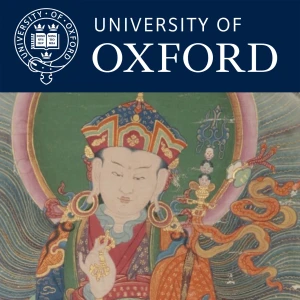
Padmasambhava, Uḍḍiyāna and Tibet
This seminar series from Oxford University applies interdisciplinary approaches to the figure of Padmasambhava, exploring him through history, myth, and ritual. It also focuses on the regions of Kashmir, Uḍḍiyāna, and Tibet, examining their mutual religious, intellectual, economic, and political interactions. The lectures draw on multiple academic fields to shed light on the legendary Buddhist master and his cultural context.
Episodes
The Oḍiyāna Mahāmudrā Lineage: Textual Communities and the Construction/Reconstruction of Institutional Identities
Adam Krug introduces the Grub pa sde bdun as a practical canon (gzhung) of Indian Mahāmudrā Works and its role in hagiography. This talk will begin with an introduction to the Grub pa sde bdun that touches upon their importance to Indic Buddhist traditions, their transmission to Tibet in the mid-eleventh century, and the role that they played in the Karma Kagyü’s formulation of a practical canon o
Śaiva understandings of the yoginī-related sacred placed and pīṭhas, in relation to the Buddhist tantras.
Olga Serbaeva examines the network of yoginī-related sacred places in Śaiva and Buddhist tantric traditions, with particular focus on the pivotal role of Uḍḍiyāṇa as a paradigmatic tantric landscape. This presentation examines the network of yoginī-related sacred places in Śaiva and Buddhist tantric traditions, with particular focus on the pivotal role of Uḍḍiyāṇa as a paradigmatic tantric la
If Uḍḍiyāna is a pīṭha, then what is a pīṭha?: Uḍḍiyānācārya and encounter as the sacred domain of the vajra-yoginīs in Newar Buddhism
Amber Marie Moore examines what is meant by the term pīṭha in Newar Buddhism, and describes the figure of Uḍḍiyānācārya in Newar narrative. Stories of encounter with Buddhist vajra-yoginīs as the inhabitants of this earthy domain flourish in connection with sites located around the Kathmandu Valley and throughout the swath of the Himalayan range and Tibet where Vajrayāna Buddhism is practiced. It
The Eleven Acts of Padmasambhava
Kurtis Schaeffer presents a little-known early narrative of Padmasambhava’s career, attributed to Guru Chowang (1217-1270). "The Life of Victorious Lord Pema in Eleven Acts" is an early narrative of Padmasambhava’s career attributed to Guru Chowang (1217-1270), which highlights Padmasambhava’s enlightened activity in India. This talk presents the structure and content of The Eleven Acts, places it
On the Earliest Depictions of Padmasambhava in Tibet: Emergence and Variation
Christian Luczanits presents some of the earliest depictions of Padmasambhava and explores their historical and religious contexts. While Tibetan texts of some of Padmasambhava’s teachings are recorded in the Dunhuang material, depictions of Padmasambhava are considerably later and appear to become common only in the course of the thirteenth century. This lecture will present some of the earliest
Uḍḍiyāna in the Krama Literature
Uḍḍiyāna looms large in early Krama scriptures, as does its karavīra charnel ground. Ben Williams investigates. Uḍḍiyāna looms large in early Krama scriptures, as does its karavīra charnel ground, which is vividly depicted in the Kālīkuladevīpañcaśataka and Kālīkulakramasadbhāva. This paper looks closely at the way Uḍḍiyāna is envisioned as a powerful seat of Kālī and her sacrificial assembly, and
Kashmir and Śaivism in and Around the Late Eighth Century
An overview of the histories of Kashmir and Uḍḍiyāna, and their relations with Tibet in the late 8th century. An overview of the history of Kashmir in and around the late 8th century, attentive to the political and religious landscape of the day and in particular to understanding the links between Tibet and Kashmir. It features an outline of the forms of Śaivism present in Kashmir at that time, se
Padmasambhava’s Tibet
Brandon Dotson examines what can be said about the social and religious context of Tibet in the late-8th and early 9th centuries, that is, the period during which Padmasambhava would have been active. This paper examines what can be said about the social and religious context of Tibet in the late-8th and early 9th centuries, that is, the period during which Padmasambhava would have been active. In
Khri Srong lde brtsan and Padmasambhava's Travels through His Land
Lewis Doney compares three different narratives about Padmasambhava and Emperor Khri Srong lde brtsan. This talk compares three perspectives on the travels of Padmasambhava, beginning in Uḍḍiyāna but focusing on his invitation to Tibet by Emperor Khri Srong lde brtsan: the early Tibetan Buddhist perspective; an early first-millennium view from the autochthonous religion, Bon; and that of a Europea
Were Padmasambhava and Vimalamitra de facto Sarvadharmāpratiṣṭhānavādins?
Dorji Wangchuk discerns underlying similarities in the philosophical views of Padmasambhava, Vimalamita, and Rong-zom-pa. Padmasambhava and Vimalamitra are two of the many towering figures that came to shape the identity of the rNying-ma school. Over the years, it has increasingly seemed that the philosophy of what Rong-zom-pa calls “special Mahāyāna”, which also
Padmasambhava and Nubchen Sangye Yeshe: Legend, Lineage, Legacy
Dylan Esler explores the nexus of links—both legendary and historical—that connect Nubchen Sangye Yeshe with Padmasambhava. Both Padmasambhava and Nubchen Sangye Yeshe are important figures in the foundational mythology of the Nyingma school—the former as the archetypal guru and fountainhead of practically all Nyingma lineages and doctrines and as the spiritual inspiration behind the treasures, th
The spells attributed to Padmasambhava in the Ba ri be'u 'bum
Sam van Schaik examines the magic spells attributed to Padmasambhava in a grimoire compiled by Bari Lotsawa (1040-1112). The grimoire compiled by Bari Lotsawa (1040-1112), known for short as the Ba ri be'u 'bum, is one of the earliest and most
influential of its kind. The grimoire contains hundreds of brief rituals, some of which are attributed to Indian and Tibetan figures.
Alongside obscure, a
Padmasambhava and the Copper-Colored Mountain
Ben Bogin sketches a cultural history of Padmasambhava's 'Copper-Colored Mountain'. Following his sojourn in Tibet, Padmasambhava is said to have departed for the Glorious Copper-Colored Mountain (zangs mdog dpal ri), a site that he transformed into a tantric Buddhist paradise where he resides to the present day. In this talk Ben Bogin sketches a cultural history of the Copper-Colored Mountain th
Tripartite Lineages and Cremation Ground Revelations: Crossovers Between Early rDzogs chen and Kaula Śaivism
Paul Thomas presents evidence that Indian Tantric Śaivism exerted a direct influence on Tibetan Dzogchen in the 11th and 12th centuries. As Paul Thomas argues in his recent PhD dissertation, it is probable that Indian Tantric Śaivism exerted a direct influence upon Tibetan rDzogs chen in the eleventh and twelfth centuries. In this talk he discusses two related elements of this crossover: peculiar
O rgyan Tshe dpag med traditions: Glimpse of an Ocean
Cathy Cantwell traces the tradition of Padmasambhava in the form of Amitāyus from Guru Chowang in the 13th century. Many Nyingma tantric longevity practices are Padma-centric, e.g. the ’Chi med srog thig favoured in the Dudjom tradition, or the Padma tshe’i snying thig of the Khyentse tradition. These complex multi-layered cycles include many elements traceable to early sources, such as the Aparim
On Padmasambhava’s Names, Himalayan Syncretism, and the Apotheosis of the Fierce Guru
Dan Hirshberg describes the origins of the famous 'Eight Names' of Padmasambhava, and also of his fierce form as 'Guru Dragpo'. Padmasambhava earns only scattered mentions among imperial-era sources, and yet in later centuries he becomes the protagonist of a vibrant biographical tradition that would forever establish him as the catalyst for the adoption of Buddhism in Tibet. One key mode of elabor
Recommended

Pride and Prejudice (version 6, dramatic reading)

InsideAIR

English Made Simple

Golden's Oldies

The CTO Lens

RHISE: Real History in Simple English (B2-C1, British)

Outsiding

Why? with Emma Kennedy
British English Listening Practice - English Go! Podcast

The English Podcast

The Rest Is Science

Global News Podcast
