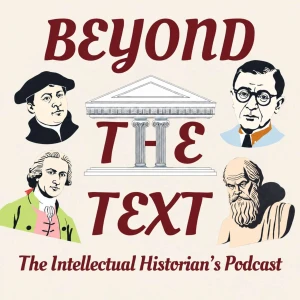
Beyond the Text: The Intellectual Historian's Podcast
Beyond the Text is a podcast about intellectual history, exploring the ideas and thinkers that have shaped societies and driven change. Co-hosted by Samuel Woodall and Jack Thomson, it emphasizes context over quick takes, drawing on Quentin Skinner's view that historical texts must be understood within their surrounding circumstances. Each episode examines the connections, influences, and societal currents behind pivotal concepts and moments. The show is aimed at listeners who want a deeper, nuanced understanding of the history of thought.
Episodes
What Can We Really Know? Kant’s Critique of Pure Reason
Send us Fan MailWhat can we really know—and where must reason recognise its limits?In the second episode of our Kant series, Samuel Woodall and Jack Thomson explore the Critique of Pure Reason: Hume’s challenge, synthetic a priori knowledge, Kant’s Copernican turn, space and time, phenomena and things in themselves, and the antinomies of reason. We finish by asking how the limits of theoretical kn
Who Was Kant, and What Is Enlightenment?
Send us Fan MailWhat does it mean to think for yourself? In the opening episode of our Kant series, Samuel Woodall and Jack Thomson explore the life of Immanuel Kant and the challenge at the heart of his question: What is Enlightenment?From his upbringing in Königsberg to his appointment as professor of logic and metaphysics, we follow Kant into the debates about science, sensation and reason that

Can outsiders understand divided societies? With Dr Michaël Green
Send us Fan MailCan an outsider understand a divided political culture better than those inside it? Samuel Woodall and Jack Thomson are joined by Dr Michaël Green, University Professor at the University of Łódź and Director of its Centre for Self-Narratives, for a special audio-only conversation.Through letters, diaries and memoirs, we explore what personal accounts reveal about early modern lives

Can Education Save Us from Society?
Send us Fan MailCan education protect us from the society that forms us? In the final episode of our Rousseau series, Samuel Woodall and Jack Thomson turn to Émile (1762), childhood and the difficult task of learning to be free.Rousseau wants children to learn through nature and experience rather than arbitrary commands. Yet his tutor quietly arranges the world around the pupil. Samuel and Jack as

Can society make us free again?
Send us Fan MailIf society creates dependence and inequality, can political association also make us free? In the second episode of our Rousseau series, Samuel Woodall and Jack Thomson move from the Discourse on Inequality (1755) to The Social Contract (1762).We distinguish natural differences from inequalities sustained by convention and institutions, consider pity and perfectibility, and explore

Who was Jean-Jacques Rousseau, and why did he turn against civilisation?
Send us Fan MailIn the first of three Beyond the Text episodes on Rousseau, Samuel Woodall explores the life behind the arguments: the Confessions, Geneva, Madame de Warens, Paris and Diderot, the First Discourse, amour-propre, and the troubled relationship with David Hume.Jack Thomson is unwell, so Samuel presents this opening episode solo. The Rousseau series continues on Wednesday.CHAPTERS00:00
Who gets to call others barbarous?
Send us Fan MailWho gets to call another society barbarous, and what does that judgement reveal about ourselves? In the final episode of our Montaigne series, Samuel Woodall and Jack Thomson discuss custom, European self-criticism, cruelty, compassion and the tension between honour and political expedience.Through Of Cannibals, Of Cruelty and related essays, we ask how scepticism about custom can
How should we learn to live and die?
Send us Fan MailDoes thinking about death set us free, or keep us trapped by fear? In the second episode of our Montaigne series, Samuel Woodall and Jack Thomson explore philosophy as preparation for death, the relationship between virtue and pleasure, and an education that develops judgement rather than merely filling the memory. We then ask how attention to ordinary life and bodily limits change
Why did Montaigne make himself his subject?
Send us Fan MailIn the first episode of our Montaigne series, Samuel Woodall and Jack Thomson ask why Michel de Montaigne made himself the subject of his Essays. We explore his classical education, friendship and public life, his retreat to the tower library, and how writing became a way to examine a mind that keeps changing. Is his apparent candour straightforward honesty, literary performance, o
When does disagreement become faction?
Send us Fan MailWhen does an argument among citizens become a threat to political peace? In the final conversation of this Hobbes series, Samuel Woodall and Jack Thomson turn to De Cive to examine public disagreement, rival claims to authority and the dangers Hobbes associates with faction. The discussion completes the arc from fear, through sovereignty, to the stability of a commonwealth.Read alo
Why should we obey the state?
Send us Fan MailWhat problem does political authority solve, and what do we give up when we create it? In the second of three conversations, Samuel Woodall and Jack Thomson read Hobbes’s account of conflict, covenant and sovereignty in Leviathan. They ask why people might consent to a common power and where the obligation to obey meets the need for self-preservation.Read alongside us:Thomas Hobbes
Who was Thomas Hobbes and what was he afraid of?
Send us Fan MailThe first of three Beyond the Text conversations on Thomas Hobbes. Samuel Woodall and Jack Thomson begin with Hobbes’s life, the political upheaval around him, and the place of fear in his account of human beings. How did those experiences shape the argument for political authority?Read alongside us:John Aubrey, “Thomas Hobbes of Malmesbury,” Brief Lives, vol. 1: https://www.gutenb
Symphony for Sovereignty: How Music Toppled an Empire
Send us Fan MailIn this solo episode, we examine the political power of song during the Baltic "Singing Revolution" and the historic Baltic Way of August 23, 1989. Discover how Estonia, Latvia, and Lithuania transformed traditional folk music, mass choir festivals, and protest songs into non-violent instruments of mobilisation, successfully bypassing state control and dismantling Soviet
Moderation and Memory: Rapin de Thoyras and the Making of English Party
Send us Fan MailHow did a French Huguenot exile end up writing the history that shaped how England understood its own political parties? This episode traces Paul de Rapin-Thoyras's History of England and its role in the emergence of Whig and Tory identity — connecting directly to the broader story of eighteenth-century political faction this show keeps coming back to.🎓 A milestone moment in t
Edmund Burke and the Moral Imagination
Send us Fan Mail💭 Can feeling and imagination preserve what reason alone cannot? In this episode, Jack Thomson explores the political vision of Edmund Burke and the enduring power of moral imagination.Through Reflections on the Revolution in France, Jack traces how Burke's suspicion of abstract reason shaped a distinctly conservative political imagination — and why that tension between feelin
History of Ideas Clubs: Industrialisation and Karl Marx
Send us Fan MailStep into the upheaval of the long nineteenth century in this History of Ideas Club recording 🎙️“Industrialisation and Marx: The Making of Modern Society” explores a world transformed by unprecedented socio-economic change ⚙️. Breakthroughs in mechanical textiles, chemistry, iron production, and transport - most notably the steam engine 🚂 - drove rapid industrialisation, reshaping
History of Ideas Club: The Birth of the Modern Republic: France, America, Haiti
Send us Fan MailStep into one of the defining political transformations of modern history in this History of Ideas Club recording 🎙️“The Birth of the Modern Republic: France, America, Haiti” explores the emergence of republican government as a central feature of modernity 🏛️. Across Europe and the Atlantic world, inherited systems of monarchy were challenged - intellectually, politically, and ofte
History of Ideas Club: Revolution of Modernity: Descartes, Kant, Hegel
Send us Fan MailStep into one of the most transformative moments in intellectual history in this History of Ideas Club recording 🎙️“Revolution of Modernity: Descartes, Kant, Hegel” explores the deep tensions at the heart of modern thought - an age defined by radical doubt 🤔 and extraordinary philosophical ambition 📚. What happens when inherited truths and institutions begin to crumble? And how do
Joseph de Maistre: Order, Authority, and the Counter-Revolution
Send us Fan MailWhy did the French Revolution convince some thinkers that reason itself was the enemy? Joseph de Maistre's reactionary philosophy remains one of the sharpest critiques of Enlightenment optimism ever written.In this episode of Beyond the Text, Sam Woodall and Jack Thomson explore the provocative political thought of Joseph de Maistre, one of the most formidable critics of the E
History of Ideas Club: The Copernican Revolution in Astronomy
Send us Fan MailCopernicus demonstrated for the first time that the Earth orbits the sun, and not the reverse as was previously thought. Previous measurements had lended themselves to the latter view, but the number of 'epicycles' needed to model the known orbits and their coincidence at specific times became impractical. Copernicus' revision of the fundamental point of reference si
Augustine’s City of God
Send us Fan MailWritten as Rome burned, Augustine's City of God asked whether any earthly political order could ever be sacred. Sixteen centuries later, the question still unsettles.In this episode of Beyond the Text, Jack and Sam return to one of the foundational works of Western intellectual and political thought – City of God by Augustine of Hippo – as part of our ongoing catch-up discussi
History of Ideas Club: The English Civil War
Send us Fan MailThe conflict between monarchical and republican visions of the state reflects far deeper disagreements about the human person - especially the nature of freedom, authority, and the possibility of self-government. Monarchies have often fallen before their societies were fully prepared to confront the practical and moral challenges of republican rule.In this episode, we explore the E
History of Ideas Club: The Gregorian Reforms and the Protestant Reformation: Changing Concepts of Law and State
Send us Fan MailIn the eleventh century, the Gregorian Reforms sought to impose coherence on ecclesiastical or canon law and to clarify the relationship between Church and State. At their heart lay a radical question: to what extent should secular authority be subordinated to spiritual power?Four centuries later, this settlement had come under intense strain. Peasants’ revolts, resistance from uni
History of Ideas Club: Rome: From Empire to Republic (and Back Again)
Send us Fan MailHow did Rome move from kingship to republic, and from republic to empire? In this episode, we explore the political evolution of Rome through the lens of classical political thought and historical experience.Drawing on Cicero’s famous account of constitutional change - itself indebted to Plato - we trace Rome’s shifting forms of government, from its early monarchy through the emerg
History of Ideas Club: 'And the Word Became Flesh…’: Christianity’s Emergence and Impact
Send us Fan MailChristianity emerged from a world already shaped by Jewish law and Greek philosophy, yet it introduced one of the most radical ideas in intellectual history - that God became flesh. In this episode, we explore how the doctrine of the Incarnation transformed ancient understandings of the human person, purpose, and moral life.We examine how early Christian thought synthesised inherit
History of Ideas Club: Disraeli and Oakeshott
Send us Fan Mail💭 Can politics be an art of belonging rather than a science of control? In this final instalment of the Heritage Series, Samuel Woodall explores the enduring legacy of Benjamin Disraeli and Michael Oakeshott — two thinkers who gave conservatism its humane and imaginative character.From Disraeli’s Sybil and the vision of “One Nation” politics, to Oakeshott’s On Being Conservative an
History of Ideas Club: Roger Scruton
Send us Fan Mail💭 Can conservatism be a culture of love rather than fear? In this episode, Jack Thomson explores the life and thought of Sir Roger Scruton (1944–2020) — philosopher, writer, musician, and one of the most articulate defenders of beauty, belonging, and the sacred in modern life.Through works such as The Meaning of Conservatism, Beauty, and England: An Elegy, Jack examines how Scruton
History of Ideas Club: Edmund Burke and the Romantic Poets
Send us Fan Mail💭 Can feeling and imagination preserve what reason alone cannot? In this episode, Jack Thomson explores how Edmund Burke’s political vision of order, tradition, and moral imagination found unexpected echoes in the Romantic movement — especially in the poetry of Wordsworth and Byron.Through Burke’s Reflections on the Revolution in France, we trace the emergence of the conservative i
History of Ideas Club: Joseph de Maistre
Send us Fan MailWelcome to the third instalment of our Heritage Series, part of the History of Ideas Reading Club, hosted by Jack Thomson (MA Philosophy, University of Buckingham).In this session, we turn to the fiercely counter-revolutionary thought of Joseph de Maistre (1753–1821) — one of the most provocative and eloquent defenders of authority, monarchy, and faith in the wake of the Enlightenm
History of Ideas Club: Augustine's City of God
Send us Fan MailIn this episode of the History of Ideas Club, Jack Thomson (MA Philosophy, University of Buckingham) leads a discussion on St Augustine’s The City of God. We explore Augustine’s response to the fall of Rome, his vision of the earthly and heavenly cities, and the influence of his thought on theology, politics, and philosophy.The History of Ideas Club meets bi-weekly in London to rea
Plato's Republic
Send us Fan MailIs justice something we value for itself, or only for what it gets us? Plato's Republic is where Western political philosophy starts arguing about it.In this episode of Beyond the Text, Samuel Woodall and Jack Thomson sit down for an in-depth discussion on Plato’s Republic—one of the most influential works in the history of political thought. Written against the backdrop of At
History of Ideas Club: Plato's Republic
Send us Fan MailIn this History of Ideas Club session, we turn to one of the foundational texts of Western political thought: Plato’s Republic. Written in the aftermath of Athens’ political turmoil and the execution of Socrates, The Republic reflects Plato’s deep skepticism toward democracy and his radical vision for a just society governed by wisdom rather than popular opinion.Plato (c. 427–347 B
Rawls and Sandel
Send us Fan MailRawls built a theory of justice from behind a "veil of ignorance." Sandel spent a career arguing it left something essential out. This episode is that argument.In this episode of Beyond the Text, Samuel Woodall and Jack Thomson take a deep dive into the thought of John Rawls, exploring his major contribution to liberal political philosophy and the critiques it provoked fr
History of Ideas Club: Rawls and Sandel
Send us Fan MailIn this session of the History of Ideas Club, we dive into the thought of John Rawls, one of the towering figures of 20th-century political philosophy, and explore the debate he sparked with thinkers like Robert Nozick and Michael Sandel.Rawls’ seminal work, A Theory of Justice (1971), redefined liberal political thought with his concept of "justice as fairness"—a vision
F. A. Hayek: Law, Legislation, and Liberty
Send us Fan MailHayek's case against planned social order and for spontaneous, evolved law — and why it still anchors modern debates about the state's proper limits.In this episode of Beyond the Text, we dive into Friedrich Hayek’s Law, Legislation, and Liberty, a profound exploration of legal philosophy, governance, and the limits of state power. Hayek draws a crucial distinction betwee
The History Of Ideas And Political Thought Reading Club Presents: Liberty Series, Hayek.
Send us Fan MailIn this session of the History of Ideas Reading Club, we explore Friedrich Hayek's influential ideas on knowledge, society, and governance. We discuss his distinction between scientific knowledge and knowledge about the operations of society, questioning how our ignorance of the complex systems of social interaction impacts freedom. 🤔🌍 Hayek's view that social institution
The French Existentialists: Sartre, De Beauvoir, Camus
Send us Fan MailFreedom, absurdity, and radical responsibility — how three thinkers in postwar Paris redefined what it means to choose.In this episode, we dive into the key ideas of Sartre, De Beauvoir, and Camus, exploring how French existentialism reshaped our understanding of freedom, responsibility, and justice.🔹 Jean-Paul Sartre – Being and Nothingness What does it mean to exist in a world wi
The History Of Ideas & Political Thought Reading Club Presents: Liberty Series French Existentialism
Send us Fan MailHistory of Ideas Club (Live) | The French ExistentialistsIn this session of the Liberty series, hosted by Samuel Woodall and Jack Thomson from the Buckingham Political Thought Reading Club, we delve into the world of French existentialism. Join us as we explore the key ideas of Jean-Paul Sartre, Simone de Beauvoir, and Albert Camus—examining concepts like radical freedom, bad faith
John Stuart Mill, Linchpin Between Classical and Modern Liberalism
Send us Fan MailMill tried to reconcile individual liberty with social good — and ended up as the hinge between two very different liberal traditions.John Stuart Mill (1806–1873) wasn’t just a brilliant thinker—he was the product of an intense intellectual environment, shaped from childhood by his father, James Mill, and the utilitarian circle of Jeremy Bentham. Trained rigorously in logic, philos
The History Of Ideas And Political Thought Reading Club Presents: Liberty Series: John Stuart Mill
Send us Fan MailJoin us as we delve into the life and legacy of John Stuart Mill (1806–1873), one of the most influential thinkers of the 19th century. This seminar explores how Mill's intellectual development was shaped by the close-knit network of families, mentors, and philosophical allies surrounding him. Raised under the rigorous tutelage of his father, James Mill—a key figure in the uti
John Locke, Edmund Burke and Thomas Paine - The Quest for Liberty
Send us Fan MailThree radically different accounts of liberty, property, and revolution, from three thinkers who each shaped how the English-speaking world argues about freedom.In this episode, Samuel Woodall and Jack Thomson explore the ideas of John Locke and Thomas Paine, building on and going beyond the discussion at the History of Ideas Club. Locke’s Two Treatises of Government argued that go
The History Of Ideas And Political Thought Reading Club Presents: Liberty Series, Locke & Paine.
Send us Fan MailJohn Locke (1632–1704), a key figure of the Enlightenment, is known for his contributions to philosophy, politics, and epistemology. His Essay Concerning Human Understanding introduces the concept of the tabula rasa, arguing that the mind begins as a blank slate, acquiring knowledge solely through experience. This empiricist view challenged traditional notions of innate ideas, such
Rousseau's Social Contract and the Civic Religion
Send us Fan MailRousseau thought freedom meant being forced to obey a law you gave yourself. This episode unpacks that paradox — and the civic religion he thought it required.In this new episode of Beyond the Text, we're introducing an exciting format going forward! Join Samuel Woodall (PhD Candidate in Intellectual History) and Jack Thomson (MA in Philosophy), both from the University of Buc
The History Of Ideas And Political Thought Reading Club Presents: Liberty Series, Rousseau.
Send us Fan MailThis week's discussion will focus on Book 4 of Jean-Jacques Rousseau's The Social Contract. In this section, Rousseau delves into the complexities of the general will, the role of the sovereign, and the delicate balance between individual freedom and collective authority within the state. We'll explore Rousseau's arguments on the necessity of civil religion, the
The Plinian Society and the Birth of Evolutionary Science in 19th-Century Edinburgh
Send us Fan MailBefore Darwin published a word, a student society in Edinburgh was already arguing about evolution. Meet the Plinian Society.What if the intellectual debates of 19th-century Edinburgh held the secrets to modern evolutionary science? Join us on Beyond the Text as we uncover the fascinating world of the Plinian Society, where influential minds like Robert Jameson and Robert Edmund Gr
Rt Honourable Tom Brake (Lib Dem) on Constitutional Reform, Brexit and the Union
Send us Fan MailA former Liberal Democrat MP on constitutional reform, Brexit, and the future of the Union, from the inside.This episode is from an interview with the society I founded in 2021, Progressive Britain.In this episode, we are honoured to welcome the Director of Unlock Democracy, and former Liberal Democrat Chief Whip, Tom Brake. 🚀 His think tank is advocating for constitutional reform
Science in the Age of Revolutions: the Context of Darwin.
Send us Fan MailDarwin didn't arrive in a vacuum — the scientific and political revolutions around him shaped what On the Origin of Species could even say.Welcome to "Beyond the Text," the podcast that delves into the intersection of science, history, and society. Join your host, Samuel Woodall, as we explore the fascinating world of science during the age of revolutions, just after
Henry Purcell's Dido and Aeneas and King Arthur
Send us Fan MailTwo of Purcell's greatest works, and what they reveal about power, myth, and Englishness in Restoration culture.Hello, esteemed music enthusiasts, and welcome to "Beyond the Music." I'm Samuel Woodall, your guide on this captivating journey through the life and works of the incomparable Henry Purcell. As an intellectual historian, I bring a unique perspective to
Transcribing the Bentham Project
Send us Fan MailBehind the scenes of transcribing Jeremy Bentham's vast unpublished archive — and what it's like doing the unglamorous work of intellectual history.🌟 Welcome, dear followers, to a new journey on "Beyond the Text"! 🌟 Today, we embark on a philosophical odyssey, exploring the pioneering ideas of Jeremy Bentham and the birth of Utilitarianism. We'll unravel th
Rt Honourable Jesse Norman MP (Con) on "The Winding Stair": Dissecting Francis Bacon's Ambition and the Art of Historical Fiction
Send us Fan MailA sitting MP and Bacon biographer on ambition, power, and writing history as fiction.Join the ranks of history enthusiasts and literary connoisseurs as I, Samuel Woodall, sit down with the erudite Dr Jesse Norman, former Minister of State for Decarbonisation and Technology and author of "The Winding Stair." Step back in time to Elizabethan and Jacobean England, where the
Professor Ritchie Robertson on 'The Enlightenment and the Pursuit of Happiness'
Send us Fan MailWas happiness always the Enlightenment's real project? Ritchie Robertson makes the case.Embark on a journey through the corridors of history as Ritchie Robertson, a distinguished scholar in German literature and intellectual history, unravels the complexities of the Enlightenment era in his seminal work "The Enlightenment and the Pursuit of Happiness 1680 to 1790." O
Shapers of Political Thought Edmund Burke and Thomas Paine Explored
Send us Fan MailBurke and Paine argued about the French Revolution in real time — and the disagreement still defines left and right.Embark on a profound intellectual odyssey with me, Samuel Woodall, as we navigate the epochal clash of Enlightenment giants Edmund Burke and Thomas Paine. Our cerebral expedition, enriched by the erudite insights of historian John Matthews, promises to leave you with
Prof. Anthony Pagden on 'The Enlightenment and Why it Still Matters'.
Send us Fan MailA leading historian on why Enlightenment ideas remain the ground we still argue on, whether we admit it or not.Welcome to Beyond the Text: The Interviews! In today's episode, we're privileged to host Professor Anthony Pagden, a distinguished scholar whose work on the Enlightenment sheds light on its relevance in our modern world.Professor Pagden's academic journey sp
Prof. Denis Lacorne on 'The Limits of Tolerance'
Send us Fan MailHow much difference can a liberal society actually tolerate before tolerance itself breaks down?Welcome to our latest episode of Beyond the Text: The Interviews Join us as we delve into a captivating discussion with esteemed guest Professor Denis Lacorne, author of The Limits of Tolerance. Together, we explore his profound research on tolerance, religious freedom, and secularism, t
The Tyranny of Reason
Send us Fan MailWhen does reason stop liberating us and start dominating us? A look at the Enlightenment's own internal critics.Welcome to Beyond the Text: Academy to Arena, where we explore how historical ideas shape our modern world. In this episode, we delve into the Enlightenment period, examining the impact of reason and rationality on today's society. Join us as we scrutinize the w
Professor Dominic Aquila on 'The Church and the Age of Enlightenment (1648-1848)'
Send us Fan MailTwo centuries of an uneasy relationship between organized religion and Enlightenment rationalism.Welcome to our special series Beyond the Text: The Interviews. Delve into the rich tapestry of history with our exclusive interview featuring distinguished historian Dominic Aquila! In this special episode, we unravel the captivating narrative within his latest book, The Church and the
The Enlightenment or the 'Age of Reason'
Send us Fan MailWhat did contemporaries actually mean when they called their own era "the Age of Reason"?Welcome to the first episode of the special series Histories on the Beyond the Text Podcast. Journey through the corridors of the Enlightenment, an epoch of profound transformation in thought and society. Delve into the roots, navigating the scholastic systems and encountering figures
Enlightenment, Encyclopédie and Ernst Cassirer
Send us Fan MailHow Diderot's Encyclopédie tried to organize all human knowledge — and how Cassirer later made sense of the Enlightenment as a whole.Join me, Samuel Woodall, on Beyond the Text, where we unravel the Enlightenment's intricacies. From Descartes to Rousseau, and insights from scholars like Cassirer and Venturi, we explore reason's impact, philosophical debates, and the
Rt Honourable Hillary Benn MP (Lab): Brexit, COVID-19 and Education
Send us Fan MailA senior Labour MP on three of the defining crises of recent British politics.Welcome to the Beyond the Text special series Academy to Arena. In our second episode, we dive into a compelling 'In Discussion' event I ran during my presidency of a group called Progressive Britain, featuring the Labour Party's Rt Honourable Hillary Benn MP. With seven years as Secretary
19th Century Cornwall: Popular Protest, Religion and the Path to Brexit
Send us Fan MailAn unlikely through-line from Cornish popular protest to modern Euroscepticism.Welcome to the debut episode of Academy to Arena, a captivating podcast within the Beyond the Text series. Join me as we delve into the dynamic intersection of political theory and real-world battles, exploring how ideas can transform into impactful change.In this episode, we embark on a fascinating jour
Natural Law and Natural Rights
Send us Fan MailWhere do rights come from if not from government? The natural law tradition that still underwrites modern human rights language.Embark on an illuminating intellectual journey as we traverse the captivating landscapes of Natural Law and Natural Rights in this compelling podcast episode. Join us on Beyond the Text as we delve into the profound philosophies of two influential thinkers
Resistance and Reformation
Send us Fan MailWhen is resisting political authority a duty rather than a crime? The Reformation forced Europe to answer.Embark on a historical odyssey as we unveil the tumultuous Reformation era in our latest Beyond the Text episode – 'Resistance and Reformation'.In Part 1, we delve into the bold acts of Magisterial and Radical Reformers that paved the way for the development of resist
Saviël ter Hart on 'How Should Moral Ideas be Formed?'
Send us Fan MailA philosopher's case for how moral ideas actually take shape — and what that means for how we argue about ethics today.Welcome, listeners, to a special episode of Beyond the Text. Today, we are honored to sit down with Saviël ter Hart, a first-class BA Hons graduate in History and Politics from the University of Exeter, currently mastering in International Relations at IBEI in
Meddling with the Medieval
Send us Fan MailWhy the "Dark Ages" label is mostly wrong, and what actually made medieval political thought so inventive.Uncover the minds of the medieval era in this week's episode of Beyond the Text. Embark on an epic journey through time as we explore the brilliance of medieval scholars. Augustine and Aquinas, our intellectual heroes, seamlessly bridged ancient wisdom with Chris
Jean-Jacques Rousseau: Pt. 4, The Social Contract & Emile
Send us Fan MailJoin us for the concluding segment of our exploration into the profound ideas of Jean-Jacques Rousseau on Beyond the Text: Thinkers. In this episode, we'll delve into two of Rousseau's most influential works – The Social Contract and Emile, or On Education.In The Social Contract, Rousseau challenges us to scrutinize the role of modern states in our lives, famously proclai
Jean-Jacques Rousseau: Pt. 3, Discourse on Inequality
Send us Fan MailWelcome to Beyond the Text: Thinkers, where we delve deep into philosophical ideas. In this episode, we explore Jean-Jacques Rousseau's Second Discourse and his Discourse on Inequality.In the first part, we examine the allure and perils of freedom, cautioning against its unbridled pursuit as Rousseau likens it to intoxicating elements. Explore his unique stance on democracy an
Jean-Jacques Rousseau: Pt. 2, Discourse on the Arts and Sciences
Send us Fan MailWelcome to Beyond the Text: Thinkers, a special edition hosted by Samuel Woodall, offering a unique exploration of intellectual history. In this episode, we dive into the profound ideas presented in Rousseau's First Discourse, challenging prevailing Enlightenment beliefs.Rousseau's critical perspective on the 'Age of Reason' questions the authenticity of virtue
Jean-Jacques Rousseau: Pt. 1, Characteristics, Contracts & Confessions
Send us Fan MailWelcome to Beyond the Text: Thinkers. Join us today as we embark on the first part of our journey through the (counter-)Enlightenment philosophy of Jean-Jacques Rousseau. In "Rousseau Part 1: Characteristics, Contracts & Confessions," we delve into Rousseau's profound influence on political philosophy, the Romantic movement, and modern democracy.Explore with us a
All the Classics: Part 2, Confucius (Kong Fuzi) & the Axial Age
Send us Fan MailConfucius belongs to a strange global moment — the Axial Age — when several civilizations invented moral philosophy independently.Welcome to Episode 3, Part 2 of Beyond the Text, where we embark on a captivating journey through the annals of history and philosophy. In this installment, we delve into the profound wisdom of Confucius as revealed in his "Analects."Join me as
All the Classics: Part 1, Platonic Thought
Send us Fan MailBefore it was "Western philosophy," it was just Plato, arguing in Athens.Welcome to Beyond the Text! Join your host, Samuel Woodall, for an enriching exploration of the classics in part one of "All the Classics." In this episode, we delve into the timeless wisdom of Plato, dissecting 'Crito' and 'The Republic,' Book One. Embark on a journey t
Interpreting the Past: Skinner and Foucault
Send us Fan MailTwo towering, opposed methods for reading old texts — and why the choice between them changes what "intellectual history" even means.Welcome to Beyond the Text Episode 2, where we dive deep into the fascinating realm of intellectual history! Join me as we unravel the distinct approaches of Quentin Skinner and Michel Foucault, two luminaries who have reshaped our understan

By the Book: The Rules of Intellectual History
Send us Fan MailWelcome to Beyond the Text, where intellectual history comes alive! In our inaugural episode, we delve into the core principles of this captivating field. Join us as we pay homage to the insightful teachings of Professor Richard Whatmore and embark on a journey into the renowned 'Cambridge School' of intellectual history.In this episode, we highlight the significance of u
Recommended

Who We Are Now with Izzy & Richard Hammond

True Crime Investigators UK
Uk Mix RadioShow

CAA on General Aviation

Pod Save The King

Pride and Prejudice (version 6, dramatic reading)

InsideAIR

English Made Simple

Golden's Oldies

The CTO Lens

RHISE: Real History in Simple English (B2-C1, British)
Outsiding
