The LRB Podcast
The LRB Podcast brings you weekly conversations from Europe’s leading magazine of culture and ideas, hosted by Thomas Jones and Malin Hay, and featuring our fortnightly 'On Politics' podcast hosted by James Butler. It covers a wide range of topics from literature and politics to current affairs, drawing on the London Review of Books' rich archive of essays and reviews.
Episodes

Ulysses: James Joyce's properly obscene book
Tom McCarthy, writing in the LRB, described James Joyce's Ulysses as a ‘heavy book, a book full of weight, a fallen book’; a ‘properly obscene book’; ‘a book in which the central stake is the coming into being of the book itself’; a book for which ‘people should desist, once and for all, from using the term “interior monologue” to describe the novel’s outbreaks of unassigned first-person narrative

How Fredric Jameson became Fredric Jameson
Perry Anderson once wrote that in Fredric Jameson’s account of postmodernism, ‘the vocation of Western Marxism has reached its most complete consummation.’ Praising the ‘spacious rhythms’ of his ‘complex, yet supple syntax’ and ‘sudden bursts of metaphoric intensity’, Anderson also called Jameson a ‘great writer’. As Toril Moi wrote recently in the LRB, he was a great reader, too. Moi, who was rec

Who were the English?
For decades after the Roman legions left Britain in the early fifth century, people expected them sooner or later to return. ‘During this bizarre interregnum,’ Pablo Scheffer wrote recently in the LRB, ‘a veneer of romanitas was everywhere.’ But unlike in other parts of the former Roman Empire, it didn’t endure, as Angles, Saxons and other Germanic peoples arrived in Britain – perhaps invited at f
On Politics: What is political writing?
In What is literature? (1948) Jean-Paul Sartre argued that writers and artists have a responsibility to engage with political and social realities. But is it still possible for writers to have political agency in a culture that instantly commodifies ideas? Lea Ypi, a professor of politics at the LSE, has called for a return to the questions behind ‘committed literature’ that emerged in the middle

Fascism in a time of AI
Since Trump first took office in 2016 there has been a debate on the left as to whether he and other authoritarian right-wing leaders, such as Viktor Orbán and Narendra Modi, should be described as fascist. Some have dismissed the label as rhetorical excess, while others have chosen to describe this new formation of right-wing politics as ‘post-fascist’. But, as Primo Levi wrote, ‘every age has it
An Alternative History of the Microphone
The first microphones were invented in the 1870s as components for telephones. By the 1930s, politicians as unalike as FDR and Hitler were using microphones as both audio devices and visual props for projecting power. The history of the microphone often focuses on its function as a technology of transmission, but as David Trotter wrote recently in the LRB, microphones ‘both receive and transmit’,

On Politics: What happened to the intellectual?
William Davies joins James to consider what distinguishes intellectuals from the technocrats, academics, experts, polemicists, thought leaders, gurus and utopians who compete for our attention, and to ask whether there’s still a role for them in the public realm. They look back to Weber's and Gramsci’s ideas about the autonomy and responsibility of the intellectual and discuss the ways in which Ha
What’s the point of literary criticism?
As universities are cutting English degree programmes and ever fewer people are taking English A-level, Colin Burrow isn't the only one asking ‘what’s the point of literary criticism?’ But he has several answers, and in this episode he joins Tom to discuss them, along with the work of the late Helen Vendler, one of the great critics of the second half of the 20th century, who dedicated a lifetime

On Politics: Germany's Far-Right Future?
On Sunday, the far-right party Alternative für Deutschland (AfD) won the state election in Saxony-Anhalt with 44 per cent of the vote, the highest share for any far-right party in post-1945 Germany. Among the many surprising aspects of the result was the broad, multigenerational support the AfD attracted, on an unusually high turnout of 77 per cent. In this episode, Jan-Werner Müller, a professor
The Romantic History of the Bayeux Tapestry
The story of why, and how, an arrow ended up in Harold's eye in the Bayeux Tapestry is tied to the politics of the early 19th century, to Napoleon's ambitions and Britain's national pride, and the work of two antiquaries, Anne and Charles Stothard, who travelled to northern France several times to make drawings of the great embroidery.
In this episode from our series on Romantic History, original
Roman Scandinavia
In the late 160s AD, the Roman armies of Marcus Aurelius recruited large numbers of troops from the islands east of Jutland, in what is now Denmark. After Marcus’ death in 180, his German campaigns were abandoned and the Romans withdrew to the Danube. Some of the demobilised troops returned north and ‘revolutionised their cultural world’, as Michael Kulikowski wrote recently in the LRB, ‘by adapti
Travel with Close Readings: ‘Invisible Cities’ by Italo Calvino
Italo Calvino’s novella Invisible Cities is a hypnagogic reimagining of Marco Polo’s time in the court of Kublai Khan. Polo describes 55 impossible places – cities made of plumbing, free-floating, overwhelmed by rubbish, buried underground – that reveal something true about every city.
In this free episode from their Close Readings series ‘Fiction and the Fantastic’, Marina Warner and A
Seamus Perry: Pluralism and the Modern Poet
Many thinkers have characterised modernity by its investment in the idea of pluralism, ‘of things being various’, in Louis MacNeice’s phrase. How do the virtues of plurality and difference fit with the more traditional virtues of poetic unity and imaginative order? Seamus Perry considers the ways in which modern poets have responded to the demands of pluralism, and whether Auden was right in think
Travel with Close Readings: ‘The Portrait of a Lady’ by Henry James
In The Portrait of a Lady, Henry James borrows from Eliot, Austen, folktales and potboilers, but ‘the thing that he took from nowhere was Isabel Archer’. James transformed the 19th-century novel through his evocation of Isabel, a woman who wants and suffers in a profoundly new (and American) way.
Deborah Friedell and Colm Toíbín join Tom to discuss the novel that established Henry James as
Adam Shatz: Visions of America
‘The very word “America” remains a new, almost completely undefined and extremely controversial proper noun,’ James Baldwin wrote in 1959. ‘No one in the world seems to know exactly what it describes, not even we motley millions who call ourselves Americans.’ Donald Trump’s vision of Fortress America, at war with immigrants, shadowy globalists and itself, is a violent attempt to resolve what Baldw
Travel with Close Readings: Byron’s ‘Don Juan’
Few poets have had the courage (or inclination) to rhyme ‘Plato’ with ‘potato’, ‘intellectual’ with ‘hen-peck’d you all’ or ‘Acropolis’ with ‘Constantinople is’. Byron does all of these in Don Juan, his 16,000-line unfinished mock epic that presents itself as a grand satire on human vanity in the tradition of Cervantes, Swift and the Stoics, and refuses to take anything seriously for longer t
Amia Srinivasan: The Impossible Patient
Not for the first time, theorists of politics are turning to the unconscious and its strange workings – repression and fantasy, libido and death drive, disavowal and displacement – to understand the present conjuncture: a conjuncture of authoritarian strongmen, anti-democratic populism, regressive sexual morality and genocidal war. What form of knowledge does psychoanalysis give us of politics, an
Travel with Close Readings: ‘The Prelude’ (Books 9 and 10) by William Wordsworth
Wordsworth was not unusual among Romantic poets for his enthusiastic support of the French Revolution, but he stands apart from his contemporaries for actually being there to see it for himself (‘Thou wert there,’ Coleridge wrote). This episode looks at Wordsworth’s retrospective account of his 1791 visit to France, described in books 9 and 10 of The Prelude, and the ways in which it reveals
Adam Tooze: Electrostates, Petrostates and the New Cold War
China is racing ahead in electrification, while the US turns its back on green energy in favour of a new era of fossil fuel machismo. An alignment between the three major petrostates – the US, Saudi Arabia and Russia – no longer looks implausible. The outlines of a new Cold War are becoming visible, one which will be determined by a novel mixture of ideology, critical technologies, supply chains a
Travel with Close Readings: ‘The Travels of Sir John Mandeville’
To continue our summer of travel with Close Readings, Irina Dumitrescu and Mary Wellesley look at the medieval bestseller The Travels of Sir John Mandeville. The fictional traveller’s fantastical descriptions of different places, peoples and animals across the Holy Land and Asia are almost certainly drawn mainly from other textual sources, rather than direct experience by the unknown author, and y
The long history of Black voter suppression in the US
In April this year, the US Supreme Court struck down Louisiana's voting map on the grounds that state lawmakers had violated the constitution by creating a second district with a majority of Black voters. This was followed by a similar decision by the court in June, giving Alabama the green light to eliminate a Black majority district. At the same time, President Trump has called for more restri
On Politics: Burnham’s First Week
Andy Burnham’s early promises to end rough sleeping and sort out social care won’t surprise anyone who’s followed his political career, but his apparent interest in the structures of Whitehall was less expected. To discuss what we know so far about the direction of Britain’s new government, James is joined by Stephen Bush of the Financial Times and Sienna Rodgers of the House magazine. They talk t
Nolan v. Homer
It could be argued that Christopher Nolan has been remaking the Odyssey for his whole career, and his latest film revisits many of the themes of his earlier movies, as once again a male protagonist embarks on a desperate quest to recover a female love object. But, as Emily Wilson argues, while Homer’s Odyssey might seem the perfect source material for Nolan, the ancient Greek poem also excels at m
Palantir and the NHS
The US tech giant Palantir ‘holds public contracts worth hundreds of millions of pounds in everything from financial regulation to local government’, Peter Geoghegan and Lucas Amin wrote recently in the LRB. The newsletter where they work, Democracy for Sale, ‘has been looking into Palantir’s business in the UK, and particularly its contracts with the NHS’. On this episode, Peter joins Thomas Jone

On Politics: The US at 250
Would the Founding Fathers recognise the modern United States as the republic they declared in 1776? The nation formed from Britain’s North American colonies has become the most powerful and prosperous in the world, but the muted celebrations on 4 July reflected a divided country in which, for many of its citizens, the principles of the Declaration of Independence are hard to square with what’s ha
Poetry and the Turning World: Money
In the sixth episode of their series, Sarah and Sandeep look at poems that explore the complexities of money and its metaphorical power: Frederick Seidel’s ‘In Late December’ starts with an image of degradation in the symbolic heart of global capitalism but ends with an ambiguous vision of the undead in an apparent appeal to common humanity; in Ella Frears’s Goodlord, an email from an estate agent
Among the Private Spies
The Trump-Russia dossier, leaked to the press in 2017, contained multiple allegations of collusion between the US president and Putin, including reports of meetings between Kremlin officials and members of Trump’s campaign team, and the existence of kompromat in the form of the infamous ‘pee tape’. Shortly after the dossier was leaked, Christopher Steele, the head of a private business intelligenc
Poetry and the Turning World: Food
The most popular modern food poem is probably William Carlos Williams’s ‘This Is Just to Say’, in which the speaker confesses to eating the plums his wife was saving for breakfast. Food has often been a means for poetry to represent intimate relationships, but, as Sarah and Sandeep explore in this episode, it has also provided ways of thinking about alienation, societal change, survival and displa

On Politics: The Andy Burnham Show
Andy Burnham will soon become the UK’s seventh prime minister since 2010 and will face many of the same problems that defeated his predecessors, not least the UK’s stubbornly weak economy. To dissect the collapse of the Starmer project and the prospects for a Burnham administration, James is joined by Patrick Maguire, chief political commentator for the Times, and William Davies, a political econo
Poetry and the Turning World: Weather
In Wordsworth’s 1807 description of ‘golden daffodils’, the breeze animates both the scene and the inner life of the speaker. Like many poets, Wordsworth turned to the weather to mediate between internal and external experiences. In this episode, Sarah and Sandeep look at the ways in which weather has functioned as a poetic tool, and consider three recent poems which describe the intimate and comm

World Cup Cupidity
‘The beautiful game has never looked more beautiful on the pitch, or more ugly off it,’ Simon Skinner writes in the latest LRB. Each World Cup seems more tainted by corruption than the last, but is that a nostalgic illusion? The second competition, held in Italy in 1934, was a podium for Mussolini and, as Skinner puts it, ‘an early advertisement of the tournament’s potential service to politically
Poetry and the Turning World: Divorce
Poets have always written about love, but the divorce poem is a much more recent subgenre. In this episode, Sarah and Sandeep ask if the formal processes of legal separation can be successful material for poetry, starting with a look at Milton’s prose arguments in favour of divorce and the ways in which ‘confessional’ poets such as Lowell and Sexton took on divorce as a subject alongside other tab

On Politics: What went wrong with HS2 (and almost everything else)
HS2 was conceived at a cost of £37.5 billion and originally supposed to link London, Birmingham, Manchester and Leeds. It will now connect only two stations outside London and Birmingham at a projected cost of more than £100 billion, and perhaps won’t even be ‘high speed’. To discuss what this failure tells us about Britain’s capacity to build things and the consequences for our everyday lives, Ja
Poetry and the Turning World: Technology
When Robert Browning was asked to become the first poet to be recorded, on an Edison wax cylinder in 1889, he forgot his own poem. In the second episode of their series, Sarah Howe and Sandeep Parmar consider what happens when poetry, and poets, meet technology, and why a poem itself can, in Paul Valéry’s description, be such a powerful ‘kind of machine’. They explore ambivalent attitudes to techn
Poetry and the Turning World: Work
Is writing a poem work? In the first episode of their series exploring the ways in which poetry responds to our personal and collective challenges, Sarah Howe and Sandeep Parmar start by considering the concepts of both work and play in the writing process. They then look at three poems that address workplace experiences. Valzhyna Mort’s ‘Factory of Tears’ and Robert Crawford’s ‘Jesus Christ endor

On Politics: Myths of Populism
The transformations of European politics over the past twenty years, including Britain’s vote to leave the EU and the rise of post-Soviet strongmen, are often explained as part of a ‘wave’ of populism. But as Jan-Werner Müller argues, populism is best understood as a form of politics that claims to represent the ‘real’ people and delegitimise its opponents, rather than a catch-all way to describe
Jane Austen's ‘Emma’ and the art of misreading
What kind of satirist was Jane Austen? Her earliest writings follow firmly in the footsteps of ‘Tristram Shandy’ in their deployment of heightened sentiment as a tool for satirising romantic novelistic conventions. But her mature fiction goes far beyond this, taking the fashion for passionate sensibility and confronting it with moneyed realism to depict a complex social satire in which characters

Gaza after the Ceasefire
Since the announcement of a ceasefire in Gaza six months ago, 904 Palestinians have been killed and more than 2700 wounded by the Israeli army. Last week, Trump’s Board of Peace released a report complaining of a ‘funding gap’ after reports emerged that it had received only a ‘tiny fraction’ of the $17 billion its members had pledged to rebuild the region.In this episode, Adam Shatz is joined by M
A Rough Guide to Money Laundering
More than 90 per cent of transactions in the UK are now cashless, yet there is more cash in circulation than ever before. In the UK, there’s about £1300 circulating for every individual; in the US it’s more than $7000, and the majority of this exists in the highest-denomination banknotes, such as the $100 and €500 bills. So where is it all? Remarkably, nobody really knows, but the assumption is th
When will AI replace us?
Is AI taking us into a world where computer programmers, and perhaps the rest of us too, are obsolete? And if so, how quickly is it taking us there? Paul Taylor has been looking at code since the time when computer games didn't even have screens, and in this episode he talks to Tom about the enormous changes generative AI has brought to programming and the world of work in the past couple of years

On Politics: A New Era for UK Politics
In the wake of last week’s devolved and local elections, Keir Starmer is once again fighting for his political future. Labour has almost completely vanished in Wales, came a distant second in Scotland (tied with Reform UK), and lost nearly 1500 councillors in England. But while Plaid Cymru and the SNP were victorious in Wales and Scotland, in many ways the results in England were a disappointment

On Politics: The Fall of Orbán, the Rise of Magyar
For more than a decade, Viktor Orbán has stood alongside Trump and Modi as a global figurehead for authoritarian nationalism, and an inspiration to popular strongmen everywhere with his model for the ‘illiberal’ democratic state. But on April 12 his sixteen-year tenure as Hungary’s prime minister came to an end with a surprisingly gracious concession speech to his opponent, Péter Magyar, who won t
James Lasdun's road trip to America's courts
‘Courtroom encounters present you with only a fragment of a person’s story, from which you may or may not be inclined to infer the rest,’ James Lasdun wrote recently in the LRB. Last October, he set out on a road trip across America, with the aim of attending as many different kinds of criminal and civil trials as possible in one month. His journey took him from immigration hearings in Chicago to
On Politics: The Pope and the President
When commenting on the power and influence of the Catholic Church, Stalin is supposed to have asked: ‘how many divisions has the pope?’ Donald Trump has yet to question how many F35s Leo XIV has, but he may as well have done in his angry response to the American pope’s criticism of the US and Israel’s attack on Iran. With the US president’s supporters invoking the Catholic theory of ‘just war’ to
The War in Lebanon
Lebanese and Israeli delegations met in Washington this week for their first direct talks in 33 years. On 15 April, with talks underway, the IDF’s chief of staff, Eyal Zamir, designated all of southern Lebanon up to the Litani River a ‘Hizbullah kill zone’.
In this episode, Adam Shatz is joined by Joëlle Abi-Rached and Mohamad Bazzi to discuss life on the ground in Lebanon, Israel’s strategic obj
Men Looking at Men
In a recent issue of the LRB, Tom Crewe asked if the Impressionist painter Gustave Caillebotte’s fixation with male figures and the male gaze is evidence not just of a homosocial milieu, but of homosexual desire. Meanwhile, in the same issue of the paper, James Butler reviewed Forbidden Desire in Early Modern Europe: Male-Male Sexual Relations 1400-1750 by the historian Noel Malcolm, who excavates
The philosophy of Virginia Woolf’s ‘To the Lighthouse’
In 1908, Virginia Woolf wrote that she hoped to revolutionise the novel and ‘capture multitudes of things at present fugitive’. ‘To the Lighthouse’ (1927) marks perhaps her fullest realisation of the novel as philosophical enterprise, and not simply because one of its central characters is engaged with the problem of ‘subject and object and the nature of reality’. In the final episode of their ser

On Politics: Iran and the Oil Crisis
Trump’s war on Iran has highlighted recent dramatic changes in the politics of oil. While the United States still guarantees maritime security in the Middle East, it is no longer the primary beneficiary, with most oil and gas exports from the Persian Gulf going to Asia. In Britain, meanwhile, debates over drilling in the North Sea point to the urgent need for electrification, both to achieve great
Insulin Wars
Diabetes has been recognised as a fatal condition for thousands of years: its symptoms are described in ancient Chinese, Sanskrit and Greek texts. But it wasn’t until the late 19th century that its cause began to be understood, as scientists conducted experiments on dogs. It was a pair of researchers at the University of Toronto in the early 1920s who – through a gruelling series of experiments th
On Politics: Why you can’t change someone’s mind
Something has gone wrong in the way we discuss politics. If democratic systems since the Athenian polity have been founded on debate, then what does debate do for us today, aside from making us angrier and filling billionaire-owned social media sites with monetisable content? Sarah Stein Lubrano has argued that the ‘marketplace of ideas’ is a myth and the best ideas often don’t win out. In this ep
Ordinary Abuse
‘I hadn’t wanted to have sex with the prince,’ Virginia Giuffre said, ‘but I felt I had to.’ Reviewing Giuffre’s memoir, Nobody’s Girl, in the LRB, Andrew O’Hagan writes: ‘All the pomp, tradition, ceremony and “loyalty” in the world can’t wash away the simple facts. Ghislaine Maxwell took this young girl to Jeffrey Epstein, who abused her a number of times, then they flew her around the world to b

On Politics: Keir Starmer’s Mess
Less than two years after winning a huge majority, even many of Keir Starmer’s own MPs think he’s doomed. But is he? Despite a historic loss to the Green Party in the Gorton and Denton by-election last month, the prime minister has managed to cling on, for now. His critics point to a lack of vision in government, the alienation of Labour members and a failure to accept the need for radical reform.
What next in Iran?
On 9 March, Donald Trump described the war against Iran as ‘very complete, pretty much’. Later that day, his secretary of war, Pete Hegseth, told ABC that the ongoing strikes were ‘just the beginning’.
In this episode, Adam Shatz is joined by Robert Malley and Esfandyar Batmanghelidj to discuss the chaos of Trump’s Iran strategy, whether the United States and Israel are aligned in their objectiv

Caravaggio’s Bodies
In the 1590s, Caravaggio was one of ‘the swaggering, violent young men who terrorised Romans’, Erin Maglaque wrote recently in the LRB, and he ‘made his name by painting this violent, chaotic world’.
On this episode, Erin joins Thomas Jones to discuss the ways that Caravaggio represented his models' bodies on canvas – their muscles, skin, hair, clothing and dirty toenails – and what makes his pa
On Politics: The Rearmament Consensus
‘We must build our hard power because that is the currency of the age,’ Keir Starmer declared to the Munich Security Conference earlier this month. It’s a sentiment shared across Europe, where leaders have cited Russia’s invasion of Ukraine, the rise of Chinese power and US instability to justify substantially increased defence spending. But the rearmament consensus has so far not been accompanied

Early Modern News
‘Information in the early modern world could move no faster than the bodies that carried it,’ John Gallagher wrote recently in the LRB. For a horse and rider, that was just under fifteen kilometres per hour. Yet postal systems, as pioneered by the enterprising Tassis family, were becoming ever more reliable and efficient, at first in northern Italy and then across much of Europe – despite plague,
On Politics: Mandelson and the Private Life of Power
When Peter Mandelson was a minister in Gordon Brown’s government he passed confidential advice to Jeffrey Epstein, who had recently been convicted of procuring a child for prostitution. This is among the many extraordinary details of Mandelson’s relationship with Epstein revealed by the release of more than three million pages of documents by the US Justice Department last month. In this episode,

Jessica Mitford’s Handbag
When Jessica Mitford (aka Decca) was eleven, in 1928, she opened a Running Away Account at Drummonds Bank. A few years later she ran away to Spain to help in the fight against Franco, and not long after that moved to the US where she became a naturalised citizen and joined the Communist Party.
The Mitford sisters wrote many books and even more have been written about them, but Carla Kaplan's sch

On Politics: A New Age of Protest in Iran
The protests that began in Iran last month have been suppressed with a level of state violence not seen since the 1980s, when the Islamic Republic executed thousands of leftists and other dissidents. In this episode, Adam Shatz talks to Chowra Makaremi and Amir Ahmadi Arian about the evolution of public dissent in Iran since 1979 and why the ‘Woman, Life, Freedom’ movement of 2022 opened the way t

Buckley, MAGA’s Patron Saint
‘Anti-communist dandy, scourge of Ivy League administrators, magazine chieftain, amanuensis to Joe McCarthy, father-confessor of the Nixon White House, Ronald Reagan consigliere: is it any wonder that William F. Buckley is still the patron saint of the American right?’, Thomas Meaney asked in the LRB, reviewing Sam Tanenhaus’s recent biography of the founder of National Review and host of 34 seas
On Politics: Venezuela and the Trump Doctrine
In early January, the US military seized Venezuela’s president, Nicolás Maduro, in a display of force that echoed its numerous past interventions in Latin America. Yet in this case, Trump’s justifications for the action made no mention of democracy, but cited, among other things, migration, narco-terrorism and oil. In this episode, James is joined by historian Greg Grandin to discuss what the inte

Will the AI bubble burst?
‘Is it a bubble?’ John Lanchester asked in a recent LRB of the colossal amounts of money pouring into AI firms. ‘Of course it’s a bubble. The salient questions are how we got here, and what happens next.’
On this episode of the podcast, John joins Thomas Jones to discuss some possible answers to those questions. They talk about the history of companies such as Nvidia and OpenAI, the reasons ‘art

What Don Quixote Knew
In The Man Behind the Curtain, a bonus Close Readings series for 2026, Tom McCarthy and Thomas Jones examine great novels in terms of the systems and infrastructures at work in them. For their first episode, they turn to the book that invented the modern novel. Don Quixote, the ingenious man from La Mancha, is thought to be mad by everyone he meets because he believes he’s living in a book. But fr
What Dickens taught Mariah Carey
Did Dickens ruin Christmas? He was certainly a pioneer in exploiting its commercial potential. A Christmas Carol sold 6,000 copies in five days when it was published on 19 December 1843, and Dickens went on to write four more lucrative Christmas books in the 1840s. But in many ways, this ‘ghost story of Christmas’ couldn’t be less Christmassy. The plot displays Dickens’s typical obsession with ext

Is ‘Wuthering Heights’ amoral?
Emily Brontë died on 19 December 1848. As Patricia Lockwood said in an episode of Close Readings, there is evidence that Brontë was writing a second novel to follow ‘Wuthering Heights’, but if she was, it has been lost, and it has been suggested, though never proved, that her sister Charlotte might have destroyed it. But what could possibly be in that lost novel, Lockwood wondered, that was worse,

Who owns Judy Garland?
For a century, Judy Garland’s joyous and vulnerable singing voice has captivated audiences at the theatre, over the airwaves and in the cinema. Camille Paglia wrote of her that she ‘became an emblematic personality of her time, into whom the mass audience projected its hopes and disappointments’. Bee Wilson joins Malin Hay to discuss Garland’s years at MGM Studios, where she was mistreated and ove

On Politics: Inside Britain’s Asylum System
The politics of migration have driven some of the most consequential changes in Britain’s recent history and look set to dominate the next general election. Since the end of Rishi Sunak’s government, the crossings of ‘small boats’ over the English Channel and the use of ‘asylum hotels’ have become a focal point for protest, violence and escalating rhetoric, leading most recently to significant cha
The Life and Death of a Photographer in Gaza
Fatma Hassona was a Palestinian photographer from Gaza City who was killed with her family by an Israeli airstrike in April 2025. A year earlier, the Iranian filmmaker Sepideh Farsi began recording video conversations with Hassona about her life and work under Israeli bombardment, which became the film Put Your Soul on Your Hand and Walk. In this episode, Adam Shatz talks to Farsi about the proces
Next Year on Close Readings: Realism, Nature, Narrative Poems and a history of London
We’re pleased to announce our four new Close Readings series starting in January next year:
‘Who’s Afraid of Realism?’ with James Wood and guests
‘Nature in Crisis’ with Meehan Crist and Peter Godfrey-Smith
‘Narrative Poems’ with Seamus Perry and Mark Ford
‘London Revisited’ with Rosemary Hill and guests
Bonus Series: 'The Man Behind the Curtain’ with Tom McCarthy and Thomas Jones
Episodes w
On Politics: The Bust-up at the BBC
The BBC is in crisis, again. A leaked dossier alleging a lack of impartiality in its reporting on Trump, Israel, race and gender has felled its director general and drawn threats of a defamation lawsuit from the White House. Yet many at the corporation point to the dossier’s culture war slant as evidence of a right-wing plot against the BBC. Defensive and stolid, Britain’s main news and media orga
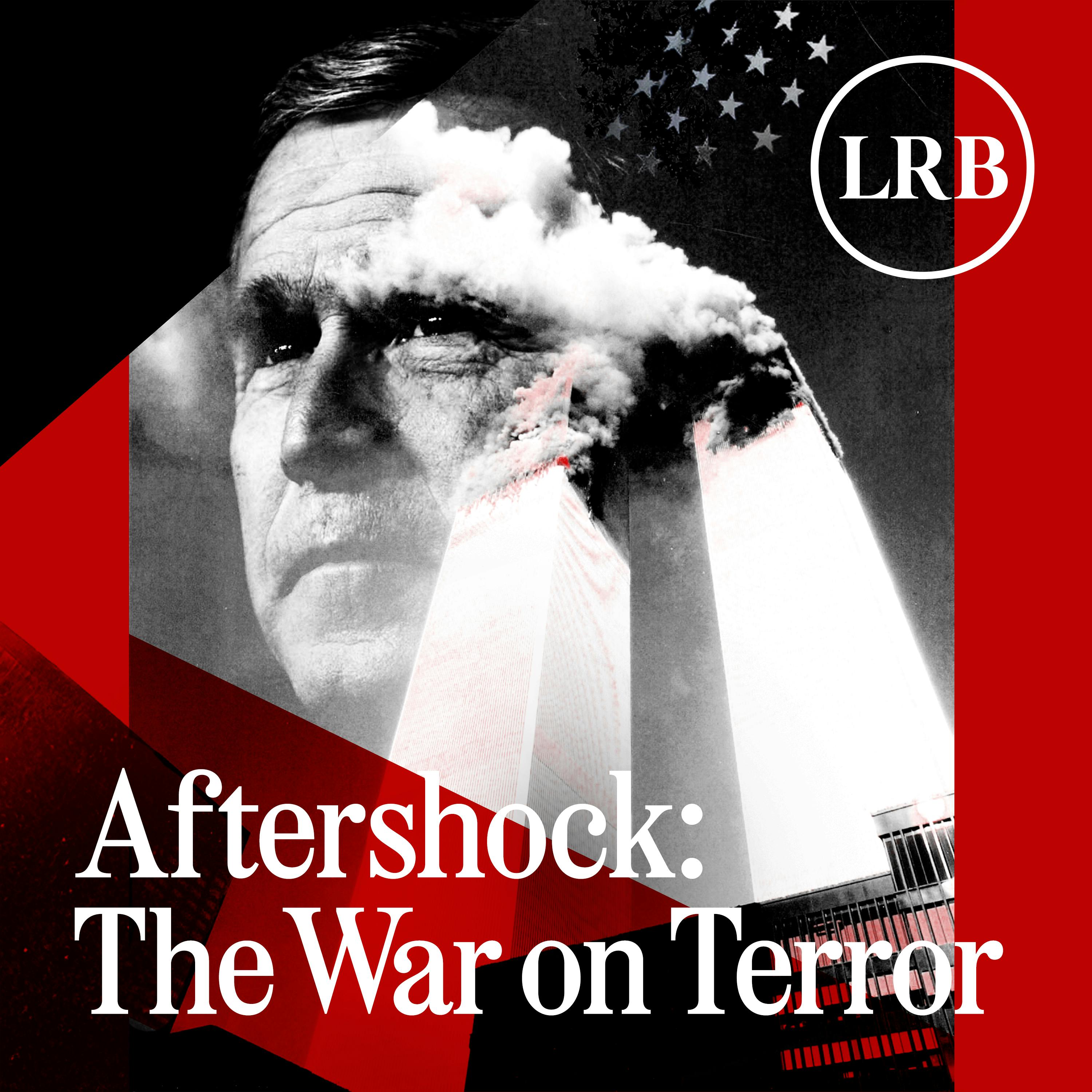
Aftershock: The War on Terror – Episode 1: With Us or Against Us
In the days after 9/11, George W. Bush declared a state of emergency and initiated what would become an unprecedented expansion of US power. Public debate narrowed: there were new limits on what was acceptable, and not acceptable, to say. The London Review of Books published a number of pieces that challenged this consensus, forcing its editor, Mary-Kay Wilmers, to defend the paper on national rad

Where does our waste go?
Since the 1980s, Brett Christophers wrote recently in the LRB, ‘firms have made vast amounts of money by sending the rich world’s waste to the global South’ – hazardous waste at first, joined more recently by discarded electronics, clothes and plastics. Literal mountains of our rubbish are accumulating on the peripheries of cities such as Accra and Delhi. Waste, like wealth, is unevenly distribute

Introducing ‘Aftershock: The War on Terror’
After 9/11, George W. Bush launched a global War on Terror. What followed was an unprecedented expansion of American power, from Guantánamo Bay to drone strikes, mass surveillance to the weaponisation of the financial system. Asked when it would end, Vice-President Dick Cheney replied: ‘Not in our lifetime.’ Two decades later, we’re still living in its shadow.
Aftershock: The War on Terror is a n

On Politics: Latin America’s Right-Wing Shift
At the end of the 20th century and across the first decade of the 21st, a swathe of countries across Latin America elected left-wing governments in what became known internationally as the Pink Tide. In more recent years, what many have seen as a second wave of progressive governments have collapsed, giving way to right-wing leaders such as Milei, Bukele and Bolsonaro, with support from internatio

Pollution and Other Serial Killers
Between the 1960s and the turn of the century, an astonishingly large number of serial killers grew up or operated in America’s Pacific Northwest. Caroline Fraser’s book Murderland, reviewed in the LRB by James Lasdun, argues that a significant contributing factor may have been the spew of lead fumes and other toxic emissions that billowed unchecked across the region during those decades. On this

On Politics: Do bond markets and the Bank of England run Britain?
Andy Burnham recently said that the government is ‘in hock to the bond markets’, and the political turbulence of the past few years, not least the downfall of Liz Truss following her ‘mini-budget’, would seem to back this up. But the bond markets are only part of the picture: the actions of the Bank of England and the fiscal rules a government sets for itself also play significant roles in the dec

Extinction, Fast and Slow
One of the difficulties in thinking about extinction, as Lorraine Daston argued in her recent review of Vanished by Sadiah Qureshi, is ‘the challenge of scale: the mismatch between our decades and centuries and the Earth’s epochs and aeons’.
Lorraine joins Tom to explore the ways that ideas about extinction are warped by our timescales and politics. They discuss how the language of natural selec

On Politics: The Online Right (and Left)
For the best part of a decade, a new type of anti-systemic, nationalist politics has been emerging from different corners of the online world. In Britain, this has united with older forms of cultural conservatism to propel Nigel Farage and Reform UK to within touching distance of power (at least for now). In this episode, James is joined by political theorist Alan Finlayson to understand what’s dr
Lessons from the Peace Process
Adam is joined by Robert Malley to discuss the ceasefire between Israel and Hamas, and the long history of the peace process, in which Malley has been involved on behalf of several US administrations. They also talk about his recent book about the conflict, Tomorrow Is Yesterday, co-authored with Hussein Agha, why attempts to broker a lasting peace have failed and what the future might hold for th

Why should we listen to Amanda Knox?
It's nearly eighteen years since Amanda Knox was arrested on suspicion of murdering her housemate Meredith Kercher in Perugia, and more than ten since she was finally exonerated of the crime. She has just written her second book, Free, which, as Jessica Olin wrote recently in the LRB, ‘chronicles her attempt to adjust to life after prison’.
On this episode of the LRB podcast, Jessica joins Tom to