Independent Thinking
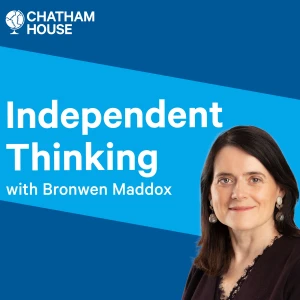
Chatham House director Bronwen Maddox hosts conversations with leading policymakers, journalists and Chatham House experts to provide insight into the latest international political issues. Independent Thinking gives listeners the opportunity to engage with the high level conversations hosted by Chatham House.
Episodes

How will Ukraine get through winter after the Trump-Putin diesel deal?
President Trump and President Putin's back-door deal to release hundreds of thousands of tonnes of Russian diesel into international markets has revitalized the Kremlin's war effort and left President Zelenskyy incandescent. Is the US president sacrificing Ukraine in the hope that it will help him in the midterms? Can Europe bridge the gap in support? And can Ukraine survive another winter under R

Europe, Brazil and beyond: Is the populist wave gathering momentum?
The rightward movement in democracies in Europe and beyond shows little sign of slowing. Germany has elected its first far-right regional government in Saxony-Anhalt. In France, voter anger with Emmanuel Macron puts the Rassemblement National's Marine Le Pen in pole position for the presidency. In Spain, Pedro Sánchez called a snap election in an attempt to mobilise the beleaguered left around Spa

Why the Houthis' Red Sea power play makes Iran even stronger
The Iranian-backed Houthi rebels' capture of Yemen's port city of Mocha means that Iran now effectively controls two crucial waterways in the region – the Bab al-Mandab Strait to the Red Sea and thus the Suez Canal, as well as the Hormuz Strait. Why has this simmering conflict exploded again? What do Iran and the Houthis want? How serious is this potential blockade for world trade and energy suppl

China rising, America in decline? The Trump-Xi summit
President Donald Trump welcomes Xi Jinping to Washington with the US-China dynamic in a moment of historic flux. China is rising economically and militarily, while the US is mired in the Iran war, alienating allies and pursuing Trump's unpredictable trade and tariff disputes. What do the two leaders want from this meeting, and will they get it? Can they reconcile their differing economic powers, t

Artificial Intelligence, Real Fears: Is it time to slow down?
A call by leaders of the tech giants on the frontier of Artificial Intelligence to 'slow the pace' of its development has sparked debate over the risks associated with AI. Does AI represent an existential threat, and if so, how urgent are the warnings? Or can humanity harness this powerful technology to our benefit? Our experts discuss the implications for international security, from cyber to the
How did 9/11 shape the world we live in?
Twenty five years ago the deadliest terrorist attacks in human history, on 11 September 2001, saw 2,977 people killed in New York, Washington, and aboard the planes hijacked by 19 members of Al-Qaeda. An immediate response followed with the US-led 'war on terror', which saw Western forces occupy Afghanistan and Iraq, and two decades of military operations across the Middle East and beyond. We look

What is the United Nations for?
The United Nations convenes for its 81st General Assembly next week amid turmoil around the world that it seeks to bring together. The conflicts in Iran, Ukraine and Gaza, and the US, China and Russia's undermining of the rules-based international order cast a shadow over UNGA. Can the organization renew itself for a dangerous multipolar world? Or is it doomed to the same fate as the League of Nat

Iran, Gaza, Trump and Netanyahu: Understanding the Middle East's crises
It's been a tumultuous year in the Middle East – and it's far from over. Six months after the US and Israel launched their offensive against Iran, the conflict continues to disrupt trade, energy and food security. President Trump struggles to escape a deadlock that threatens to seriously damage him in the American mid-term elections. Meanwhile, Gaza remains locked in a humanitarian crisis despite

The summer of '26: A turning point for the climate crisis?
The climate crisis has seldom been dramatized so vividly as in the summer of 2026. Apocalyptic fires, widespread droughts and drained rivers in Europe made clear a worsening situation that even the most fervent denier can't wave away. But is there the necessary time, commitment and technology to slow or reverse the climate spiral – even in the face of a US administration that is committed to fossi

The foreign policy challenges Labour can't ignore
Britain's new prime minister Andy Burnham is not known for his interest in foreign affairs, but foreign affairs are eternally and often unforgivingly interested in Britain. What should Burnham and his new foreign secretary Ed Miliband prioritise on the global front? How can they balance the urgent demands of defence, climate action, resetting relations with the EU and Britain's place in the wider

Is the AI boom about to bust?
The $2.6 trillion spent on artificial intelligence, data centres and advanced chipmaking dwarfs the cost of previous infrastructure megaprojects. Yet AI has become a money pit for tech giants like Amazon, Google, Microsoft and Meta, and the tech is failing to hit its stratospheric targets. Could an AI crash take overinvested economies down with it? In the longer term, whose approach will dominate?

If Ukraine is winning the war, why did Zelenskyy fire his defence minister?
Ukraine's drone strikes deep into Russian territory coincided with one of Kyiv's biggest political and military convulsions of the war: Ukrainian president Volodymyr Zelenskyy fired the popular defence minister Mykhailo Fedorov only for his decision to spark protests across the country. Why did Zelenskyy do it? Has the power struggle damaged his authority? Is Ukraine really regaining the initiativ

Can Andy Burnham remake Britain at home and abroad?
Andy Burnham took over as UK prime minister with a vow to restore hope in British politics – and an early volley of voter-friendly policy promises. But are they quite as significant as billed? How much room to manoeuvre does Burnham really have? Will new chancellor John Healey release enough funds to the Ministry of Defence, which he quit in frustration? Does Ed Miliband have what it takes to succ

Has Trump made the presidency too powerful?
The 2026 World Cup final in New Jersey may represent the pinnacle of soft power for the USA and a moment of global prestige for President Donald Trump. But at home, concerns are growing over his ever-expanding vision of presidential power. Is America now living with an 'imperial presidency'? Has the Supreme Court given the president powers that future generations might find hard to take back? How

NATO in Ankara: Is Europe ready for a Russian attack?
This year's NATO summit brought together the leaders of all 32 member states in Ankara. President Donald Trump's return to the summit brought renewed controversy, with remarks on Greenland and Iran underscoring the geopolitical tensions that continue to test the unity and purpose of the transatlantic alliance. What happened in Ankara and what does it mean for NATO's future? If the Ukraine confl

USA at 250: Soft power, hard power and the future of the American dream
The United States marks its 250th birthday at a moment of intense division and international uncertainty. At home, President Donald Trump is aggressively remodelling America's governance around expanded White House power and burning through firewalls intended to prevent presidential overreach and self-enrichment. Internationally, his capricious mix of transactional diplomacy, coercive tariffs and

Can Andy Burnham save Labour?
UK Prime Minister Keir Starmer leaves No.10 a decade since the Brexit referendum that began the UK's cycle of chaos, and Andy Burnham seems set to take over unopposed. Our experts discuss what the new regime will mean for Britain's future and its role in the world. Will attempts to bring the UK closer to Europe without actually rejoining the EU continue? Will Burnham want to increase Britain's def

It isn't easy being green: The UK's net zero trilemma
Can Labour's prized plans to decarbonize power generation by 2050 withstand growing demands for extra defence spending – an acrimonious argument that has already claimed two senior defence ministers? Or pressure to preserve and extend welfare benefits from the party's left and the unions, many of whom see net zero as a job killer? Plus: China's colossal subsidization of green technology has create

Defence Investment Paralysis: Why the UK's defence minister quit, and what it means
A tumultuous week for Britain's faltering rearmament plans sees Defence Secretary John Healey resign from Keir Starmer's cabinet, saying the prime minister and the Treasury lack the will to properly fund the defence of the nation. Al Carns, the armed forces minister, also resigned saying the government's long-awaited Defence Investment Plan (DIP) was 'not built for the threat we face'. The departu

Rules against power: Does the world need a new economic alliance to balance the US and China?
Would the world benefit from a new economic alliance to stop China and the US from undermining the global rules we all depend on – a new 'third pole'? That's the conclusion of a new Chatham House report published this week. How would an economic bloc like this work? Who could build it? And how would China and the US – even post-Trump – react to such a challenge to their power? Laurel Rapp, direct

Ebola in DR Congo: A 'catastrophic collision of disease and conflict'
The major Ebola outbreak in the Democratic Republic of Congo's northeast is not just a public health emergency in an already impoverished and violence-beset region. Armed rebellion, fragile government and a collapse in public trust are combining to make outbreaks more frequent – and fostering dangerous disinformation that makes the virus harder to fight. How dangerous is the Ebola virus? Could it

Could Britain really rejoin the EU?
Almost exactly ten years since Britain's seismic vote to leave the EU, the debate reopens thanks to early skirmishes in the fight for leadership of the Labour Party and thus the prime ministership. Could a credible bid to rejoin make its way onto Britain's political agenda? Are the drastically changed economic and defence environments making the case for re-entry unanswerable? And under what terms

The Trump-Xi summit: What does the US want from China and will Trump get it?
President Donald Trump brings a band of senior US business executives seeking trade deals to China for what is possibly the biggest bilateral summit of 2026. But what does the US hope to achieve? More sales of Boeings, beef and soybeans; an off-ramp from the US-Israel war on Iran; a sense of world pre-eminence; or all three? Our experts discuss whether Taiwan will end up paying the price for Chine

Is Putin losing control of his war in Ukraine?
Is the initiative on the Ukraine war slipping out of Russian president Vladimir Putin's hands? And how has the US-Israel war on Iran affected Moscow? The economic crisis is tightening, and Moscow and St Petersburg are increasingly subject to lengthy internet and mobile blackouts. Fearing Ukrainian drone attacks, Russia has vastly scaled down its traditional celebration of military power – the Vict

King Charles in Washington: Did the royal visit save the 'special relationship'?
King Charles III's state visit to the US won acclaim as the monarch charmed President Donald Trump. But can it really rescue US-UK relations from their current dire state? The 'special relationship' – a term first voiced by Chatham House before becoming widely popularized by Winston Churchill – now seems not so special. Our experts discuss what Britain and Europe should do now that the US wants to

Is the shock of the US-Iran war helping Europe come together?
EU expansion, energy shocks, and uneasy alliances: will the conflict in the Gulf – and other crises – force a more unified European strategy? This week's episode comes from the Delphi Economic Forum in Greece, where host Bronwen Maddox is joined by Grégoire Roos, director of our Europe, Russia and Eurasia programmes. As the fallout from the US-Israel war on Iran ripples through global markets,

Iran, Pope, Economy: How many battles can Trump fight at once?
From Hormuz to Hungary and the Vatican to the Federal Reserve, it has been an unusually contentious week for the White House, even by the standards of President Trump's second administration. This week's podcast comes from the US, where our analysts assess the political and economic state of the US as it begins gearing up for the midterm elections. From New York, Chatham House Director Bronwen M
What lessons will China, India and other Asian nations draw from the Iran war?
China prepared in advance for a US attack on Iran. But many of its Asian neighbours have been hit hard because their economies were heavily reliant on energy imports from the Gulf. In the short-term, the near-closure of the Strait of Hormuz has triggered rationing, and shortages of diesel, gas and fertiliser. Does that set a negative precedent for other choke points across the world? In the
Why are UK energy costs so high? And how to bring them down
An earlier than usual episode of the Independent Thinking podcast, ahead of the Easter break. In a one-on-one conversation, Chatham House Director Bronwen Maddox discusses energy with Sir Dieter Helm, Professor of Economic Policy at the University of Oxford, who has been advising governments and writing on energy, water and the environment for decades. They examine how energy policies of differen
Iran war: regional shock or global crisis?
One month on from the start of the US and Israeli war on Iran, governments worldwide are trying to assess the scale of its long-term impact on the global economy and political system. Much will depend on how long the conflict continues, and how long Iran blocks fuel exports and other cargo vessels from passing through the Strait of Hormuz. The White House and Iran have sent conflicting signals abo

Is Iran one crisis too many for Trump?
The US-Israel war on Iran is straining Trump's alliances, at home and abroad. Three weeks into exactly the kind of war of choice that he spent years decrying, US President Donald Trump is not getting the amount of international support that he seeks for his campaign of air strikes on Iran. There is also reluctance among NATO and other allies to be drawn into the political and economic turmoil caus

AI wars: Anthropic battles the Pentagon as China plans ahead
The US military's AI provider Anthropic is feuding with the Pentagon after the company tried to impose 'red lines' over the use of its artificial intelligence products for lethal autonomous weapons and mass surveillance of Americans. President Trump accused the US firm of being 'radical left' and designated it a 'supply chain risk' – usually reserved for Chinese or Russian firms who could compro

Iran: Will Trump declare early victory and risk leaving hardliners in charge?
What does President Trump hope to achieve in Iran – a quick show of force, or long-term regime change? The US and Israel's long-threatened air strikes on Iran have materialized, and the Middle East is facing widespread disruption and a mounting death toll as the war spills across borders. In this episode of Chatham House's international affairs podcast, our expert panel analyses the Trump adminis

Trump's tariffs: Are they here to stay?
The US Supreme Court ruled against President Donald Trump on his first justification for tariffs, but he says he will push them through by other means. On this week's Independent Thinking podcast, our experts analyse why Trump is wedded to tariffs as an economic and political tool, and what effect they will have on the US and global economies. They also discuss whether tariffs have ended globaliza

As Ukraine peace talks stall, can Europe step up in its defence? Independent Thinking podcast
Negotiations to end the Russia-Ukraine war do not appear to have made significant progress. In the meantime, the focus of US President Donald Trump's 'lighthouse diplomacy' appears to have switched to Iran. Chatham House analysts discuss the state of the talks, and whether Europe will step up to provide the weapons and military support that Ukraine needs. They also examine how the Russia-Ukraine c
Rubio to Europe: A softer tone than Vance. But same message?
In a special edition of Chatham House's Independent Thinking podcast recorded at the Munich Security Conference 2026 over the weekend, Chatham House Director Bronwen Maddox and Grégoire Roos, Director of the Europe and Russia and Eurasia Programmes, unpack the key issues that emerged from this year's forum. The main speaker, US Secretary of State Marco Rubio, adopted a different tone from Vice Pre

As the UK lurches from crisis to crisis, is it becoming ungovernable?
As Britain's Prime Minister Keir Starmer ploughs through crisis after crisis, his Labour Party faces multiple threats in upcoming local elections. Our Chatham House analysts examine whether having six prime ministers in a decade is a sign that Britain, like some of its neighbours, has more fundamental underlying problems that make it increasingly hard to govern. Host Bronwen Maddox is joined by

Oil, regime change, and what's next in Trump's MAGA playbook?
After the US capture of Venezuelan President Nicolás Maduro, our analysts discuss where in the Western Hemisphere US President Trump and Secretary of State Marco Rubio may turn their attention to next. Host Bronwen Maddox is joined by Laurel Rapp, director of Chatham House's US and North America Programme, and Dr Christopher Sabatini, Senior Fellow for Latin America. They dissect the so-called 'D
UK in China: Hard choices between rival superpowers
Host Bronwen Maddox is joined by Ben Bland, head of our Asia-Pacific Programme, and Dr Yu Jie, senior research fellow on China. They discuss the opportunities and risks of closer engagement between the UK and China, and why the opacity of Chinese elite politics makes them an unpredictable security actor. Read our latest: EU leaders echo de Gaulle, saying Europe must depend on no-one. But where sh
Trump vs Carney at Davos - One summit, two visions
Chatham House Director Bronwen Maddox joins the Independent Thinking podcast from the World Economic Forum in Davos. In London are guest host David Lubin, a Senior Research Fellow in Chatham House's Global Economy and Finance Programme; and Grégoire Roos, Director of the Europe and Russia and Eurasia Programmes. They examine the implications of President Trump's speech for Greenland, NATO, Europe
Greenland in the cross hairs of Trump's bid for hemispheric dominance
Host Bronwen Maddox is joined in the studio by Laurel Rapp, Director of Chatham House's US and North America Programme; Marc Weller, Director of the International Law Programme and down the line by Juno Berthelsen, of Greenland's opposition Naleraq party, which favours independence. Read our latest: Who owns Greenland? As Carney visits China to diversify Canada's trade, the 'Donroe Doctrine' fur
Does Venezuela usher in an era of might is right?
Bronwen Maddox is joined by Marc Weller, Director of Chatham House's International Law Programme; Laurel Rapp, Director of the US and North America Programme; and Christopher Sabatini, Senior Fellow for Latin America. They discuss the failure of regional diplomacy that preceded the 3 January 2026 attack by the US on Venezuela, the tentative response of the international community in its aftermath,
Trump Year One – China's economic rivalry with the US is here to stay
In the last Independent Thinking podcast of 2025, host Bronwen Maddox is joined by David Lubin, Senior Research Fellow with Chatham House's Global Economy and Finance Programme; Marion Messmer, Director of the International Security Programme; and Yu Jie, a senior research fellow on China in Chatham House's Asia-Pacific Programme. For further analysis read 'The economics of the new Monroe Doctrine
What does Trump's national security strategy mean for Europe, China and Middle East?
This is a special edition of Chatham House's Independent Thinking international affairs podcast, recorded at the Doha Forum 2025. Many of the official and backroom discussions at Qatar's annual gathering of more than 5,000 world leaders, policymakers, dialogue, corporate and humanitarian organizations from 162 countries were dominated by discussions of President Donald Trump's National Security
Europe scrambles to avoid being sidelined on Ukraine
How are Europe and Ukraine reacting after the US and Russia sought to strike their own deal, and Putin warned that Moscow – while not planning for war with Europe – is 'ready right now'. Host Bronwen Maddox is joined by Grégoire Roos, Director of the Europe and Russia and Eurasia Programmes; Natalie Sabanadze, a Senior Research Fellow and former Georgian Ambassador, and Jaroslava Barbieri, Resea
Britain's budget – a recipe for growth or decline?
Britain's Chancellor of the Exchequer Rachel Reeves published her – widely leaked – budget this week. How does it leave her ruling Labour Party positioned in Britain? And what do the calculations look like from overseas, where other countries have adopted different solutions to the problems facing them? For this discussion on Chatham House's international affairs podcast, host Bronwen Maddox is jo
Sudan – the internal and external forces tearing it apart
After the North Darfur capital El Fasher fell to the Rapid Support Forces, aid agencies and survivors talk of civilians being massacred in the streets. The international affairs podcast of Chatham House examines the human toll, and the dynamics of a war fuelled by regional powers and their proxies seeking to control Sudan's territory, gold, natural resources, and access to key waterways. Host Bro
What does Ukraine need to get through the winter?
Nearly four years after Russia's full-scale invasion, Ukrainian officials and analysts look at the prospects for a ceasefire, and at the military, economic and human cost that President Vladimir Putin's campaign has inflicted on the country. They discuss the Russian strikes on Ukraine's energy infrastructure, intended to demoralise the civilian population, and what European allies should do to b
Mamdani won in New York. For Trump, was it a setback or backlash?
Zohran Mamdani's victory in New York's mayoral race this week – and other electoral successes – energized Democrats in the US and left-wing parties worldwide. The new standard-bearer of the American left is hailed by progressives as a generational shift of leadership – at 34 he will be the first Muslim mayor of New York, and one of its youngest ever. But he faces opposition from many quarters ove
Europe after the Dutch elections. Goodbye far right? Not so fast.
Far-right Dutch leader Geert Wilders suffered a setback on Wednesday's elections, with centrists poised to take back power. Rob Jetten, 38, leader of the centre-progressive Democrats 66 party, is set to become the Netherlands' youngest leader in modern history after running on the upbeat slogan 'Yes we can'. But the hard right remains influential. To discuss the outcome, and what it tells us a
AI Plus. Generals purged. China's leaders plan for 2030
China's ruling Communist Party leadership met in Beijing to frame the next five-year-plan. Amid a trade war with the United States, they set priorities for economic policy and technology, including how to build artificial intelligence into key sectors of society. New faces appeared and old ones vanished, with a purge of senior military officials and others as President Xi Jinping sacked some off
How to advance Trump's Gaza plan from magical thinking to lasting peace
Beset by early ceasefire disputes between Israel and Hamas, international backers of President Trump's Mideast project must move quickly to elevate it from vague wish list to viable framework. Rapid delivery of aid, reconstruction - and security for Palestinians and Israelis – are essential. But without a political end game, it will founder. Sanam Vakil, Marc Weller and Stephen Farrell join host
Trump, Gaza and shutdown
At home the US is mired in domestic dysfunction with a government shutdown now in its second week. But abroad, President Trump has brokered a deal that - although it didn't win a Nobel Peace Prize - could end the two-year Gaza war. Laurel Rapp and Max Yoeli join guest host Christopher Sabatini. They discuss the effects of the government funding crisis and protracted political deadlock on the US e
In UK politics is Reform now the party to beat?
It's party conference season in Britain. Both ruling Labour and opposition Conservatives are nervous about the rise of Nigel Farage's right-wing Reform UK, successor to the Brexit Party. Pollster Joe Twyman and Olivia O'Sullivan, Director of Chatham House's UK in the World Programme, join host Bronwen Maddox for this week's podcast. Read our latest: Explainer | Can the Trump peace plan for Gaza s
The UN must adapt to the Trump era. How?
The United Nations is a guardian of international law, its leader assured member states this week. But President Trump questioned the point of the UN. Marc Weller and Christopher Phillips join Bronwen Maddox to assess challenges to the global order in a world of strongmen and multipolarity. Read our latest: Event | Is this a new age of nuclear proliferation? Comment | Does the US want to weake
Trump's UK state visit sealed deals, but at what cost?
President Donald Trump brought AI and tech CEOs on his second state visit for a deal pledging £31 billion in investment for the UK. Olivia O'Sullivan and Laurel Rapp join host Bronwen Maddox to discuss the politics and dealmaking behind the pageantry, on Chatham House's weekly international affairs podcast. Read our latest: Event | Global Britain meets America First: What next for the 'specia
Will China lead a post-American world?
Are we moving into a post-American world and if so will China try to lead and set the rules for it? In the face of American withdrawal, China senses an opportunity to shape a new world order. This week on Independent Thinking, Samir Puri and James Kynge join Bronwen Maddox to discuss the changing nature of the international order. Read our latest: Event | Interview and discussion with Isaac Herz
Trump's tools – Tariffs and sanctions
How much of Donald Trump's sanctions strategy is substance — and how much is performance? In this episode of Independent Thinking, Chatham House experts unpack whether sanctions work. And at Trump's shifting use of sanctions, tariffs and personal power plays in global economic policy. With Dr Christopher Sabatini, Timothy Ash, and Christopher Vandome from Chatham House. Read our latest reports:
Will Trump deliver for Ukraine?
What does President Donald Trump's promise of Patriot missiles for Ukraine — and a 50-day tariff ultimatum to Putin — really mean for Ukraine and Russia? Chatham House experts Jaroslava Barbieri, John Lough and Samir Puri look at whether it is a significant pivot towards Ukraine, how both sides are faring in the war, and how U.S. credibility is affected by Trump's changing positions. They are joi
Gaza: What next after Trump-Netanyahu talks?
What does Benjamin Netanyahu's visit to the White House mean for the likelihood of a Gaza ceasefire? Bronwen Maddox is joined by Stephen Farrell, Yossi Mekelberg, Sanam Vakil and Max Yoeli to examine the state of negotiations, U.S.-Israel and regional dynamics, and competing plans for what comes next. Read our latest: Lebanon's moment of truth The Rio summit showed that BRICS is less anti-Wester
One year hard Labour: Why is the UK so difficult to govern?
After a crisis week for Britain's ruling Labour Party, host Bronwen Maddox and Chatham House's Olivia Sullivan are joined by economist Professor Stephen Millard and pollster Joe Twyman to look at the foreign and domestic challenges facing the country just one year after Keir Starmer won a landslide election victory. Read our latest: Is China friend or foe to the UK? A government audit says: 'It'
Iran's nuclear programme: destroyed, damaged or intact?
Did US strikes cripple Iran's nuclear programme — or just set the stage for the next crisis? Bronwen Maddox hosts from Jordan, joined by international security expert Marion Messmer and Middle East associate fellow Lina Khatib in London, to examine the claims and counter-claims and what it means for the region's fragile balance of power. Read our latest: US strikes on Iran: What next for Iran, I
What does the Iran-Israel war mean for the region and the world?
Following Israel's strikes on Iran on 13 June, and the subsequent sequence of retaliation and counter retaliation, fears are rising that the conflict could escalate. In this special episode of Independent Thinking (an edited version of a live webinar) Galip Dalay joins a panel of experts to discuss strategic goals, the responses of the key regional and international actors, including the Gulf st
Can Britain be great again?
Is Britain chasing faded glory or forging a credible future? As the government lays out its latest spending review, Bronwen Maddox is joined by Jeremy Hunt and Samir Puri to ask whether bold talk of growth, defence and science hides a deeper strategic drift – or a real path back to global influence. Read our latest: Europe could win the battle for the future of digital money History suggests
War plan or wish list - The UK Strategic Defence Review
Drones, AI, cyber warfare and nuclear weapons are a key part of the UK's new Strategic Defence Review, along with conventional weapons. Chatham House experts unpack the strategy, spending pledges and how Britain should adapt its military to deal with Putin, China, and Donald Trump. Bronwen Maddox is joined by Chatham House experts Grace Cassy, Marion Messmer and Olivia O'Sullivan to unpack the s
What's the future for Gaza?
As Gaza reels from staggering humanitarian devastation, Bronwen Maddox speaks with Yossi Mekelberg, Stephen Farrell, and Julie Norman to unpack the political drivers of Israel's war, the role of Donald Trump, and the region's competing visions for Gaza's future. From internal power struggles to shifting U.S. policy and Arab diplomatic proposals, this episode asks: what future is even possible for
Is Brexit finally done?
Nine years after the Brexit vote, a new UK–EU deal promises smoother trade and deeper cooperation — but is it the end of the Brexit saga or just another chapter? Bronwen Maddox digs into what the deal really means with Rod Liddle and Nicolai von Ondarza, from political fallout to Britain's shifting role on the world stage. Read our latest: The dissolution of the PKK could transform Turkey's d
Can the UK take on the EU, US and China?
As trade tensions, security concerns, and diplomatic crossroads converge, the UK's bid for economic growth faces hard choices on the global stage. In this episode host Bronwen Maddox explores the UK's complex balancing act between the EU, US, and China with guests Janka Oertel and Sir Martin Donnelly. Read our latest: The UK–EU summit will bring some progress on defence cooperation. But more c
Can India and Pakistan step back from the brink?
Tensions between India and Pakistan have surged following a deadly attack in Kashmir and air strikes by India inside Pakistan. With nuclear risks, regional diplomacy, and rising domestic pressures in play, what could prevent this crisis from spiralling further? In this episode, Bronwen Maddox discusses what this means for South Asia and the world with Marion Messmer, a senior research fellow wit
Ukraine's impossible choice
As Donald Trump floats a controversial peace deal that could leave Ukraine facing territorial losses and NATO exclusion, Kyiv is forced to weigh an impossible choice between sovereignty and survival. Bronwen Maddox speaks with Orysia Lutsevych from Chatham House and Matthew Savill from RUSI about battlefield fatigue, shifting alliances, and the future of European security. Find out more: Trum
Is the US dollar losing its dominance?
As the IMF Spring Meetings unfold in Washington DC, Bronwen Maddox asks whether we are witnessing the twilight of the US dollar's global dominance. Amid political shocks and shifting financial allegiances, could the world be inching towards a post-dollar era? Bronwen is joined by Isabelle Mateos y Lago, chief economist at BNP Paribas, and David Lubin from Chatham House's Global Economy and Fina
How can Nigeria tackle corruption?
In this episode of Independent Thinking, we explore the root causes of corruption in Nigeria, its impact on everyday life, and potential solutions for change. Bronwen Maddox speaks with Leena Koni Hoffmann about her in-depth report on the issue, as well as insights from speakers at a Chatham House conference focused on Nigeria's ongoing fight against corruption. Read our work on Nigeria: Takin
Is the US confronting China in Latin America?
This week on Independent Thinking, we explore the growing battle for influence in Latin America between the U.S. and China. In just two decades, China has gone from a minor player in the region to a dominant force—challenging the US. How is President Trump's government responding and could his policies actually give Beijing more room to expand? Guest host Chris Sabatini is joined by Yu Jie, Rober
Are Donald Trump's tariffs the end of globalization?
President Trump has unveiled sweeping new trade tariffs—but what happens next? Bronwen Maddox explores the global reaction, the economic fallout, and whether this marks the beginning of the end for globalization. She's joined by Jason Furman, former Chair of the Council of Economic Advisers under President Barack Obama, alongside Dame DeAnne Julius and David Lubin from Chatham House's Global Eco
Can Europe replace the US as a global power?
In this week's episode of Independent Thinking, Bronwen Maddox discusses whether Europe can take up the mantle of the US, and lead the world as an economic and political powerhouse. Can Europe can fill the vacuum caused by America's shifting foreign policy, and in doing so, become more of an economic force? Bronwen explores this topic with three Chatham House experts - Creon Butler, Director of t
How closely is China watching the US?
This week on Independent Thinking, three Chatham House experts look at the view from China now that Donald Trump is in charge. Ben Bland speaks to Yu Jie, William Matthews and David Lubin, about how China is repositioning itself on the world stage, viewing its own security and preparing for a potential trade war. We'll also explore what the Chinese Communist Party is really thinking, what har
Will Syria's new leader rescue or destroy the country?
In this week's episode Haid Haid, Rim Turkmani, and Lina Khatib discuss the recent developments in Syria following the fall of Bashar al-Assad's regime. We delve into the country's economic struggles, the rise of interim President Ahmed al-Sharaa, the resurgence of sectarian violence, and the challenges facing Syria's path to democracy. It also explores the roles of regional and international pla
Is the UK military strong enough?
With the UK pledging to increase defence spending to levels not seen since the Cold War, what does the future of British defence look like? In this episode, we discuss the evolving nature of warfare, the impact of technology on modern battlefields, and whether Britain is truly prepared for the next conflict. Joining Bronwen Maddox are Sir John Sawers, former head of MI6; James Heappey, former Arme
Can the UK, France and Germany forge a new transatlantic path?
As Donald Trump moves to reshape America's foreign policy, we discuss what this means for the allies in Europe. Can the the United Kingdom, France and Germany forge a new path or is transatlantic unity fading fast? Bronwen Maddox is joined by the Chair of Chatham House Sir Simon Fraser, former Wall Street Journal editor-in-chief Gerard Baker, Marion Messmer, a senior research fellow with our Inte
Should Europe start planning for the worst?
Ties between the US and Ukraine have soured with Donald Trump calling Ukraine's Volodymyr Zelenskyy a 'dictator' in a public war of words. Meanwhile US and Russian diplomats met in Saudi Arabia to discuss Ukraine's future without representatives from Kyiv or Europe. Should the continent be preparing for a future without the US as an ally? Bronwen Maddox is joined by historian and author Timothy Ga