The Ancients is a podcast dedicated to discussing our distant past, covering a wide range of topics from Neolithic Britain to the Fall of Rome. Each episode features interviews with historians and archaeologists, focusing on a specific theme from antiquity. The show is hosted by Tristan Hughes and aims to bring ancient history to life for modern audiences.
Episodes
The Plain of Jars: An Ancient Asian Mystery
How do thousands of massive, two-meter-tall stone jars end up scattered across the remote mountains of Laos? And more importantly, what were they used for?Deep in a landscape still shadowed by unexploded bombs, the Plain of Jars remains one of Earth's greatest archaeological puzzles. Tristan Hughes joins archaeologists Charlie Cooper and Dr. Nick Skopal to unearth groundbreaking new discoverie
The Year of Five Emperors
How do you celebrate the New Year in ancient Rome? With an assassination and a bloody free-for-all for the imperial throne, of course.Following the murder of the gladiator emperor Commodus on New Year’s Eve 192, a chaotic succession battle erupted. Tristan Hughes and Dr. Simon Elliott unpack the infamous Year of the Five Emperors; a riotous drama where mad, honourable, and ruthless men seize and l
Britain's First Homo Sapiens
What was it like to share Britain with Neanderthals and cave hyenas 40,000 years ago?Tristan Hughes ventures deep underground to Kents Cavern, a glittering labyrinth affectionately known as Britain’s first home. He's joined by archaeological scientist Dr. Helen Fewlass on a live, groundbreaking excavation. Together they discover how cutting-edge science and ancient stone tools are rewriting th
The Mycenaeans: Was Agamemnon Real?
They built the great fortresses of the Bronze Age, developed a mysterious writing system and, according to Homer, led the Greek assault on Troy. But how much of the legend is rooted in reality? Was Agamemnon a real Mycenaean king?Tristan Hughes is joined by Dr Steve Kershaw to explore the world of the Mycenaeans. Who were these formidable Bronze Age Greeks, and what do their extraordinary palaces,
Easter Island
How do you make a giant stone statue walk? On one of the most isolated islands on Earth, the people of Rapa Nui carved AND moved the extraordinary Moai, colossal faces hewn from soft volcanic rock that still inspire wonder today.Today, Tristan Hughes is joined by Prof. Terry Hunt to uncover the story of Easter Island. How did its first settlers build a thriving society in such a remote and resourc
Bronze Age Syria: Cradle of Cities
Mesopotamia, Egypt and the Hittites usually dominate the story of the Bronze Age. But Syria was home to some of the region's most powerful cities and kingdoms and helped forge the ancient Mediterranean world.Tristan Hughes is joined by Dr Amanda Podany to uncover this lost cradle of cities, from the wealthy trading hub of Ebla to the royal intrigues of Mari and the rise of the mysterious Mitan
Origins of Constantinople
Why did Emperor Constantine abandon Rome to build a spectacular new capital from scratch? In the year 312 a bloody civil war and a miraculous heavenly vision changed the Roman world forever.Tristan Hughes and Professor Judith Herrin uncover the epic origins of Constantinople. Discover how Constantine ruthlessly eliminated his imperial rivals, harnessed the strategic power of the Bosphorus, and ere
The Ninth Legion: Did They Disappear?
It's one of history’s most compelling cold cases. What happened to the Ninth Legion, a crack unit of 5,000 Roman soldiers who vanished from the historical record without a trace?Tristan Hughes is joined by Roman historian Dr Simon Elliott to investigate the fate of the legion that helped conquer Britain. Was the Ninth wiped out in a bloody defeat on Rome’s northern frontier, or did it meet its
Viking Origins: The Nordic Iron Age
Two thousand years ago, centuries before the Vikings, there was another Scandinavia. An Iron Age world.Tristan Hughes is joined by Dr Marianne Hem Eriksen to uncover the deep roots of the seafaring North, journeying through a forgotten world of elite halls, Roman encounters, and ancient burial rites.MOREIron Age BritainListen on AppleListen on SpotifyIron Age IrelandListen on AppleListen on Spotif
Caratacus: King of the Britons
Before Boudicca, another British leader brought the Roman war machine to a grinding halt. Meet Caratacus; the cunning King of the Britons who spent seven years outmaneuvering the empire.Tristan Hughes is joined by Dr. Miles Russell to uncover the forgotten story of this charismatic guerrilla fighter. From leading fierce resistance in Wales to his betrayal, capture, and a life-saving speech in Rome
Ancient Antarctica
The frozen continent of Antarctica was once a land of forests, rivers and thriving ecosystems. And millions of years before humans ever existed it was home to a whole host of ancient creatures, from the first sharks to the earliest marsupials.Tristan Hughes is joined by paleontologist Professor John Long to uncover what the trilobite and dinosaur fossils buried beneath the ice reveal about this lo
Prehistoric Penguins
When the asteroid wiped out the dinosaurs, one remarkable avian survivor traded the skies for the sea. Tristan Hughes and paleontologist Dr Steve Brusatte explore how prehistoric penguins emerged on ancient Zealandia, lost their flight and grew into colossal apex predators. But how did these giant ocean rulers eventually shrank to conquer the frozen continent of Antarctica?MORETerror BirdsListen t
Life and Death in Ancient Babylon
Babylon was one of the greatest cities of the ancient world. But what was life really like for the people who lived there? Behind its magnificent temples and royal palaces lay a city of crowded streets, disease, danger and everyday struggles.Tristan Hughes is joined by friend of the show and Babylonian extraordinaire Professor Lloyd Llewellyn-Jones to uncover the realities of life in Hammurabi'
The Gospels: Are They Historical?
How much can we really know about the historical Jesus? The Gospels of Matthew, Mark, Luke and John have shaped Christianity for nearly 2,000 years, but they were written decades after the events they describe. So how should we treat them as historical sources?Tristan Hughes is joined by Professor Helen Bond to examine where the Gospels came from, who wrote them and how closely they reflect the wo
Maya Hieroglyphs Decoded
Forget everything you thought you knew about the ancient Maya. Cracking their mysterious hieroglyphs didn't just reveal boring calendars, it exposed a cutthroat, Game of Thrones-style world of rival superpowers, Tikal and Calakmul.Tristan Hughes is joined by Professor David Stuart to uncover tales of powerful female warlords, dark pilgrimages to the underworld, and the secret jungle "whiteboard" o
Human Sacrifice in Ancient Britain
WARNING: This episode contains descriptions of graphic violence from the start.When we picture human sacrifice in ancient Britain, the iconic, flaming Wicker Man often comes to mind. But how much of this is Roman propaganda, and what does the actual archaeology reveal? Tristan Hughes is joined by archaeologist Dr. Miles Russell to separate popular myth from gruesome reality. From perfectly preserv
Ice Age America: The Clovis Culture
Before the mammoths disappeared, people hunted them across Ice Age America. Armed with distinctive stone spear points, the mysterious Clovis culture left behind traces of a world filled with giant beasts and landscapes now lost to time.Tristan Hughes is joined by archaeologist Dr Madeline Mackie to explore the latest discoveries surrounding America’s prehistoric history. Who were these remarkable
The First Punic War
How did the Romans ambush a massive Carthaginian fleet from behind a Sicilian island to win one of history's fiercest sea battles? For over 20 years, Rome and Carthage fought a brutal war for supremacy over Sicily. Tristan Hughes is joined by Carthage expert Dr. Eve MacDonald to explore the epic First Punic War; a conflict defined by titanic naval clashes, lethal boarding bridges, war elephants...
Iron Age Ireland
How much of Iron Age Ireland is myth, and how much is archaeological reality? At the monumental Hill of Tara, sacred kings ruled over a landscape steeped in ancient ritual and ancestral memory.Tristan Hughes is joined by Dr. John Waddell, author of The Celtic World, to explore the truth to be found through the mist and beneath the hills. We hear about legendary rulers like Queen Medb, epic cattle
Human Origins: Did We Begin in Africa?
The story of human origins is often imagined as a simple journey from Africa, but is the truth actually much messier? Tristan Hughes and leading palaeoanthropologist Prof. Chris Stringer dismantle the traditional narrative, discussing how recent breakthroughs in fossils and ancient DNA reveal a complex, shifting history of multiple migrations and cross-breeding to uncover where we truly come from.
Egypt's Lost Cities
What happens when an entire city disappears? Beneath the sands and wetlands of Egypt lie the remains of forgotten cities that once stood at the heart of one of the ancient world’s greatest civilisations.In this episode of The Ancients, Tristan Hughes is joined by Egyptologist Chris Naunton to uncover the story of Egypt’s lost cities. From the rediscovery of Tanis, the mysterious city immortalised
Roman Emperor Augustus and His Trusted General
Augustus was Rome's first Emperor. But who made his empire possible? Behind the throne stood Marcus Agrippa, the brilliant general whose victories secured the Roman world yet whose name was consciously erased from the record by his erstwhile great friend.In this very special episode Tristan Hughes is joined by bestselling author Robert Harris to uncover the remarkable life of Agrippa. How did a ma
The Vandals
The Vandals have gone down in history as the barbarians who helped bring down the Western Roman Empire. Their name became synonymous with violence and destruction, but who were they really?In this episode, Tristan Hughes is joined by Professor Andy Merrills to uncover the real story of the Vandals. From their migration across Europe to the conquest of Carthage, they explore how the Vandals emerged
Terror Birds
What kind of predator needs no teeth to terrify its prey? The terror birds were enormous flightless hunters that ruled South America for millions of years, standing metres tall and built for a life of pursuit and slaughter.In this episode, Tristan Hughes is joined by palaeontologist Dr Steve Brusatte to explore the world of the phorusrhacids. What were these extraordinary birds really like? How di
The Maya Ballgame
A rubber ball. A stone court. And a sport where the stakes could be life and death.For more than 2,000 years, Mesoamerican peoples played a remarkable ballgame that became far more than entertainment; across the Maya world, it became a spectacle and a ceremony with religion, politics and power at it's heart.Today, Tristan Hughes is joined by archaeologist Ed Barnhart to uncover the oldest sporting
How Slavery Built the Roman Empire
Was the Roman Empire really made by conquest? Or was it powered by something much darker?For centuries, millions of enslaved people sacrificed their lives and their labour on the altar of Roman progress, an integral cog in the grinding imperial machine. And so today on The Ancients, Tristan Hughes is joined by Dr Emma Southon, author of Servus: How Slavery Made The Roman World to bring their overl
Romulus & Remus
The story of Romulus and Remus is one of the most famous myths from the ancient world. But the Romans believed the founding of their city stretched far beyond the tale of the twin brothers. Heroes, kings and exiles all played a part in Rome's legendary beginnings.Tristan Hughes is joined by Jeremy Armstrong to explore the myths behind the founding of Rome. Why did the Romans link their origins to
Shapur I: Rome's Greatest Enemy?
Few rulers humbled Rome quite like Shapur I. A King of Kings, he rebuilt the Sasanian Persian Empire, defeated Roman armies and captured Emperor Valerian in one of antiquity's most remarkable military triumphs.In this episode of The Ancients, Tristan Hughes is joined by Eve MacDonald to explore the rise of Shapur the Great. Why did he find so much success against the ancient Roman behemoth? How di
Scotland's First Warriors
Three thousand years ago, prehistoric Scotland was a landscape of rival communities, raids and warfare. Bands of warriors fought for power and territory leaving behind extraordinary weapons that reveal a more violent side to Scotland’s ancient past.In this episode of The Ancients, Tristan Hughes is joined by Dr Matthew Knight, Senior Curator of Prehistory at the National Museum of Scotland, to exp
The Catiline Conspiracy
In 63 BC, Rome faced a conspiracy that threatened to tear the Roman Republic apart. At its centre stood two figures: Marcus Tullius Cicero, the grand old orator of Rome and Lucius Sergius Catilina, accused of plotting violence, rebellion and the overthrow of Rome’s political order. But was the danger as great as Cicero claimed?In this episode of The Ancients, Tristan Hughes is joined by Professor
Alexander the Great's Mad Scientist
WARNING: graphic descriptions of violence and warfareMeet Diades, Alexander the Great’s overlooked military engineer, the man who made the impossible siege of Tyre happen.Tristan Hughes and Professor Edmund Richardson retell the thrilling, brutal, brilliant story of invention, ambition, and ancient warfare at its most extreme.In 332 BC, he turned a coastal blockade into a 1km causeway, then faced
Hollywood’s Odyssey: The Historians' Verdict
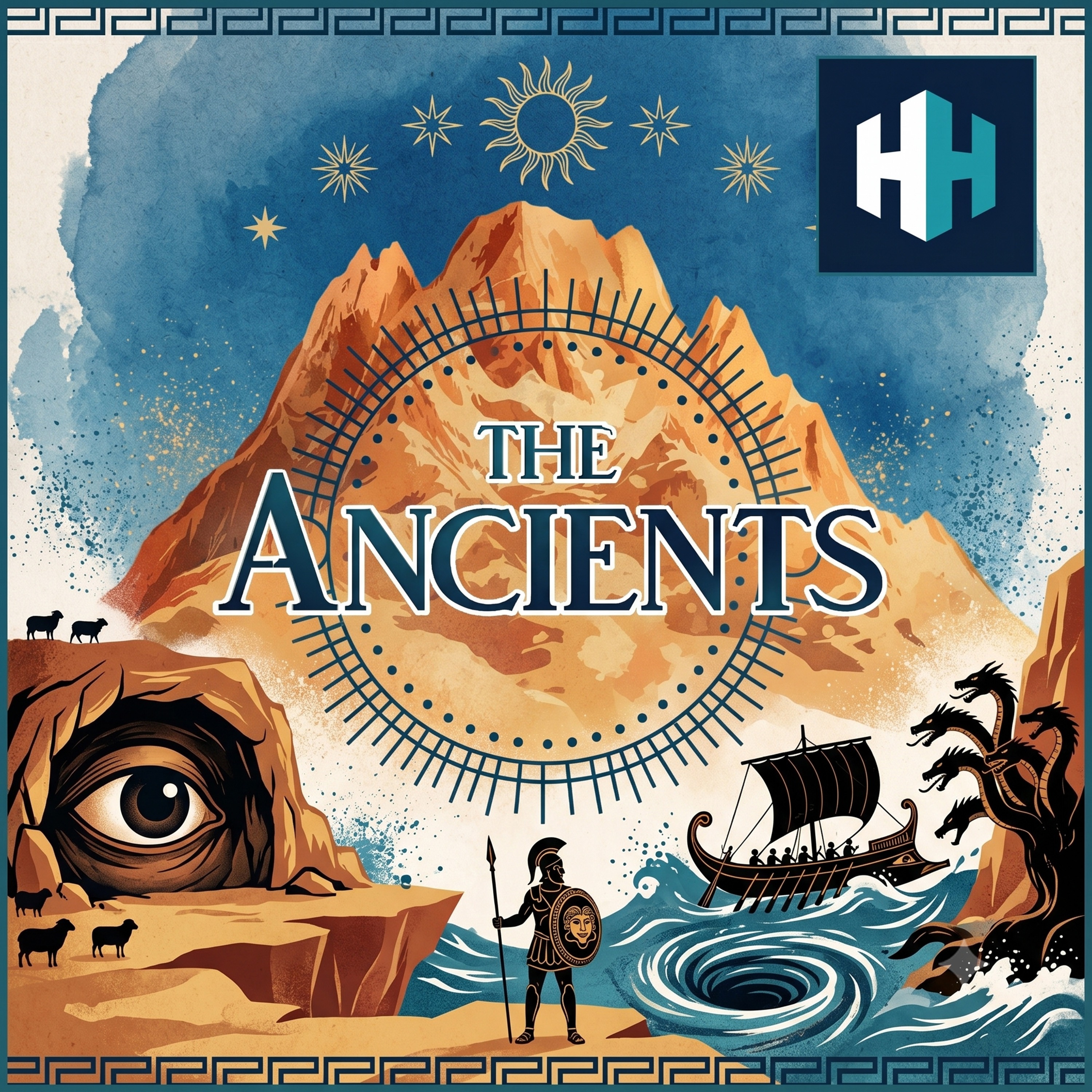
Christopher Nolan’s blockbuster film Odyssey brings Homer’s epic roaring back to life and Tristan Hughes and Dr. Emily Hauser are here to unpack every storm, monster and star-making turn. From the brilliance of the adaptation to the ancient story beneath it, Tristan and Emily bring their expert historical knowledge to challenge what Nolan keeps, what he changes, and why Odysseus still captivates u

The First New Zealanders
What if the first New Zealanders crossed an ocean, landed in a brand-new world, and built a whole society in just a few generations?Tristan Hughes and Dr Richard Walter tell the story of East Polynesian voyagers who reached Aotearoa around the late 1200s, bringing canoes, knowledge, and ambition from Hawaiki to a vast, forested island world.From the moa-rich site of Wairau Bar to archeological evi
Odyssey | Sea of Monsters & Slaughter of the Suitors
When Odysseus finally returns to Ithaca, his homecoming turns into a ruthless reckoning. Tristan Hughes and Dr. Emily Hauser dive into the shocking climax of Homer’s Odyssey, where hospitality, vengeance and survival collide in a blood-soaked finale.What drives Odysseus to unleash such fury, and what does the massacre reveal about power, justice and ancient heroism?We're going on *TOUR* to Austral
Caral: Oldest City in the Americas?
Long before the age of the Inca and Maya, a remarkable city once flourished on the coast of modern Peru. Founded more than five thousand years ago, the sacred city of Caral is home to monumental pyramids, lavish temples and one of the world's earliest urban societies.Tristan Hughes is joined by Jason Nesbitt to uncover the story of this remarkable Mesoamerican settlement. How did this ancient city
Odyssey | Cyclops, Circe and Calypso
What if the world’s most famous homecoming was really a nightmare of monsters, gods, and one very stubborn king trying to get back to Ithaca?In our new series Tristan Hughes and classicist Dr. Emily Hauser dive into Homer’s Odyssey, an epic of shipwrecks, sorcery, giants and divine meddling, where Odysseus is never quite sure whether the next shore will save him or destroy him.They trace his journ
Egypt's Book of the Dead
For over a thousand years, the Book of the Dead guided ancient Egyptians through the afterlife. Filled with powerful spells these remarkable texts were designed to help the dead overcome the dangers of the underworld and reach eternal life in the company of Osiris, God of the Dead.Today, Tristan Hughes is joined by Yekaterina Barbash to explore the fascinating history of the Book of the Dead. Why
The Trojan War
The story of Achilles, Odysseus and the siege of Troy has captivated audiences for millennia, but behind the legends lies a deeper mystery. Was this epic war a myth, a memory of a real Bronze Age conflict, or something in between?Today Tristan Hughes is joined by Eric Cline to explore the reality behind Homer’s greatest tale. From the legendary heroes of The Iliad to the ruins of Troy, discover wh
The Flood Myth
Thousands of years before the story of Noah and the Ark, people in ancient Mesopotamia were already telling tales of a devastating divine flood. Written into the Epic of Atrahasis, this ancient story describes a man chosen to survive catastrophe by building a great boat and preserving life from destruction.Today, Tristan Hughes is joined by Sophus Helle to explore this legend from ancient Babyloni

Delphi: Centre of the Ancient World
For more than a thousand years, Delphi was considered a cultural centre of the ancient world. Every year a throng of pilgrims climbed the slopes of Mount Parnassus to seek the words of Apollo through the famous Oracle of Delphi.Today Tristan Hughes is joined by Michael Scott to uncover Delphi's story, the sanctuary that shaped the ancient Mediterranean. How did the Pythia become the most famous or
Stonehenge with Ken Follett
What if the secrets of Stonehenge lie not just in the stones, but in the people who hauled them there?Tristan Hughes sits down with best-selling novelist Ken Follett to uncover and imagine the lives of the Stone Age builders, the rival communities around Salisbury Plain, and the extraordinary teamwork needed to raise one of the most famous monuments in the world.They reveal fascinating details abo
The Library of Alexandria
The Library of Alexandria was one of the most important and most celebrated buildings of the ancient Mediterranean. It was a great hub of learning and literature and made Alexandria one of the ancient world’s foremost centres of knowledge and culture. But when was it built? And where did all the books come from?Tristan Hughes speaks to Dr. Islam Issa about the story behind one of histories greates
Boudica and the Iceni
In 60 AD Roman Britain was very nearly brought to the brink. Cities burned, authority crumbled, and for a brief moment one woman challenged the might of the Roman Empire. Her name was Boudica.Today, Tristan Hughes is joined by novelist and historian Elodie Harper to explore the life and legend of Boudica, the Iceni queen responsible for such rebellious devastation. They discuss the brutal events t
The Cambrian Explosion: When Life Began?
538 million years ago, life on Earth changed forever. In an evolutionary burst known as the Cambrian Explosion, complex animals rapidly appeared in the oceans, laying the foundations for almost every major animal group alive today.Tristan Hughes is joined by the mighty Henry Gee to explore biology’s 'Big Bang'. What triggered this extraordinary leap in evolutionary complexity? Why did creatures wi
The Pharisees
The Pharisees are one of the most familiar names in the ancient world, but are they also one of the most misunderstood?Tristan Hughes is joined by Dr Helen Bond to step back into first-century Judea, where the Pharisees were debating law, purity and resurrection under foreign rule. They look at how much power the Pharisees really had, their debates with Jesus in the Gospels, and how focussed they
The Rosetta Stone
In July 1799, French soldiers unearthed a stone that would transform our understanding of the ancient world. Discovered in a fort at Rashid, the Rosetta Stone became the key to deciphering Egypt’s long-lost hieroglyphs. Within two decades, scholars began unlocking its secrets. But what does it actually say? Tristan speaks with Dr Ilona Regulski to explore the stone, the script, and the race to dec
Neanderthal Art
Fifty thousand years ago, Neanderthal artists in Ice Age Europe painted symbols and handprints deep inside caves, leaving behind some of the oldest known art on the continent. These discoveries are transforming how we understand our closest human relatives.Today, Tristan Hughes is joined by Genevieve von Petzinger to explore the fascinating story of Neanderthal art. What kinds of images did Neande
Spartacus
In 73 BC, a gladiator escaped slavery and launched a rebellion that shook the Roman Republic to its core. His name was Spartacus, and his uprising became one of the greatest threats Rome had ever faced from within.Tristan Hughes is joined by Ben Kane to explore the dramatic story of Spartacus and his slave revolt that swept across Italy. Together, they cover the breakout at Capua to the battles ag
The Fall of Hadrian's Wall
When the Romans left Britain in the early 5th century AD, Hadrian’s Wall did not simply collapse into ruin. Its forts and ramparts endured, becoming strongholds for the communities who continued to live along this ancient frontier.Tristan Hughes is joined by Professor Rob Collins to explore the fascinating story of Hadrian’s Wall after the end of Roman rule. Who were the people who remained on the
Iron Age Britain
What if Iron Age Britain was never a land of barbarians at all, but a world of skilled farmers, powerful women, trade, ritual, and spectacle? Tristan Hughes is joined by Professor Tom Moore to reveal a far richer pre-Roman Britain, from roundhouses and hillforts to chariots, feasts, and buried offerings. Archaeology uncovers a society shaped by movement, identity, violence, and belief, where the I
Prehistoric Greenland
What can a frozen island reveal about the people who thrived there for thousands of years? Tristan Hughes is joined by Dr. Asta Mønsted to explore prehistoric Greenland through astonishing archaeology and living mythology, from permafrost-preserved homes, tools, and clothing to whale hunts, shamanic stories, and the world of the Thule Inuit. Along the way, they uncover how families survived the Ar
The Other Humans: Why We Survived?
For most of human history, we were not alone. Human evolution was shaped by multiple human species living side by side, from Neanderthals in Europe to Denisovans in Asia, before all but one disappeared.Tristan Hughes is joined by Ella Al-Shamahi to explore the story of the early humans who once shared our world. How did these different species evolve? Did they compete or coexist? And what do the l
What If Alexander Fought Rome?
Rome vs Alexander. It's a counterfactual of suitably epic proportions, fit for movie theatres and sprawling strategy video games. What would've happen had the great Macedonian general not perished in Babylon and advanced on an emerging Roman Republic?Tristan Hughes is joined by Roman historian and friend of the show Steele Brand to ask - what would’ve happened had Alexander invaded Italy? They exp
The Real Armageddon
Armageddon is more than just a biblical prophecy hailing the end of days. It is a real place: Megiddo, an ancient city that for thousands of years stood at the crossroads of empires, trade routes and wars in the ancient Near East.In this episode of The Ancients, Tristan Hughes is joined by friend of the show Eric Cline to uncover the true story of the real Armageddon. Why did Megiddo become associ
Ancient China: The Warring States
How did ancient China plunge into 261 years of chaos, and how did that turmoil forge an empire?Tristan Hughes is joined by Professor Andrew Seth Meyer to explore the Warring States period, from collapsing Zhou power and ruthless coups to mass armies, crossbows, and battlefield slaughter. They trace the rise of Confucian ideas, the seven great states, and the brutal climb of Qin toward China’s firs
The Prehistoric Plague
The first ever outbreak of 'plague' - Yersinia Pestis, the most feared disease in human history - was long thought to be the Plague of Justinian in 541 AD. But new studies of ancient DNA have revealed traces of Yesinia Pestis dating back more than 5,000 years. In this episode of The Ancients, Tristan Hughes is joined by Laura Spinney to explore the origins of prehistoric plague. How did
The Persian Gulf
Near the Strait of Hormuz, one of the world’s most vital commercial chokepoints, lies an ancient trade route that powered civilisation 4,000 years ago: the Persian Gulf - where goods and ideas flowed between the great cities of Mesopotamia, Arabia and beyond to the far flung cities of the Indus Valley and the Indian subcontinent.In this episode of The Ancients, Tristan Hughes is joined by Dr Steff
The Last Days of Pompeii
In 79 AD, life in Pompeii unfolded beneath the shadow of a tremoring Mount Vesuvius. Streets bustled, businesses thrived, and merchants built fortunes, unaware disaster was hours away. But what happened when that disaster struck? How did these ordinary Roman citizens seek to survive last days of Pompeii?In today's episode of The Ancients, Tristan Hughes is joined by Dr. Jessica Venner to uncover t
The First Tools
What if the first technology was just a stone?Tristan Hughes and Dr. Emma Finestone, - Curator and the Robert J. and Linnet E. Fritz Endowed Chair of Humans Origins at Cleveland Museum of Natural History - travel back over 3 million years to Africa, where early hominins began shaping stone tools that transformed survival, diet, and behaviour. From the earliest finds to the widespread tool making i
Athens vs Persia: The Legend of Themistocles
A legend of the great Greek city of Athens, Themistocles rose from obscurity to save ancient Greece and helped shape one of the greatest naval powers in history. Yet his story ends in exile, condemned as a traitor and serving the very empire he once defeated: Persia.In this episode of The Ancients, Tristan Hughes is joined by Michael Scott to explore the extraordinary life of Themistocles. Togethe
The Hittites
What made the Hittites one of the great Bronze Age powers, and how did their empire survive on war, diplomacy and faith? Tristan Hughes is joined by Professor Elena Devecchi to uncover ancient royal intrigue, lavish festivals, the 'Thousand God', and the world’s oldest known peace treaty. From Hattusha’s immense lion gates to secret archives and sacking Babylon, it’s a dramatic deep dive into an e
Homo Sapiens vs Neanderthals
Tristan Hughes is joined by Ella Al-Shamahi, paleoanthropologist and presenter of the hit BBC series Human, to explore what interactions between early Homo sapiens and Neanderthals may have been like, from communication and cultural exchange to interbreeding and the possibility of hybrid children navigating belonging. They discuss how new research is challenging “primitive” stereotypes to reveal h

The Romans and China
How did Roman silver travel from Egypt to China across monsoon seas, pirate waters, and bustling ports? Tristan Hughes is joined by legendary archaeologist Sir Barry Cunliffe for a dramatic journey through the Indian Ocean, where Roman glass, pepper, and silk linked two ancient superpowers. From Sri Lanka to the Malacca Strait, they reveal a dazzling world of traders, middlemen and maritime advent
Judas Iscariot
**Warning: This episode contains graphic descriptions of violence, including suicide**What really happened to Judas Iscariot? From shifting accounts in the Gospels to the 30 pieces of silver, Tristan Hughes is joined by Professor Paul Middleton to trace the stories that made Judas Christianity’s most infamous villain.Along the way, they explore the kiss in the Garden of Gethsemane, the conflicting
Britain's First Dog
Fifteen thousand years ago, as the Ice Age loosened its grip on Northern Europe, humans returned to the previously inhospitable British Isles. But they did not come alone. Among their number was a companion once thought to be an impossibility: Britain's earliest known dog.In this episode of The Ancients, Tristan Hughes Dr. Selina Brace and Dr. William Marsh from the Natural History Museum to explo
The Roman Centurion
What did it take to become a Roman centurion? To command, to punish and to lead from the very front of Rome’s armies?In this episode of The Ancients, Tristan Hughes is joined by Dr Ben Kane to uncover the reality behind one of the most iconic ranks of the ancient world. From the brutal discipline of life on campaign to the prestige and pressure of command, discover how centurions became the backbo
The Delian League: Ancient NATO?
What happens when a defensive alliance slowly turns into an empire? Tristan Hughes and Professor Polly Low explore the Delian League, the so‑called “ancient NATO”, from its Persian War origins to Athenian domination. Discover tribute, revolt, contested sources and how a league of allies became Athens’ hard-edged maritime empire.MOREThe Persian Wars: Xerxes, Thermopylae and SalamisListen on AppleLi

Leonidas: King of Sparta, Hero of Thermopylae
In 480 BC, at the narrow pass of Thermopylae, a vastly outnumbered Greek force prepares to face the advancing army of the Persian king Xerxes. At its head stands Leonidas, king of Sparta, ready to make a final stand that will become one of the most famous moments in ancient history.In this episode of The Ancients, Tristan Hughes is joined by Dr Andrew Bayliss to peel back the myth and uncover the
What if the Ides of March Failed?
What if Julius Caesar had survived the Ides of March? This episode explores his last known plans — vast eastern campaigns, sweeping reforms, and his visions for Rome’s future. Could he have rivalled Alexander the Great, crowned himself king, or reshaped the Republic forever? Discover history’s greatest “what if.”MOREThe Rise of Julius CaesarListen on AppleListen on SpotifyCleopatraListen on AppleL
Herodotus: The Father of History
What drove Herodotus to write the first great story of history? Tristan Hughes speaks with Dr. Roel Konijnendijk to uncover the world of Herodotus of Halicarnassus - the traveler, investigator, and storyteller behind The Histories.From Persian kings to Greek heroes, they explore his methods, digressions, and the quest to explain why empires rose, wars raged, and memory became history.MOREHomerList
The Phoenicians
Three thousand years ago, Phoenician ships sailed west across the Mediterranean, their holds packed with pottery, wine and enslaved people to trade. Passing beyond the fabled Pillars of Heracles, they were pushing at the familiar limits of the ancient world.In this episode of The Ancients, Tristan Hughes is joined by Professor Josephine Quinn, to explore the story of the Phoenicians. From the bust
Bronze Age Star Map: The Nebra Sky Disk
In 1999, a mysterious bronze disc buried for millennia in central Europe transformed how we see the prehistoric world. The Nebra Sky Disk - forged 3,600 years ago - is the oldest known depiction of the night sky.In this episode of The Ancients, Tristan Hughes is joined, once again, by archaeologist Raven Todd DaSilva to uncover the remarkable story of this Bronze Age star map. Discovered in German
The Age of Dinosaurs with Henry Gee
Before Tyrannosaurus and Triceratops, Earth was rebuilding from catastrophe. Out of the ashes of the Great Dying rose a new prehistoric world and with it came the age of the dinosaurs.In this episode of The Ancients, Tristan Hughes is joined by Dr Henry Gee to explore the full sweep of dinosaur history, from their emergence on the supercontinent Pangaea to their 150-million-year dominance of the p
Ramesses the Great: Death of a Dynasty
“Look on my works, ye mighty, and despair.” Ramesses II reigned as Egypt's unchallenged champion for more than sixty years. But within decades the dynasty of Egypt’s greatest pharaoh had fallen apart. Tristan Hughes is joined by Dr Campbell Price to chart how the reign of Ramesses the Great descended into slow collapse. From monumental building projects that once proclaimed eternal power to t
Alexander the Great | Lord of Asia
As friendships fracture and old alliances break, Tristan Hughes and Dr Adrian Goldsworthy chronicle the epic downfall of Alexander the Great. Alexander’s relentless campaigns from Bactria to Babylon push his empire, army and inner circle to breaking point, hear the battles, betrayals and decisions that hastened a legendary conqueror’s tragic end.MOREThe Romans and India with William DalrympleListe
The House of Ramesses II: Egypt's Greatest Pharaoh?
The name of Ramesses the Great is etched deeper into Egypt than almost any other ruler. Colossal statues moulded in his image tower over the Nile. Reliefs of his victories are carved into countless temple walls. But were did Ramesses II come from? And how was this legend of Egyptian history born?In this episode of The Ancients, Tristan Hughes is joined by Dr Campbell Price to uncover the rise of t
The Fall of Persia | Alexander the Great
Tristan Hughes and Dr Adrian Goldsworthy continue the special series on Alexander the Great, delving into the epic sieges of Tyre and Gaza in 332 BC, and Alexander's triumphant campaign through Egypt. They explore the strategic brilliance at the Battle of Gaugamela, the fall of Persepolis, and the eventual demise of Darius III. As Alexander's army pushes further east, tackling internal conspiracie
The Skulls of Jericho
In the depths of ancient Jericho, beneath layers of earth dating back 10,000 years, archaeologists uncovered something extraordinary: human skulls cast in plaster, their faces carefully reconstructed and their eyes set with shells. Who were these haunting figures meant to represent?In this episode of The Ancients, Tristan Hughes is joined by archaeologist Raven Todd DaSilva to explore the mysterio
The Invasion of Persia | Alexander the Great
In spring 334 BC, a young Macedonian king sets out to conquer the Persian Empire.Tristan Hughes and Dr Adrian Goldsworthy explore Alexander the Great’s early campaigns, from the daring crossing into Asia to incredible victories. They discuss Alexander's strategic genius, respect toward Persian royalty, and how these triumphs forged his path to legend.MOREThe PersiansListen on AppleKing MidasListen
How to Write Cuneiform with Dr. Irving Finkel
More than 5,000 years ago, a revolutionary script emerged in the fertile lands of Mesopotamia that would transform how people counted, governed, worshipped and told stories. This was cuneiform, the world’s earliest known writing system.In this episode of The Ancients, Tristan Hughes is joined by Dr Irving Finkel to uncover how cuneiform actually worked and how you would write it yourself. From hum