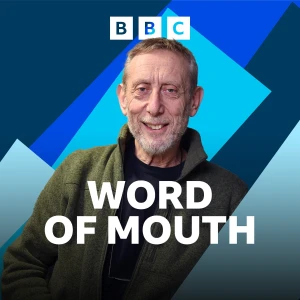
Word of Mouth
Word of Mouth is a series that explores the world of words and the ways in which we use them. It delves into language, communication, and the quirks of English. The podcast is produced by BBC Radio 4.
Episodes
Where Did Punctuation Come From?
Ever wondered where all our squiggles and dots of modern punctuation come from? Author of On The Mark Florence Hazrat gives us a witty and fascinating insight into how punctuation began and has evolved through the centuries, continuing to adapt and change as our methods of writing and communicating become increasingly short and pithy as we do so much online. Produced in partnership with the Open U
Bouncer George Bass on de-escalating conflict
Michael Rosen talks to security guard George Bass, the author of What The Bouncer Saw: Life on the Front Line of the Security Business. George says words and tone are his riot shield. He shares what he's learned about how to talk and joke people down from anti-social behaviour and also how to communicate in code on the radio.Produced for BBC Audio Bristol by Beth O'Dea, in partnership with the Ope
Voices of Manchester
Rob Drummond, Professor of Sociolinguistics at Manchester Metropolitan University, talks to Michael about the ways people talk in Greater Manchester. They discuss which areas are seen as more 'Lancashire' or more 'Manc' in their speech, and what is known as the 'happy vowel.' Plus they dissect the accents of celebrities such as the Gallagher Brothers, Gary Neville and Sara Cox.Rob's project can b
Bias against women's voices
Jane Setter talks to Michael Rosen about negative attitudes to vocal traits seen as exclusively female, from vocal fry to higher pitch. Can men really not talk in a sexy voice? And why did Margaret Thatcher change hers?Produced for BBC Audio Bristol by Sally Heaven, in partnership with the Open University
How the Normans changed the way we speak
Radio 4 is marking the arrival of the Bayeux Tapestry in Britain with a special day of programmes reassessing the Norman Conquest and its meaning for us today.In Word of Mouth, Michael Rosen explores the impact of the Norman invasion on the English language. He asks Dr Philip Durkin about the huge influence of Anglo-Norman, the dialect of French that was used in Britain after the Conquest for abou
Gaelic
Michael Rosen is in conversation with Gaelic language expert Roddy Maclean about the status of Gaelic in Scotland. Roddy explains its origins as one of the Indo-European languages, a Celtic language we characterise by sound differences. One group is called P-Celtic, the other is called Q-Celtic, and Gaelic's in the Q-Celtic group. Traditionally Gaelic has been spoken in The Highlands - the Gàidhea
Fairy Tales
Michael Rosen talks to anthropologist Jamie Tehrani about how fairy tales travel the world, ever changing and evolving. He’s traced their transmission across oral traditions: the kinds of plots, characters and motifs that endure. From the Iranian Prince Zāl to Little Red Riding Hood's compelling Chinese cousin: The Tiger Grandmother.
Jamie Tehrani is Professor in the Department of Anthropology at
Smell
Michael Rosen on the words used to describe the qualities of smells in different languages. Asifa Majid is Professor of Cognitive Science at Oxford and her research has found that some do it much better than others. She puts Michael to the test to see how English stacks up.
Produced for BBC Audio Bristol by Beth O'Dea, in partnership with the Open University
Subscribe to the Word of Mouth podcast
How did people speak throughout history?
Michael Rosen meets popular YouTuber Simon Roper, who tries to recreate how people spoke in the past.
Produced for BBC Audio Bristol by Sally Heaven, in partnership with the Open University.
Subscribe to the Word of Mouth podcast and never miss an episode: https://www.bbc.co.uk/sounds/brand/b006qtnz
Words to Love the Living World
The words that we use to label or describe things in nature – words for landscapes, creatures, seasons, the weather – can they help awaken us to the world around us? Drawing on languages from all over the world, Michael Rosen hears about Words to Love a Planet: An Illustrated Dictionary of Language, Landscape and Life from author Ella Frances Sanders. Produced for BBC Audio Bristol, in partnership
The World of Words: editing, typography and print
Michael Rosen finds out about fascinating literary errors from editor Rebecca Lee, the author of Rogues, Widows and Orphans: Mischief and Misadventures in the World of Books. They share favourite famous typos and find out where the phrase "out of sorts" originated.Produced for BBC Audio Bristol by Beth O'Dea, in partnership with the Open University.
Subscribe to the Word of Mouth podcast and never
Oracy: We Need to Talk
Oracy, alongside literacy and numeracy, is being encouraged in schools. Amy Gaunt, from the charity Voice 21, explains to Michael Rosen how children are learning to talk, and through talk. How does talking about a subject help children learn about it? And how does an oracy rich classroom help the less able as well as the more confident?
We also hear from Tia, who went to a school that works with V
Michael Rosen and Dara Ó Briain talk about time
On his 80th birthday, Michael Rosen discusses with Dara Ó Briain how we talk about and understand time, and how we look back on the different chapters of our lives.
To hear the full conversation, download the podcast.
Produced for BBC Audio Bristol by Beth O'Dea, in partnership with the Open University.
Subscribe to the Word of Mouth podcast and never miss an episode: https://www.bbc.co.uk/sounds/
Language Extinction
Michael Rosen talks to Sophia Smith Galer about the languages we're losing. She's found that by the end of this century half of the world’s 7000 languages will be gone, and she's travelled across the world to meet both the people who are experiencing this and those who are fighting to keep the words and the knowledge they hold alive.
Sophia Smith Galer is the author of How to Kill a Language: Powe
Tourette Syndrome
Michael Rosen talks to Ione Georgakis from Tourette Action about about her personal and professional experience of Tourette Syndrome and vocal tics. How and why do tics happen, and what are some of the myths and misunderstandings around the syndrome?Produced for BBC Audio Bristol by Sally Heaven, in partnership with the Open University.
Subscribe to the Word of Mouth podcast and never miss an epis
Vincentian Creole
Michael Rosen talks to linguist Teddy Mack about Vincy, a language rooted in English spoken on the Caribbean island of St Vincent, alongside standard English. But the English Teddy encountered when he moved to the UK proved to be very different (and far from standardised) and he's learned to switch throughout his life.
Produced for BBC Audio Bristol by Beth O'Dea, in partnership with the Open Univ
Aphorisms: Sayings to Live By
Michael Rosen talks to James Geary about his lifetime obsession, aphorisms. These short, witty philosophical sayings have been coined by everyone from Emily Dickinson and James Baldwin to Hallmark, and even Michael's mum.Produced for BBC Audio Bristol by Sally Heaven, in partnership with the Open University.
Subscribe to the Word of Mouth podcast and never miss an episode: https://www.bbc.co.uk/so
Can AI be our friend?
Michael Rosen talks to digital anthropologist Jennifer Cearns about the rise of AI companions- how do we talk to AI, and how does AI talk to us?
They discuss how chatbots work, whether Michael is replaceable, different application for AI, including romantic partners and griefbots, and what happens when an AI companion goes wrong.Produced for BBC Audio Bristol by Sally Heaven, in partnership with
Scouse
As a port city Liverpool has long been open to a wide variety of global influences and languages that developed into a way of speaking that's termed 'Scouse' - from a word that probably originates in the Baltic region derived from the word 'lobscouse'.
Tony Crowley grew up in the heart of Liverpool. When he left home and went to Oxford University he became increasingly aware of his accent and his
The Story of A-Z
Michael Rosen goes on an alphabetical odyssey with linguist Dr Danny Bate, author of the book 'Why Q needs U: A History of Our Letters and how We Use Them'. From A through to Z, where did all our letters come from, and how have they changed over time? Produced in partnership with the Open University by Becky Ripley.
Julia Donaldson: A life in language
Julia Donaldson, author of The Gruffalo and many other beloved children's books, tells Michael Rosen about her own writing, reading, speaking and listening. Her childhood experiences were a big influence, as was busking in Paris and writing songs which ended up on Play School and Play Away. One of the songs became her first book, A Squash and a Squeeze.
They also talk about Julia's new book, Paper
It's not what you say, it's how you say it
Michael Rosen on the linguistic comfort food of clichés, pragmatics and how we use language to connect us beyond the actual words used. Derek Bousfield explains how words do more than carry meaning: context governs what we say and how it’s understood.
Dr Bousfield is Reader in Pragmatics and Communication and Co-Director of The Manchester Centre for Research in Linguistics and co-author of Talking
The Language of the Manosphere
The 'Manosphere' is a group of loosely affiliated mainly young males who have developed a specialised vocabulary to discuss women online in a negative and hostile way. Some of the vocabulary is a response to feminism which some men claim is diminishing their role in society. For other men a failure to attract women has given rise to phrases such as Chad and Stacey and a belief in the 80/20 theor
Crash Bang Wallop: The Sound of Words
Michael Rosen is joined by linguist Dr Catherine Laing to discuss onomatopoeia and other words that sound like their meanings. Not just words for sounds like 'crash' and 'bang', or words for animal noises like 'woof' and 'quack', but also other words which perhaps hold something of their meaning within their form. Is there something rough about the word 'rough'? Does 'smooth' feel smooth? And how
How to Persuade a Courtroom
Michael Rosen talks to criminal defence barrister Joanna Hardy-Susskind about the legal language of Crown Court cases in England and Wales. From the grandeur of the courtroom and stock phrases like "with respect to my learned friend" to the more colloquial directness of talking to a defendant. How do barristers build persuasive arguments when talking to a jury, or when discussing legal matters wit
Keeping My Family's Language Alive
Michael Rosen talks to Samantha Ellis, author of Chopping Onions on My Heart, about her efforts to keep alive the language of her parents: Judeo-Iraqi Arabic. Samantha grew up in London hearing her parents speak the language they spoke in their homeland of Iraq. Now she's keen to try and speak it herself, and to share the poetic expressions of Judeo-Iraqi Arabic with her son.Produced for BBC Audio
Speech difficulties
Michael Rosen asks what happens to people's sense of identity and social being when speaking becomes hard. Jonathan Cole has interviewed people with conditions such as cerebral palsy, vocal cord palsy, spasmodic dysphonia and post-stroke aphasia. They describe in their own words what the experience of not being able to express themselves is like, the frustration and isolation as well as the adapta
The Art of Listening
Michael Rosen talks to sociolinguist Dr Haru Yamada about how we listen in different ways across different cultures and social groups. It's the side of conversation that is not about talking, but which is equally - if not more - important to how we communicate. Haru is the author of 'Kiku: The Japonese Art of Good Listening', and she believes that listening is something we can all learn to do bett
Lists
Most of us make lists in some form or other - from essential groceries to reasons to feel positive about life. In this programme Linguistics Researcher Jo Nolan talks to Michael about her interest in the language we use in their making and their uses in literature and society.
Jo says the language we use in our lists is idiolectal - it reflects our inner selves, whether in our abbreviations, our
The Welsh Language with Huw Stephens at the Hay Festival
In a special recording at the Hay Festival, Michael Rosen talks to bilingual Welsh radio and television presenter Huw Stephens about the Welsh language. And then Huw gets Michael to try reading 'Dyn Ni yn Mynd i Hela Arth, also known as We're Going on a Bear Hunt.
Produced for BBC Audio Bristol by Beth O'Dea, in partnership with the Open University.
Subscribe to the Word of Mouth podcast and never
The language that changed the world
Michael Rosen hears the fascinating story of the origin of all Indo-European languages from Laura Spinney, the author of Proto: How One Ancient Language Went Global. Today, nearly half of humanity speaks an Indo-European language and Laura has been investigating how that came to be.
Produced for BBC Audio Bristol by Beth O'Dea, in partnership with the Open University.
Subscribe to the Word of Mout
The End of the Full Stop?
The use of punctuation is rapidly changing within the quickfire back-and-forth of instant messaging. Are these changes causing misunderstandings? Presenter Michael Rosen and his guest Dr Christian Ilbury discuss. Is the full stop on the way out? What about capital letters? Exclamation marks and question marks seem to be holding their ground, but what about the rest? Produced for BBC Audio Bristol
Street Names
Michael Rosen talks to sociolinguist Philip Seargeant from the Open University about where our street names come from, including Whip-Ma-Whop-Ma-Gate in York, and Michael's old address, Love Lane. Also, have you ever thought about the difference between a street and a road? Are there regional differences in the names given to streets? And why are street names sometimes changed?Producer: Sally Heav
Old English, New English
Michael Rosen explores the evocative Old English words used in daily life a thousand years ago, many of which are still in use now. He's joined by the linguist author of The Wordhord, Hana Videen. Hana has been hoarding words from Old English (450 AD to 1150 AD) for a decade, when she began tweeting one a day. Now she has lots of people following her to find out more about the language, and a new
Talking Cockney
Michael Rosen's parents both grew up in the East End, and now he talks cockney with Andy Green and Saif Osmani from the Modern Cockney Festival. Including some mythbusting about rhyming slang, a discussion about how cockney has evolved, and of course a mention of Dick van Dyke. The Modern Cockney Festival takes place from March 1st to 31st with a month-long programme of online and offline activiti
Creating Languages for Film and Television with Professor David Adger
David Adger is Professor of Linguistics at Queen Mary University of London. He's created new languages for TV series and films and he explains to Michael Rosen how he goes about it. For his latest language he used existing Creole languages for his 'conlang', or constructed (artificial) natural language. He talks Michael through the grammar and language principles he applies to his creations and
Politeness with Louise Mullany
Professor Louise Mullany talks to Michael Rosen about politeness, and how it governs our lives, from the behaviour of football managers to the different ways children can embarrass us. Why, in this country at least, is it so mortifying to mistakenly assume someone is pregnant, when in other cultures it's simply thoughtful to book two seats on a plane for a larger person. Starring Michael Rosen as
Jackie Kay on the Scots language
Poet Jackie Kay has written a book in Scots: Coorie Doon: A Scottish Lullaby Story. She joins presenter Michael Rosen to talk about her love of the language and what it meant to her growing up.
Produced for BBC Audio Bristol by Beth O'Dea.
Subscribe to the Word of Mouth podcast and never miss an episode: https://www.bbc.co.uk/sounds/brand/b006qtnz
The Language of Genetics
Adam Rutherford joins Michael Rosen to make sense of the heavily-loaded and often unscientific language that we use to talk about genetics, inheritance, ancestry and race. Adam is a geneticist, science writer, and lecturer in Biology and Society at University College London. His work tries to make sense of what our genes do (or don't) tell us about our similarities and our differences. He writes a
Susie Dent's World of Words
Susie Dent joins Michael Rosen to talk about her lifelong fascination with words and their origins. It's a programme bringing some apricity, which is one of Susie's favourite words. Her love of language began when she was a child, then found expression in her passion for French and German and now in her work as a lexicographer, writer and language broadcaster.Produced for BBC Audio Bristol by Beth
Social media language
Michael talks to linguist Dr Andreea Calude about her research into how language is used on Facebook, TikTok, YouTube, LinkedIn and Twitter/X. And he asks if we're witnessing the death of email.Dr Andreea Calude is the author of The Linguistics of Social Media: An Introduction.Produced for BBC Audio Bristol by Beth O'Dea.
Subscribe to the Word of Mouth podcast and never miss an episode: https://ww
How Animals Talk
Michael hears from zoologist Arik Kershenbaum about the latest research on how and why different types of animals communicate, from wolves howling to dolphins whistling: a world of soundscapes. He also explains how animal communication can help to shed light on the human variety.Dr. Arik Kershenbaum is a zoologist and the author of: Why Animals Talk: The New Science of Animal Communication. Produc
A Poet Writing in Three Languages
How best to write about love and other things. Nabeela Ahmed talks about writing in a second language and how her early life in Kashmir shaped the language she uses to express different aspects of her life. She is also a champion for the Pahari language in her home city of Bradford. Pahari is a language spoken by people in Northern areas of India, Kashmir and Pakistant. It fell out of favour as
Fine Distinctions
Eli Burnstein talks about fine distinctions between words, including Michael's personal bugbear of forewords, prefaces and introductions, some clarity on clementines, satsumas, tangerines and mandarins, and of course the lunch, dinner and tea debate.Produced for BBC Audio Bristol by Sally Heaven.
Subscribe to the Word of Mouth podcast and never miss an episode: https://www.bbc.co.uk/sounds/brand/b
Former astronaut Col. Chris Hadfield on the language of Space exploration
Colonel Chris Hadfield is a veteran of three spaceflights. He crewed the US space shuttle twice, piloted the Russian Soyuz, helped build space station Mir and served as Commander of the International Space Station.
Getting words and language right in as clear and a concise way is a matter of life and death for astronauts. Crews are traditionally made up of different nationalities and Russian is
The words we use about getting older and why they matter
How we talk about getting older can affect how we age, both mentally and physically. Michael asks Dr Lucy Pollock for her advice on ageing well and happily.Dr Lucy Pollock has been an NHS consultant geriatrician, a doctor specialising in the care of older people, for over 30 years. She is the author of The Book About Getting Older, and her new book is The Golden Rule: lessons in living from a doct
How babies learn language
Recently a video went viral of a baby talking - or babbling - with a Liverpool accent. Professor Julian Pine from Liverpool University explains how babies and young children learn language, including the rules we take for granted. Including the surprising reasons who children make mistakes like saying "nana" instead of banana, or "I play football yesterday" instead of "I played football yesterday.
Little Green Men: the secret rules of word order
Michael explores the mysterious rules of word order with linguist Dr Laura Bailey. We all know them instinctively, without knowing that we know them. Contains the truth about killer whales and also why Yoda sounds like an alien.Produced for BBC Audio Bristol by Beth O'Dea.
Word of Mouth with Michael Morpurgo at the Hay Festival
Michael meets fellow children's author Michael Morpurgo - author of over 150 books - including Kensuke's Kingdom, Private Peaceful and Warhorse. They talk words, writing, books and language and why it's so important that children learn to love reading at an early age.Producer: Maggie Ayre
Language When There Are No Words
Joshua Reno talks about how Charlie, his non-verbal son who is on the autism spectrum, communicates with him very effectively using gestures known as "home signs". Joshua is the author of Home Signs: An Ethnography of Life beyond and beside Language.Produced for BBC Audio Bristol by Sally Heaven
The Irish Language
In conversation with Michael about his book "32 Words For Field" Manchán Magan reveals Ireland's deep connection with the landscape expressed through the Irish language. The author traces his country's relationship with the natural world and its corresponding belief system that encompasses the 'otherworld'. He lists many similarities between Irish and Sanskrit and even Arabic - suggesting a lin
Disaster Dialogue
Professor Lucy Easthope explains why language is important in the aftermath of a disaster, why some words are useful and some can be damaging.Produced for BBC Audio Bristol by Sally Heaven
Football Club Names
Dominic Fifield explains how football clubs got their names, uncovering a fascinating social history behind the Wanderers, Wednesdays and Villas.Produced for BBC Audio Bristol by Sally Heaven
How to Think Like an Anthropologist, with Gillian Tett
"If you want to hide something in the 21st century world, you don't need to create a James Bond style plot. Just cover it in acronyms". Gillian Tett is a columnist at the Financial Times, but she initially trained as a cultural anthropologist, studying marriage rituals in Tajikistan. She joins Michael Rosen to discuss how the study of language has been vital to her work, who continues to see the
Family Sayings
Michael shares listeners' stories about the words and phrases passed down in their families that they keep using, and what they mean to them. With Rob Drummond, Professor of Sociolinguistics at Manchester Met University, and author of You’re All Talk: why we are what we speak.
Producer Beth O'Dea, BBC Audio Bristol
Are you different in another language?
Michael Rosen talks to neuroscientist Dr Julia Ravey about whether we think and act differently when speaking a non-native language.More and more people are finding themselves speaking multiple languages in our cross-cultural societies. But when we communicate in a different tongue, do we become a different person? From the decisions we make to the memories we form, research in neuroscience and ps
Words for Sale!
Michael Rosen explores how language has become an online commodity, with Dr Pip Thornton, Chancellor's Fellow at the University of Edinburgh. Dr Thornton explains, with the help of auction props and a receipt machine, what happens to the words that we put into an online search and how the engines make money from our words and phrases. We discover why William Wordsworth's daffodils and clouds have
Unequal English
Michael Rosen is joined by language scholar Ruanni Tupas, to discuss Unequal English - how native English is perceived differently, depending on where you come from.Ruanni, who's from the Philippines and also spent two decades in Singapore, has spent his career thinking about what it means to be a native English speaker when you come from somewhere other than the West. He chats with Michael about
A Life in Lexicography
Grant Barrett is a lexicographer, linguist, author, editor, founder of Wordnik and Head of Lexicography at Dictionary.com. He also co-hosts A Way With Words, a phone in show about language, which airs coast to coast across the United States.
He and Michael discuss the joy of flicking through a dictionary with friends vs the fast return of an online look-up, the history of dictionaries, and Grant's
Writing Comedy with Isy Suttie
Isy Suttie is an actor and comedian best known for her role in Peepshow and her one woman show Love Letters on Radio 4 as well as many other shows and podcasts. Here she talks to Michael Rosen about writing her comedy and what informs it. She grew up in Matlock in Derbyshire and a deep love as well of knowledge of the place and its people find their way into her humour. Words ending in consonan
Everyday Shakespeare
Michael Rosen talks to Ben and David Crystal about the Shakespeare quotes we use every day, without even realising. We’ve all heard someone roll their eyes and say “the lady doth protest too much, me thinks” - or head back to their desk muttering “once more unto the breach!” Shakespeare had a way with words that makes his writing extremely relatable, even today. Ben and David Crystal tell Michael
Therapy Speak
Susie Orbach talks to Michael Rosen about the use and misuse of “therapy speak”. With the rise of mental health awareness, it seems to have leaked out of the therapist’s office and into our homes. Instead of saying someone’s getting on our nerves, we talk about “boundaries”; instead of accusing someone of lying, we call them a “gaslighter”; instead of telling someone we’re listening, we say we’re
Fandom
There's lots of 'birging' in this week's programme. For those not in the know - that's short for Basking In Reflected Glory and it's something football fans in particular do when they talk about their team's triumphs using the 'extended we'. Michael Bond author of 'Fans' talks to Michael about the words and language different fan groups have as a shared means of communication. Whether it's being
The stories behind our names
Michael Rosen talks to journalist Sheela Banerjee about the family and cultural histories revealed by our names. In her book What’s in a Name? Friendship, Identity and History in Modern Multicultural Britain, she takes a deep dive into her own personal and family names and those of her friends. Names turn out to be excellent prisms through which to view history and the stories she uncovers are sur
Audio description: putting art into words
Lonny Evans audio describes in theatres and museums, and Terry James, who is vision impaired, trains audio describers. They talk to Michael about their work.Producer Sally Heaven
Interpreting Presidents Putin and Zelensky
Irina Morgan is a high level interpreter. Being bi-lingual in Russian and Ukrainian means she's in demand whenever Vladimir Putin or President Zelensky give a press conference requiring simultaneous interpretation. Irina talks to Michael about the language do's and don'ts of live translation, and about how she puts herself into the mindset of someone like President Putin in order to give an accura
Learning Yiddish
Michael Rosen is learning Yiddish. Every Sunday, he joins other adults in an evening class, conjugating verbs and practising rhymes.For this episode of Word of Mouth, he invites his teacher, Tamara Micner, to join him in the studio. The pair have fun swapping family stories and sharing how they were first exposed to Yiddish. Tamara explains where the language came from and how it's evolved, and th
Chatbots
Michael is joined by Emily M Bender, Professor of computational linguistics at the University of Washington and co-author of the infamous paper ‘On the Dangers of Stochastic Parrots’. Cutting through the recent hype, she explains how chatbots do what they do, how they have become so fluent and why she thinks we should be careful with the terminology we employ when talking about them.Presented by M
The Language of Fascism
Michael Rosen speaks with Jason Stanley, the Jacob Urowsky Professor at Yale University to discuss the language of fascism. They discuss propaganda, slogans and ‘vermin terminology’ as well as how fascist language changes according to culture, geography and time.
Presented by Michael Rosen and produced for BBC Audio in Bristol by Ellie Richold.
Women's Words
Dr Jenni Nuttall talks to Michael about the words used by and about women since the beginnings of language. Including some words we should never have lost.
A Load of Nonsense
Michael Rosen talks nonsense with literary scholar Noreen Masud. From the nonsense language of Shakespeare's fools, to the nonsense lyrics of The Beatles, via the limericks of Edward Lear, the portmanteaus of Lewis Carroll, and the made-up words of three year olds. A BBC Audio Bristol production. Produced by Becky Ripley.
Psychiatrist and Patient
Neuropsychiatrist Anthony David talks to Michael about the dialogue that takes place between him and his patients.Producer Sally Heaven
The Life Inside: Philosophy in Prison
Andy West talks to Michael Rosen about his work discussing philosophy in prisons around England. His book The Life Inside is a memoir of his own experience of the justice system through his family. His father, brother and uncle all spent long stretches in jail. Andy talks about the various meanings words such as 'freedom' 'hope' and 'time' have to prisoners. The conversations he has with them
Richard Osman's love of language
Richard Osman talks in depth to Michael Rosen about his life in language: from growing up loving TV and sports, to working on Pointless and then writing The Thursday Murder Club. And you can download the longer Word of Mouth podcast version to hear their conversation in full. Download button on the BBC programme page.
Link to all the Word of Mouth podcasts: https://www.bbc.co.uk/programmes/b006q
Interpreting for Mum and Dad
Sanmeet Kaur has been interpreting for her parents since the age of five, when her family arrived in the UK from Afghanistan.Producer Sally Heaven
Subtitles
Karli Witkowska is the subtitler behind films and TV shows including Stranger Things. She explains to Michael how descriptions such as 'tentacles wetly squelching' enhance the experience of Deaf and hard of hearing viewers as well as being entertaining in themselves.Producer Sally Heaven
Snap Crackle and Every Little Helps - the language of food advertising
Giles Poyner has worked in marketing and advertising for over twenty years and has worked on some of the biggest global brands. He explains how when it comes to marketing food and drink words really do matter. From taking every day slogans that we then associate with a brand to employing iambic pentameter to create taglines that stick in the customer's head. Although companies are using ever more
Grammar Table
Ellen Jovin is a grammar and language fan. Her book Rebel With A Clause: Tales and Tips From A Roving Grammarian details her travels with her Grammar Table. Keen to engage with people face to face rather than online Ellen purchased a fold up table and set off on a road trip around the United States setting up on street corners and waiting for people to talk to her. The idea was that people could c
Band names
Bob Stanley from Saint Etienne talks band names, from the (subjectively) rubbish to the brilliant, along with some of the best origin stories. Producer Sally Heaven
Exclamation Marks!!
In the first of a new series, Michael Rosen exclaims excitedly over exclamation marks with Dr Florence Hazrat, who has a passion for them. They explore the history behind the first punctuation symbol to indicate emotion and ask why some people do not like using them at all. Florence is the author of An Admirable Point: A Brief History of the Exclamation Mark!Producer Beth O'Dea