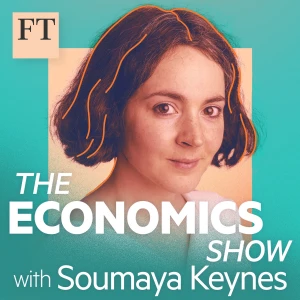
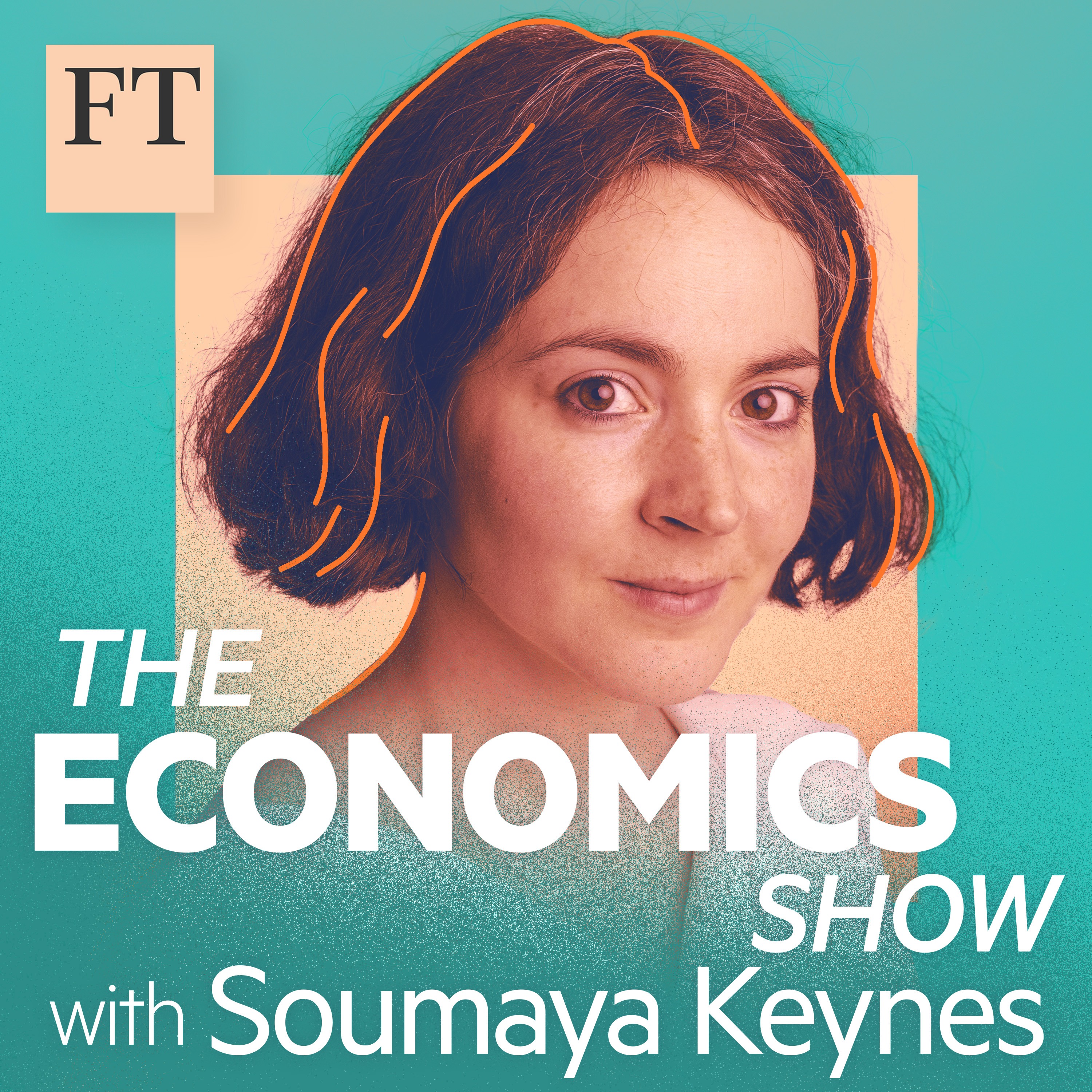
The Economics Show
The Economics Show with Soumaya Keynes is a weekly podcast from the Financial Times that offers smart, digestible analysis and incisive conversation on the hottest topics in economics. Each episode features Soumaya Keynes, an economics columnist for the FT, along with FT colleagues and special guests. The show aims to provide deep insights into economic issues while keeping the discussion accessible and engaging.
Episodes
Lessons in communication for Kevin Warsh. With Chris Giles
It is not a calm time in the markets. Investors are losing their cool while bond yields rise along with inflation. So where are central bankers? Offering words of calm? Or adding to the anxiety? The Fed’s Kevin Warsh has been telling people they need to look to the data, not to him. But is it that simple? The FT’s Chris Giles joins host Soumaya Keynes to talk through what makes for good central ba
The EU vs China: it’s complicated. With Bernd Lange
Europe has a China problem. Every single day, Europe buys a billion euros’ worth more stuff from China than it sells back. And the EU wants to stand up to Beijing over surging exports, which are challenging European industry. But China is also a vital market for European businesses and a crucial supplier of goods and raw materials. So how do you pick a trade fight with a country you depend on? Hos
Why Big Tech wants more economists
Tech companies are hiring economists to study how AI is reshaping work and society. But what happens when the companies building the technology also produce the research into its effects? Host Soumaya Keynes talks to Ara Kharazian, chief economist at Ramp and Peter McCrory chief economist at Anthropic, alongside FT data journalist John Burn-Murdoch, about why economists are in such demand, what pr
How to be a middle power in a superpower world. With Jenny Bates
The global economy is becoming increasingly hostile with tariffs, export controls and industrial policy being used as geopolitical weapons, while the world’s biggest powers compete for economic advantage. So where does that leave a middle power like Britain? Host Soumaya Keynes speaks to UK senior civil servant Jenny Bates, who’s just completed the Heywood Fellowship at Oxford university, where sh
Can you spreadsheet your way to equal parenting? With Corinne Low
Dads today are doing more childcare than previous generations, so why hasn’t the parenting gap between mothers and fathers disappeared? One reason: mums are doing more too. Host Soumaya Keynes talks to Corinne Low, associate professor at the University of Pennsylvania's Wharton School and author of 'Femonomics’ (titled ‘Having it all’ in the US), about what the data tells us about how couples divi
Will US debt burst the AI bubble? With Ruchir Sharma
Building data centres and running the US government have something in common: they cost a lot of money. Tech companies are borrowing heavily to fund the AI build out, just as Washington is borrowing vast sums to fund the US government, and those two borrowing binges may be on a collision course. Investors are already worried about America’s mounting debt burden and about whether the AI boom has be
Memory chip mania isn’t going away, with Dan Kim
In recent months, part of the chip market has been going bananas. Prices for memory chips – which AI data centres use in droves – have rocketed, as US tech companies lock in massive orders. That’s bad news for consumers facing more expensive electronic devices. But what are the broader consequences of misalignment in this market? How will the chip squeeze end? And, as memory chips become a strateg
Kevin Warsh spoke — what did we learn? With Torsten Slok
Federal Reserve chair Kevin Warsh took to the stage at Jackson Hole under pressure. Inflation is sticky, bond markets have been wobbling and his insistence on minimal Fed communication has been seen by some to make matters worse. Soumaya speaks to Torsten Slok, chief economist at Apollo Global Management, to discuss what Warsh did (and didn’t say), the changing relationship between the Fed and the
From "The Story of Money": How a stock market crash gave birth to modern antisemitism
The 1873 Gründerkrach, the spectacular stock market crash that followed Germany’s unification, is one of history’s great financial maelstroms. But its most enduring legacy isn’t about money. Host Robin Wigglesworth speaks to Pulitzer Prize-winning author Liaquat Ahamed about how the resulting economic malaise fuelled social division and transformed old prejudices into antisemitic conspiracy. It ga
From "Trumponomics": Can the US Actually Tax Billionaires?
As wealth becomes increasingly concentrated — and artificial intelligence threatens to shift even more income from workers to investors — has the US tax system become outdated? Stephanie Flanders speaks with Harvard professor Jason Furman, a former economic adviser to President Barack Obama, and Bloomberg reporter Caitlin Reilly about wealth taxes, capital gains, inheritance and whether taxing Ame
How to break China’s chokehold on rare earths
In the midst of the US-China trade conflict last year, Beijing unsheathed its fiercest weapon. By ramping up restrictions on exports of rare earth metals – crucial elements for high-tech manufacturing – China forced the US to climb down. That show of strength was a wake up call for the US. It has since spent huge sums backing mining companies, penned eye-catching deals and moved to collaborat
Will AI solve the productivity puzzle? With Nick Bloom
Productivity has been a problem for the past 15 years. In developed countries, weak demand, a lack of competition and a paucity of new ideas have all been blamed. Could AI finally reverse that trend? Soumaya speaks to Stanford economics professor Nick Bloom about why CFOs and CEOs expect AI to supercharge their businesses; how concentrated (or otherwise) the gains might be; and why working from ho
Is China catching up with the US in AI? With Kyle Chan
The US has long been the world’s undisputed leader in AI. Now, that lead looks under threat. Cutting-edge Chinese models such as Kimi K3 are proving almost as capable as leading American models; meanwhile, companies in the US and Europe are turning to cheap, efficient Chinese software from companies including DeepSeek and Z.ai in an attempt to curb high usage costs. As China takes strides – and Be
The US-Iran war has not triggered a food crisis — yet. With Adam Hanieh and Susannah Savage
When the US and Israel started bombing Iran earlier this year, market watchers eyed the oil markets nervously. But as the price of crude oil climbed, so did the price of another key commodity produced in the Gulf: fertiliser. Five months later, the world’s food system is looking better than feared, but as Adam Hanieh, director of the Middle East Institute at the School of Oriental and African Stud
The economics of weight loss, with Rebecca Diamond and Claer Barrett
In the western world, richer people tend to be thinner – especially women. But does wealth make people thin, or does being thin make them wealthy? And could the rise of weight-loss drugs such as Mounjaro and Wegovy give people – especially women – greater control over their economic outcomes? Soumaya speaks to Harvard professor Rebecca Diamond, the author of a new working paper that finds female u
Why didn’t the Iran war cause a recession? With Tyler Goodspeed
When Iran closed the Strait of Hormuz, economists were panicked. Several warned that a prolonged closure of the chokepoint could trigger a recession. After all, that’s what oil shocks do. But no recession came – even after oil prices jumped to almost twice their pre-war level. Why didn’t the global economy tumble into a recession – and are we out of the woods? Soumaya speaks to Tyler Goodspeed, au
How to win at AI (if you’re not the US or China), with AI minister Kanishka Narayan
When the US government banned a top AI lab from exporting its newest models, the world took notice. Export controls forbidding foreign access to Anthropic’s Mythos and Fable systems locked most of the world out of using this cutting-edge technology. As AI becomes more embedded in our daily lives, countries want to secure access to frontier models. But unless you’re the US or China, your country do
China wanted western tech. Now, the tables have turned. With John Minnich
For decades, China accelerated its industrial development through a straightforward bargain: foreign firms invested in China, often through joint ventures, gaining access to the enormous Chinese market, while Chinese companies absorbed western tech and knowhow. Today, that dynamic is changing. China's high-tech industries are now world-leading, and western governments are looking on enviously. So
Brexit at 10: What comes next? With Anand Menon
Just before the UK voted to leave the EU in June 2016, the Treasury (and others) warned the consequences would be catastrophic. GDP would fall and unemployment would rise, Sterling would dip and government borrowing would climb. The shock of Brexit would plunge the UK into a recession. Ten years later, it’s clear some of those predictions were wide of the mark. But Brexit has made the UK’s economy
The US-China decoupling fantasy, with Jessica Chen Weiss
Everything looks to be going China’s way: Beijing has a stranglehold on the world’s critical minerals, and its high-tech manufacturing has rapidly become world-leading. Its massive trade surplus is undermining vital industries in the rest of the world. Is this part of a Chinese masterplan for world domination? The truth is a little more nuanced than that. Soumaya Keynes speaks to Jessica Chen Weis
How to win a trade war, with Paul Krugman and Chad Bown
In a reversal of roles, Nobel prize-winning economist Paul Krugman steps into host Soumaya Keynes shoes to quiz her and co-author Chad Bown about their new book "How to Win a Trade War", and the lessons it contains for surviving a global world order where traditional trade rules are being abandoned. They discuss the fragile domestic politics of a trade war, what the rest of the world can learn fro
Can African countries mimic Asia’s economic success? With Joe Studwell
Africa is traditionally seen as a continent of immense resources, let down by poor governance and excessive violence. Joe Studwell disagrees. In his book, How Africa Works, Studwell flips those assumptions upside down, and argues that low population density, a brutal disease burden and "low-budget" colonialism have hampered the continent’s development. Now, Studwell says, Africa is in a position t
Should economics have fewer taboos? With Alvin Roth
Economists like to think of their discipline as a rational science. But might we make better decisions if we ditched some of our moral aversions? Specifically: would we make better choices if we learned to conquer moral repugnance? Alvin Roth, Nobel laureate, and author of the recent book ‘Moral Economics’, tells host Soumaya Keynes why a free market in kidneys and surrogacy makes economic sense,
Will AI help the Fed conquer inflation? With Austan Goolsbee
Between the Iran war, high gas prices, and wobbly jobs numbers, central bankers have plenty to worry about. But some see a light on the horizon: artificial intelligence. AI could lead to abundant production and lower prices, allowing the Fed to lower interest rates, and boost the economy – or so the theory goes. But how will we know if AI is boosting productivity? And what happens if the AI advoca
How will falling fertility rates hurt the economy? With Melissa Kearney
Typically, a society’s population remains stable if women have about 2.1 children each. By that metric, the word has a big problem. In developed countries the total fertility rate is well below that figure. So what are the economic consequences of that shortfall? Soumaya Keynes speaks to Melissa Kearney, a professor at the University of Notre Dame and the director of the Aspen Economic Strategy Gr
Will energy security fears change the global energy market? With Daniel Yergin
A few months ago, the oil market looked pretty serene. But the US-Iran war has upended global supplies and pushed energy security to the top of the policy agenda. Importers have realised they need to diversify their energy sources. What role will renewables have to play? And would a shift towards green energy just mean trading one bottleneck for another? Soumaya Keynes speaks to Dan
Introducing: The Story of Money
The economist John Kenneth Galbraith once quipped that “there can be few fields of human endeavour in which history counts for so little as in the world of finance.” This show sets out to prove the opposite. Each week, FT columnist Gillian Tett and FT Alphaville editor Robin Wigglesworth dig into the ideas, personalities and institutions that have shaped global finance. From unregulated banking in
Will the energy shock change global trade imbalances? With Brad Setser
China runs an enormous trade surplus, much to the chagrin of some of its trading partners: cheap exports of cars, chemicals and other goods are hampering major economies, especially in Europe. But the Asian nation, the world’s largest exporter, is a net importer of oil. Could higher oil prices help redress global trade imbalances? Soumaya Keynes speaks to Brad Setser, senior fellow at the Council
How long will the Iran energy shock last? With Chris Giles
President Donald Trump backed off his threats to wipe out “a whole civilization". Instead, we have a ceasefire – at least for now. But how much damage has the conflict between Iran, the US and Israel already done to the global economy? Where will that damage show up next? And how long will the effects of the Iran shock be felt? Soumaya Keynes speaks to the FT’s economics commen
Economic warfare: lessons from history, with Mark Harrison
Warring countries have attacked each other’s economies for hundreds of years. But do the tools of economic warfare – sanctions, tariffs, blockades and embargoes – actually work? Soumaya speaks to Mark Harrison, emeritus professor of economics at Warwick university, and co-editor (with Stephen Broadberry) of Economic Warfare and Sanctions since 1688, about what centuries of economic conflict can te
The global economy is Iran’s hostage. Can it be released? With Edward Fishman
Iran’s de facto closure of the Strait of Hormuz has already rocked global oil markets and stock market indices, spooking everyone from politicians to central bankers. But if Iran wants to make matters worse, it can. Soumaya speaks to Edward Fishman, senior fellow at the Council on Foreign Relations and author of ‘Chokepoints: American Power in the Age of Economic Warfare,’ to find out what this co
Lessons from China’s industrial dominance, with Kyle Chan
There’s a trope going around these days: western commentators travel to China, tour its factories and when they return home they say that when it comes to innovation, China has won the global race. But how true is that? Host Soumaya Keynes discusses the successes and shortcomings of China's evolving industrial policy with Kyle Chan, author of the High Capacity newsletter and a fellow in the John L
Introducing Untold: Opus Dei
Introducing Opus Dei, a new season of Untold from the Financial Times. Host Antonia Cundy uncovers the cultural and political influence of a controversial Catholic organisation in America. Opus Dei exists to help people get closer to God, but some members say they found other agendas – and unexpected harm – entangled in that spiritual mission. The first episode of Untold: Opus Dei launches March 2
Is AI (finally) making us more productive? With John Burn-Murdoch and Sarah O’Connor
Banks, consultancies and LinkedIn posts alike are trumpeting the transformative effects of AI, promising an imminent uptick in productivity. Some of these claims are no doubt exaggerated. But there are unmistakable signs that AI is boosting productivity. How is that showing up in economic data? And what does that information tell us about the future of the economy? Soumaya is joined by John Burn-M
Are investors getting the Iran conflict wrong? With Robin Brooks
Markets haven’t exactly been calm since the conflict in Iran started. But are they mispricing the risks of a bigger economic blow-up? And how does this conflict compare with what happened after Russia invaded Ukraine? Host Soumaya Keynes discusses these questions with Robin Brooks, author of the Shadow Price Macro substack and senior fellow in the Global Economy and Development prog
Could common debt make the EU stronger? With Carlos Cuerpo
Some believe a deeper pool of common debt would allow the European Union to tackle some of its biggest problems, attracting more investment, reducing the cost of financing, and helping the EU achieve greater strategic autonomy. One such believer: Carlos Cuerpo, Spain’s economy, trade and business minister. In this episode, Soumaya asks him how a common EU safe asset would work, whether money (not
Trump’s tariffs are not dead yet, with Michael Froman
Shortly after the US Supreme Court ruled Donald Trump’s tariffs were illegal, he hit back. The president vowed to impose a 10% levy on US imports through different means. He raised those duties to 15% the following day. These tariffs – imposed under the Trade Act of 1974, rather than the International Emergency Economic Powers Act (IEEPA) – are only temporary. But Trump has a range of tariff tools
What did ‘Nudge’ get wrong? With Nick Chater
When Richard Thaler and Cass Sunstein released their book ‘Nudge’ in 2008, it caught the public imagination. ‘Nudge theory’ – the idea that people could be encouraged to make better choices through small, subtle interventions – was innovative, and exciting. A decade and a half later, a whole lot of nudging seems to have come to a whole lot of nothing. Why wasn’t ‘nudge theory’ more help in tacklin
How China is fighting ‘involution’, with Yanmei Xie
China’s export powerhouse is feeding global demand for cheaper electronics, cars, clothing, and plenty more besides. But the supercharged competition driving that trend is causing problems within China itself, including deflation and thin or negative profit margins. China’s government has recognised the problem, but what is it actually doing in response – and how should the country’s trading partn
What an economist eats for lunch (in 2026), with Tyler Cowen
If you want to understand food – and eat better – economics is a good place to start. How do immigration patterns shape a country’s cuisine? How do labour laws make our working lunches worse? And why do strip malls serve such good grub? To find out, Soumaya Keynes talks to Tyler Cowen, economics professor at George Mason University and chair of the Mercatus Center think-tank. Cowen has written abo
How big a deal is the EU-India trade agreement? With Nicolas Köhler-Suzuki and Ajay Srivastava
The EU-India trade deal was partly a geopolitical statement, directed towards Trump. But what’s actually in it? What were the toughest bits to agree, who gave up concessions, and what will the deal mean for the economies of India and the EU? Soumaya Keynes is back to chat to Nicolas Köhler-Suzuki, adviser for trade and economic security, Jacques Delors Institute, and Ajay Srivastava, founder of th
The economy in 2026: What risks lie ahead? With Gita Gopinath
Are the headline growth figures really telling us the full story about the global economy? Gita Gopinath, a former deputy managing director at the IMF and a professor of economics at Harvard University, discusses this question with Martin Wolf, the FT’s chief economics commentator. They talk about how AI investments are offsetting the economic drag from tariffs, the risk of another financial crisi
How the Fed fights back, with Don Kohn
It wasn’t the Trump administration’s first attack on the Federal Reserve – but it was perhaps the most shocking. The Department of Justice’s criminal investigation into Jay Powell – nominally over his testimony about the refurbishment of Fed buildings – has ramped up pressure on the Fed chair, whom Donald Trump has frequently criticised over the central bank’s interest rate stance.
How bad is America’s affordability crisis? With Mechele Dickerson
Affordability is set to be a key issue in US politics ahead of the country’s midterm elections. And though American politicians often express their support for the country’s middle class, life has become progressively more difficult for that group, Mechele Dickerson argues. The University of Texas law professor explains how sluggish wage growth, housing policy and the growth of personal debt have
Behind The Money: How First Brands Group collapsed
Some of the world’s biggest financial institutions are reeling after the collapse of a little-known car parts supplier: First Brands Group. The company filed for bankruptcy last month, and since then, FT reporters have shone a spotlight on billions of dollars of hidden debt and a secretive founder whose borrowing habits left creditors exposed. The FT’s corporate finance editor Robert Smith and ban
Martin Wolf speaks to Christine Lagarde: Europe’s ‘existential crisis’
The European Commission must urgently dismantle internal trade barriers that are stifling innovation, productivity and investment across the EU. So says Christine Lagarde, president of the European Central Bank, in a conversation with the FT’s chief economics commentator, Martin Wolf, as she calls for immediate structural reforms and explains why this is the moment to do it.This interview was reco
The Wolf-Krugman Exchange: Power, plutocracy and political economy
In this final episode of their series for The Economics Show, FT chief economics commentator Martin Wolf and Nobel laureate Paul Krugman consider listeners’ questions and comments ranging from a critique of globalisation, increasing inequality and plutocracy, the global appetite for US federal debt, China’s economic future and much more.Subscribe and listen to this series of The Economics Show on
The Wolf-Krugman Exchange: America vs the world
The US last week released its new national security strategy – and it wasn’t good news for Europe. The document, which sets out US foreign policy priorities, blasted Europe for undermining “political liberty and sovereignty”, de-emphasised the threat from Russia, reframed America’s competition with China and put influence over the western hemisphere at the top of the US agenda. In this episode, FT
The Wolf-Krugman Exchange: Maga man and Mamdani
Donald Trump promised to bring industrial jobs back to America when he swept to victory in last year’s presidential election, powered by a 12-point lead among male voters, but can he really deliver? In the second of this four-part series, the FT’s chief economics commentator Martin Wolf and Nobel prize-winning economist Paul Krugman discuss the economic plight of American men - why their problems
The Wolf-Krugman Exchange: Trump’s ‘vibecession’
As President Donald Trump approaches the one-year anniversary of his second term in office, the FT’s chief economics commentator Martin Wolf, and Nobel prize-winning economist Paul Krugman sit down to discuss the US economy and the state of American democracy. Are American consumers finally feeling the effect of Trump’s tariffs? Is AI to blame for the frozen labour market? Or is the spectre of a w
Coming soon: The Wolf-Krugman Exchange: One year of Trump
In this four-part series starting on Wednesday November 26, FT chief economics commentator Martin Wolf and Nobel-prize winning economist Paul Krugman take stock after (almost) a year of Donald Trump’s second term and assess the impact of his presidency on the US and world economy and democracy everywhere.Martin Wolf is the FT’s chief economics commentator. You can find his articles here: https://w
Did globalisation kill neoliberalism? With Branko Milanović
Thirty-five years ago, the global economy could be neatly divided into market economies, socialist economies and poorer non-aligned countries. Today, that picture is rather more complicated. Western-style neoliberalism – expected to become the dominant economic system after the end of the cold war – is in retreat; socialism is no more; China has emerged as a global superpower; and formerly-poor co
Coming soon from Tech Tonic: Defying death
Investors are spending billions of dollars on novel ways to extend human life through inventive treatments, therapies, and even manipulating our genes. And increasingly, it seems as though anti-ageing efforts have moved from the super rich to a mass market consumer industry. In this series, we’re covering the past, present and future of the longevity movement. We’ll be looking at where the fixatio
The limits of monetary policy, with Agustín Carstens
Money, it’s often said, is a form of trust and central banks are the custodians of that trust; it’s their job to guarantee that the money they issue maintains stable purchasing power. More recently, that’s been no easy task. Witness President Donald Trump’s attacks on the independence of the US Federal Reserve. The FT’s chief economics commentator, Martin Wolf, speaks to Agustín Carstens, former g
What economics gets wrong about human behaviour, with Richard Thaler
Economists like to model people as rational creatures who make self-interested decisions. But humans don’t act that way. Why do investors, politicians and ordinary people act against their best interests – and how can they be nudged into making better decisions? To find out, FT economics commentator Chris Giles speaks to Richard Thaler, the founding father of behavioural economics. Thale
Are Trump’s tariffs legal? With Jennifer Hillman
US President Donald Trump’s tariff programme has been a central pillar of his second term in office. But a case being heard by the US Supreme Court could throw this central tenet of his trade policy into disarray. Trump has argued that tariffs are a matter of national security for which the president is ultimately responsible; others say they’re an economic issue, and should be set by Congres
How to kickstart the UK economy. With Tim Leunig
Many governments in western Europe are grappling with sluggish economic growth and the UK is no exception. From rising unemployment to weak public finances, the UK economy is in the doldrums and there’s pressure on chancellor Rachel Reeves to fix it. Tim Leunig, a former adviser to two chancellors and now a professor at the London School of Economics and chief economist at innovation think-tank Ne
Introducing Untold: Toxic Legacy
Introducing Toxic Legacy, a new season of Untold from the Financial Times. Host Laura Hughes uncovers a lead poisoning epidemic across the UK. You might be living with lead and not know it: the toxin is often invisible to the human eye, but wreaks havoc on our bodies once we’re exposed. The first episode of Untold: Toxic Legacy launches October 22. Listen on Apple Podcasts, Spotify, Pocket Ca
What’s up with the US economy? With Austan Goolsbee
Austan Goolsbee, president of the Federal Reserve Bank of Chicago and a voter on the Fed’s interest rate-setting committee, speaks to the FT’s economics commentator Chris Giles about the outlook for the US economy amid a boom in AI investment, sluggish hiring, President Donald Trump’s tariffs and continued attacks by the White House on central bank independence.Chris Giles is the FT’s economi
The economics of birth control. With Martha Bailey
When it comes to women controlling their own economic destinies, perhaps nothing has had a more profound impact than the contraceptive pill. But the US may be on the cusp of change. Earlier this year, the Trump administration froze some federal funding for subsidised access to contraceptive services and more changes are on the horizon. That has made understanding the economic impact of contracepti
How to get immigration right. With Adam Ozimek
Many argue immigration is key to America’s economic success. So as President Trump clamps down on it, what might he be getting wrong and what does the optimal skilled immigration landscape look like for the US and elsewhere? John Burn-Murdoch, the FT’s chief data columnist, speaks to Dr Adam Ozimek, chief economist at the Economic Innovation Group, who co-authored a recent paper on high-skilled im
China’s economy vs the world. With Michael Pettis
US President Donald Trump has railed against his country’s trade deficit with China. But as Chinese surpluses continue to flow into other countries, it’s worth asking how China got to where it is today, and whether Chinese growth can lift all boats. In this week’s episode, Martin Sandbu, the FT’s European economics commentator, speaks to Michael Pettis, senior fellow at the Carnegie Endowment. He’
The ugly truth about Trump’s ‘beautiful tariffs’. With Martha Gimbel
Customs duties on imported goods used to be a crucial part of US government funding – in fact, the customs service was among the first federal agencies set up after the constitution. Now, Trump is hoping that – among other things – tariffs could transform the US budget. But do the revenues they raise for government coffers help outweigh their negative economic impacts? Martha Gimbel, executive dir
China and the limits of its ‘engineering state’. With Dan Wang
China has become a superpower because of its ability to build bridges, cars and electronics at an astonishing pace. But breakneck growth comes with problems. The country is grappling with overproduction and deflation, and policymakers in Beijing are attempting to jumpstart consumer demand. How can China keep building without jeopardising its economic future? Dan Wang, research fellow at Stanford U
Fed independence? Here’s why you should worry. With Peter Conti-Brown
President Donald Trump's attempt to fire Lisa Cook, a member of the Federal Reserve’s interest rate-setting board, is not the first time in the Fed’s history that there has been an attempt to politicise central banking. But Peter Conti-Brown, associate professor of financial regulation at The Wharton School of the University of Pennsylvania, tells the FT’s Chris Giles why Trump’s intervention is d
After globalisation: What's next for a fractured world? With Neil Shearing
It’s a widely held assumption that US President Donald Trump has put globalisation into reverse. But Neil Shearing, group chief economist at Capital Economics and author of The Fractured Age: How the Return of Geopolitics Will Splinter the Global Economy, tells the FT’s world trade editor Peter Foster that Trump’s policies are a symptom and not the cause of the global trading system unravelling. T
How Asia is coping with Trump’s tariffs. With Mari Pangestu
President Donald Trump thinks that Asia's goods exports are automatically America's loss and as part of his ‘reciprocal’ tariff policy, he has imposed some of the highest import taxes on goods from south-east Asia. So what does this mean for the region? And are Trump's policies pushing those countries further into China's orbit? Alan Beattie, the FT’s senior trade writer, discusses these questions
Why Russia’s wartime economy is starting to crack, with Elina Ribakova
When the EU and US hit Russia with fresh sanctions in 2022, many analysts expected the country’s economy to crack. Instead, Russia has shown strong GDP growth, powered in large part by a massive boost to war-related industries. Now, the effects of that boost appear to be fading. Have western sanctions finally started to bite? What would happen to Russia’s economy if the Ukraine war were to end? An
Introducing the Rachman Review: Is the US heading for a debt crisis?
This week on the Economics Show, we're bringing you an interview with Ray Dalio, from our foreign affairs podcast, the Rachman Review. It originally broadcast on July 3.Gideon talks to Ray Dalio, founder of Bridgewater Associates, the world’s largest hedge fund and author of a new book: How Countries Go Broke. They discuss the size of the US debt and what history tells us about identifying warning
Can we still trust US economic data? With Erica Groshen
After the Bureau of Labor Statistics released a worse-than-expected US jobs report, President Trump fired the agency’s head, Erika McEntarfer, claiming her numbers were ‘wrong’ and manipulated. There’s no evidence this was the case but many agree gathering reliable data on the health of the economy is getting harder. The FT’s chief data reporter, John Burn-Murdoch, discusses why that’s happening a
Development funding is in crisis. What now? With Mark Suzman
The first two decades of the 21st century were a golden age for global development. International co-operation and funding drove remarkable progress in the developing world. Now, that progress threatens to stall as wealthy nations, including the US and UK, withdraw their support. A global meeting held in Spain last month ended with a new international agreement, the Seville Commitment, on funding
Has Argentina’s Milei proved his critics wrong? With Alejandro Werner
In the early 20th century Argentina was one of the world’s richest countries. For most of the past 50 years, it has been an economic disaster. But after nine debt defaults, 23 IMF programmes and two years of triple-digit annual inflation, the country’s radical libertarian president, Javier Milei, has steadied the ship. How has Milei revitalised the economy? Can he persuade investors to trust Argen
Can Europe afford to rearm itself? With Jeromin Zettelmeyer
European countries have committed to higher defence spending to face down Russian aggression. But preparing for war isn’t cheap – and in many countries, budgets are already stretched. How will European members of Nato hit their defence targets, a hefty 5% of GDP? Will EU states look beyond their own national champions, and commit to greater co-operation on defence funding and purchases? And what k
What Trump’s tariffs deadline has (not) achieved, with Dmitry Grozoubinski
July 9 marked the end of President Trump’s 90-day pause on his so-called reciprocal tariffs. Now that deadline has passed … what has actually changed? The FT’s senior trade writer Alan Beattie discusses with former trade negotiator Dmitry Grozoubinski, author of ‘Why Politicians Lie About Trade’. Dmitry explains why Trump’s tariff threats are as ineffective as they are unusual, how countries are a
The Wolf-Krugman Exchange: your questions answered
In the sixth of this six-part series of The Economics Show, Martin Wolf, the FT’s chief economics commentator, and Nobel Prize-winning economist Paul Krugman tackle a selection of questions, and even some criticisms, sent in by their audience. Listen to Paul Krugman’s cultural coda, Carole King’s It's too late, here Listen to Martin Wolf’s cultural coda, Va Pensiero from Verdi’s Nabucco,
The Wolf-Krugman Exchange: The future of the postwar system
In the fifth of this six-part series of The Economics Show, Martin Wolf, the FT’s chief economics commentator, and Nobel Prize-winning economist Paul Krugman discuss the way American politics is crashing against both the guardrails of a stable, democratic system and the rules and norms of the postwar economic order and how this could jeopardise the importance of the US on the world stage.Paul Krug
The Wolf-Krugman Exchange: AI hype vs reality
In the fourth of this six-part series of The Economics Show, Martin Wolf, the FT’s chief economics commentator, and Nobel Prize-winning economist Paul Krugman ask if advances in artificial intelligence will reshape the working world as we know it. Or are we hearing an old familiar story that has been told many times before? Paul Krugman’s Cultural Coda:Loretta Lynn - "Coal Miner's Daughter":
The Wolf-Krugman Exchange: The economy in an uncertain world
In the third of this six-part series of The Economics Show, Martin Wolf, the FT’s chief economics commentator, and Nobel Prize-winning economist Paul Krugman discuss the dangers facing the world economy and wonder what outcomes are possible at summits such as the G7 in times of political and economic risk.Paul Krugman’s Cultural Coda:Peter Gabriel: “Games Without Frontiers”https://www.youtube.com/
The Wolf-Krugman Exchange: how the old economic order fell out of favour
In the second of this six-part series of The Economics Show, Martin Wolf, the FT’s chief economics commentator, and Nobel Prize-winning economist Paul Krugman discuss the way economic trends have fractured societies on both sides of the Atlantic and the jeopardy that poses to liberal democracies in Europe and America. Paul Krugman’s Cultural Coda: Let America Be America Again by Langston Hugh
The Wolf-Krugman Exchange: the crisis of trust
In part one of this six-part series of The Economics Show, Martin Wolf, the FT’s chief economics commentator, and Nobel Prize-winning economist Paul Krugman discuss how trust in the postwar world economic system is being lost and weigh the costs and consequences of that. Paul Krugman’s Cultural Coda: Quarterflash, ”Harden My Heart”- https://www.youtube.com/watch?v=TNFSED77-GMMartin