Lectures in Intellectual History
This podcast presents recordings from a public lecture series on intellectual history. It features new work across all aspects of the field, hosted by the Institute of Intellectual History at the University of St Andrews. Listeners can explore talks and discussions from scholars in intellectual history through the institute's Substack.
Episodes
Alison Bashford (Sydney) - “Depopulation and Repopulation: Settler Colonialism and Political Economy in the Early 19th Century”
This lecture was delivered at the University of St Andrews on 26 November 2025. Alison Bashford is Scientia Professor in History and Director of the Laureate Centre for History & Population at the University of New South Wales (Sydney). Her work connects the history of science, global history, and environmental history into new assessments of the modern world, from the eighteenth to the twentieth
Niall O’Flaherty (KCL) - "Malthus and the Global Turn"
This lecture was delivered at the University of St Andrews on the 19th of November 2025. Niall O’Flaherty is Reader in History of European Political Thought at King’s College London. His research focuses on eighteenth and nineteenth-century social, religious and scientific thought in Britain with particular reference to Thomas Robert Malthus and Charles Darwin. Get full access to Institute of Inte
Avi Lifschitz (Oxford) - “Holding the Monarch to Account: Frederick the Great’s Writings in the Public Sphere”
This lecture was delivered at the University of St Andrews on the 15th of October 2025. The lecture is not for citation without permission of the author.Avi Lifschitz is Professor of Intellectual History and Enlightenment Studies at Magdalen College, Oxford. Get full access to Institute of Intellectual History at standrewsiih.substack.com/subscribe
Debating Enlightenment
This discussion took place a the University of St Andrews on February 26, 2025. Ann Thomson is Professor Emerita at the European University Institute, having been Professor of Intellectual History there from 2013 to 2020. Her research interests include the intellectual history of the long Eighteenth Century, and she studies questions at the intersection of religion, medicine and politics, as well
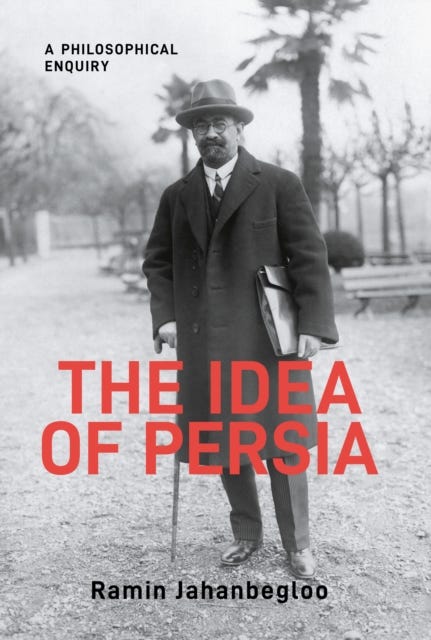
Ramin Jahanbegloo - "The Idea of Persia: A Philosophical Enquiry" (Book launch)
This episode was recorded at the University of St Andrews on 7th of October 2025. The event was held in Parliament Hall, St Andrews. Ramin Jahanbegloo’s The Idea of Persia can be found here. Get full access to Institute of Intellectual History at standrewsiih.substack.com/subscribe
Robert Frost (Aberdeen) - "Drawing in the Reins of Government: Justus Lipsius and Republican Monarchy in Poland-Lithuania"
This lecture was given at the University of St Andrews on Wednesday 17 September 2025. The lecture is not for citation without permission of the author. Get full access to Institute of Intellectual History at standrewsiih.substack.com/subscribe
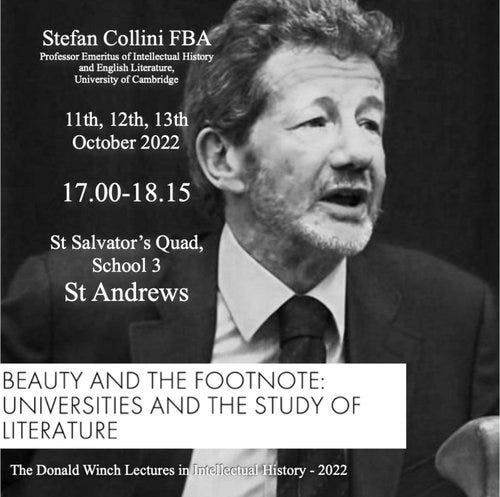
Beauty and the Footnote: Universities and the Study of Literature
Stefan Collini, FBA. Professor Emeritus of Intellectual History and English Literature, University of Cambridge.The Donald Winch Lectures in Intellectual History.University of St Andrews. 11th, 12th & 13th October 2022.In the course of the nineteenth and twentieth centuries, universities expanded to include a wide range of what came to be regarded as academic ‘disciplines’. In Britain, the study o
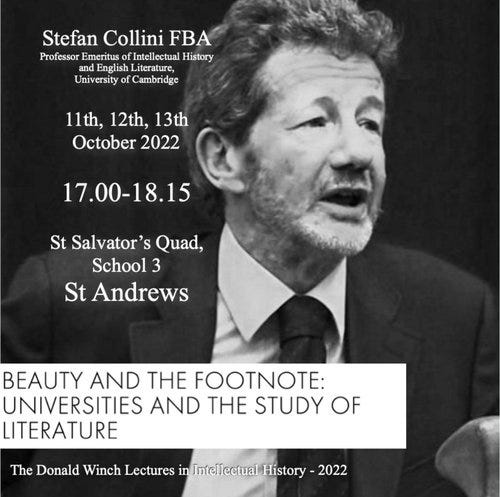
Beauty and the Footnote: Universities and the Study of Literature
Lecture 2: CareersStefan Collini, FBA.Professor Emeritus of Intellectual History and English Literature, University of Cambridge.The Donald Winch Lectures in Intellectual History.University of St Andrews.11th, 12th & 13th October 2022.In the course of the nineteenth and twentieth centuries, universities expanded to include a wide range of what came to be regarded as academic ‘disciplines’. In Brit
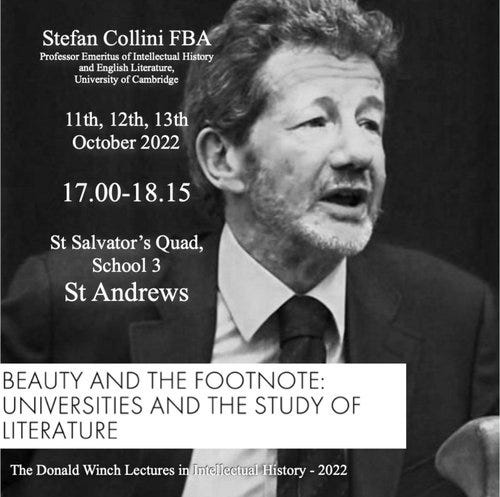
Beauty and the Footnote: Universities and the Study of Literature
Lecture 1: JustificationsStefan Collini, FBA. Professor Emeritus of Intellectual History and English Literature, University of Cambridge.The Donald Winch Lectures in Intellectual History. University of St Andrews. 11th, 12th & 13th October 2022. In the course of the nineteenth and twentieth centuries, universities expanded to include a wide range of what came to be regarded as academic ‘discipline

Sophie Scott-Brown (University of St Andrews; Remarque Institute, New York) - "British Activist-Intellectuals and the Unexpected Revival of Radical Democracy in the (Long) 1950s"
This lecture was delivered at the University of St Andrews on 25 September 2024. Get full access to Institute of Intellectual History at standrewsiih.substack.com/subscribe

Michael Brown (University of Aberdeen) - "Creating an Ancien Regime: The Union of 1800 as a Counter Revolutionary Act"
This lecture was delivered at the University of St Andrews on 18 September 2024. Get full access to Institute of Intellectual History at standrewsiih.substack.com/subscribe

Tom Pye (UCL) - "The tailzie and the politics of the feudal law in eighteenth-century Britain"
This lecture was delivered on 3 April 2024 at the University of St Andrews. Get full access to Institute of Intellectual History at standrewsiih.substack.com/subscribe

Norman Vance - "Individualism and its Discontents: Hobbes to Hayek and Beyond"
This lecture was delivered at the University of St Andrews on 13 March 2024. Get full access to Institute of Intellectual History at standrewsiih.substack.com/subscribe
Christopher de Bellaigue - "Suleyman the Magnificent and the 16th-century race for empire"
This lecture was delivered at the University of St Andrews on 31 January 2024. Get full access to Institute of Intellectual History at standrewsiih.substack.com/subscribe

Ariane Fichtl - “Overcoming the biopolitical dynamic of enslavement to achieve Immediate Emancipation”
This lecture was delivered at the University of St Andrews on 24 January 2024. Get full access to Institute of Intellectual History at standrewsiih.substack.com/subscribe

Tim Stuart-Buttle - "Behind the Curtain: Hobbes and the politics of recognition"
This lecture was delivered at the University of St Andrews on 17 January 2024. Get full access to Institute of Intellectual History at standrewsiih.substack.com/subscribe

Richard Whatmore - "The End of Enlightenment (book launch)"
This talk was given at Toppings in St Andrews on December 7, 2023. Get full access to Institute of Intellectual History at standrewsiih.substack.com/subscribe

Jesse Norman - "Ambition, revenge, truth, fiction - The Winding Stair"
The barely known story of the 30-year rivalry between Francis Bacon and Edward Coke is a fascinating case study in late-Elizabethan-Jacobean court politics. But it can also be a means by which to explore the limits of historical truth, and the uses of fiction. Jesse Norman is a Visiting Research Fellow at St Andrews, a Fellow of All Souls and a Member of Parliament (UK). This lecture was given on

Vassilios Paipais - "Between Pacifism and Just War: Oikonomia and Eastern Orthodox Political Theology"
This lecture was given at the University of St Andrews on 15 November 2023. Get full access to Institute of Intellectual History at standrewsiih.substack.com/subscribe
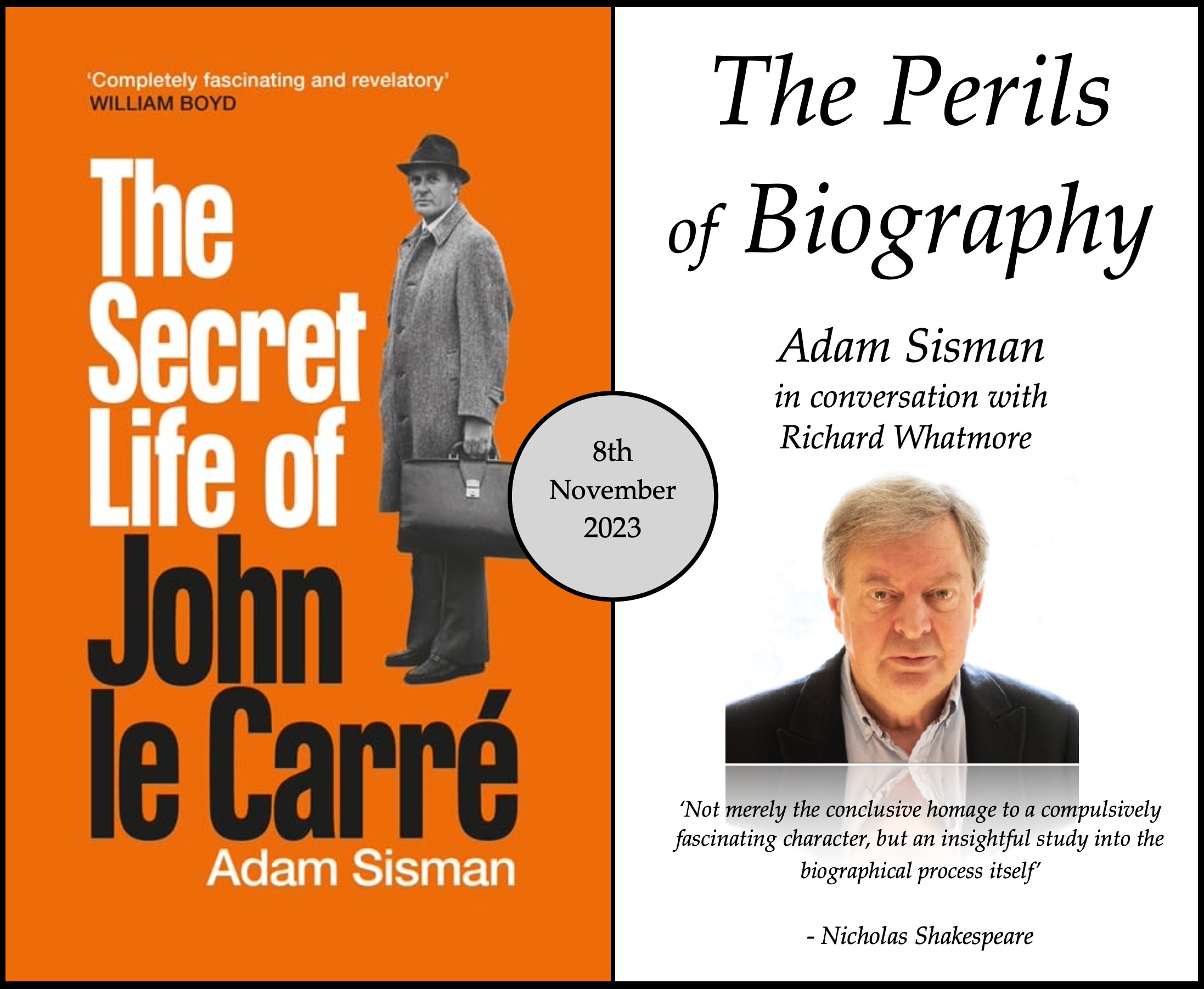
Adam Sisman - "The Perils of Biography"
Adam Sisman in conversation with Richard Whatmore. Recorded on 8 November 2023. Get full access to Institute of Intellectual History at standrewsiih.substack.com/subscribe

Alan Kahan - "Three Pillars and Four Fears: A History of Liberalisms
This lecture was delivered on 11 October 2023 at the University of St Andrews. Get full access to Institute of Intellectual History at standrewsiih.substack.com/subscribe

James Harris - “Hobbes and Rousseau on ‘the act by which a people is a people’”
This lecture was delivered on 5 April 2023 at the University of St Andrews. Get full access to Institute of Intellectual History at standrewsiih.substack.com/subscribe

Brian Young - "Utilitarianism and the universities in Victorian England: the brothers Grote in nineteenth-century thought"
This lecture was delivered at the University of St andrews on March 15, 2023. Get full access to Institute of Intellectual History at standrewsiih.substack.com/subscribe

Sarah Mortimer - "Virtue beyond Law? Christian Ethics and Political Duties in Reformation Europe"
This lecture was delivered at the University of St Andrews on February 15, 2023. Get full access to Institute of Intellectual History at standrewsiih.substack.com/subscribe

Ariane Fichtl - "Bound with the enslaved: the role of women in the formation of the political discourse of Immediate Abolitionism and its egalitarian framework"
This lecture was delivered at the University of St Andrews on February 1, 2023. Get full access to Institute of Intellectual History at standrewsiih.substack.com/subscribe

Martine van Ittersum - "The Working Papers of Hugo Grotius: A Case Study in the Micro-Sociologies of Archives"
specializes in Dutch overseas expansion in the early modern period, especially its implications for political thought and practice. She is also a book historian. Her research focuses on the social history of knowledge, including the materiality of texts, the archaeology of archives, and the history of canon formation. She has taught European, Atlantic and global history at the University of Dundee
Interviews with Leading Intellectual Historians - Maria Rosa Antognazza
During the final weeks of the summer, the Institute of Intellectual History brings a series of new interviews with leading intellectual historians about their career and work in intellectual history. In this sixth interview, we present a conversation with Maria Rosa Antognazza. is a professor of Philosophy at King’s College London. Her research interests include the history of philosophy, episte
Interviews with Leading Intellectual Historians - Jamie Gianoutsos
During the final weeks of the summer, the Institute of Intellectual History brings a series of new interviews with leading intellectual historians about their career and work in intellectual history. In this fifth interview, we present a conversation with Jamie Gianoutsos. is Associate Professor of History at Mount St. Mary’s University in the US. In the interview, Jamie shares insights into her
Interviews with Leading Intellectual Historians - Carole Levin
During the final weeks of the summer, the Institute of Intellectual History brings a series of new interviews with leading intellectual historians about their career and work in intellectual history. In this fourth interview, we present a conversation with Carole Levin. Carole Levin is Willa Cather Emerita Professor of History at the University of Nebraska. She specialises in early modern English
Interviews with Leading Intellectual Historians – Tae-Yeoun Keum
During the final weeks of the summer, the Institute of Intellectual History brings a series of new interviews with leading intellectual historians about their career and work in intellectual history. In this third interview, we present a conversation with Tae-Yeoun Keum. Dr Tae-Yeoun Keum is a political theorist specialising presently in the place of myth in political thought. Her first book w
Interviews with Leading Intellectual Historians - Jacqueline Broad
During the final weeks of the summer, the Institute of Intellectual History brings a series of new interviews with leading intellectual historians about their career and work in intellectual history. In this second interview, we present a conversation with Professor Jacqueline Broad. Jaqueline Broad is Head of the Philosophy Department at Monash University. After being awarded her PhD in 2000, sh
Interviews with Leading Intellectual Historians - Eileen M. Hunt
During the final weeks of the summer, the Institute of Intellectual History brings a series of new interviews with leading intellectual historians about their career and work in intellectual history. In this first interview, we present a conversation with Eileen M. Hunt. Eileen Hunt is a professor of political science and a political theorist whose scholarly interests cover modern political thoug

Emma McLeod - "John Bruce, precedent, and the 'mind of government' in the English and Scottish state trials of 1793-94"
This lecture was given at the University of St Andrews on April 20, 2022. Get full access to Institute of Intellectual History at standrewsiih.substack.com/subscribe

Rosa Antognazza - Leibniz as Historian
This lecture was given at the University of St Andrews on April 13, 2022. Get full access to Institute of Intellectual History at standrewsiih.substack.com/subscribe

Karie Schultz - Holy war advocates or secular political theorists? The case of the Scottish Covenanters, 1638-1646
This lecture was given at the University of St Andrews on April 6, 2022. Get full access to Institute of Intellectual History at standrewsiih.substack.com/subscribe

Craig Smith - Adam Smith and the Limits of Philosophy
This lecture was delivered at the University of St Andrews on 23 March 2022 and subsequently at George Mason University, where it was recorded. For a video of this lecture with the powerpoint slides, please vist: Get full access to Institute of Intellectual History at standrewsiih.substack.com/subscribe

Jesse Norman - Uses and abuses of the Ancient Constitution
This lecture was delivered at the University of St Andrews on 1 April 2022. Get full access to Institute of Intellectual History at standrewsiih.substack.com/subscribe

Ryan Hanley - Commerce before Capitalism: Fénelon, Vauban, and Boisguilbert
This lecture was given on 16 February 2022 at the University of St Andrews. Ryan Patrick Hanley is Professor of Political Science at Boston College. His most recent projects include The Political Philosophy of Fénelon, and a companion translation volume, Fénelon: Moral and Political Writings, both of which was published by Oxford University Press in 2020. Get full access to Institute of Intellectu

John Robertson - The Refutation of Natural Law by Sacred History in Giambattista Vico's New Science
Professor John Robertson (Cambridge & St Andrews) delivered this lecture at the University of St Andrews on February 27, 2020. The event was organised by the Institute of Legal and Constitutional Research in collaboration with the Institute of Intellectual History. Get full access to Institute of Intellectual History at standrewsiih.substack.com/subscribe

Giulia Delogu - The Emporium of Words: Free Ports and Port Cities as Laboratories of Modernity (16th-19th centuries)
Dr Giulia Delogu (Venice) delivered this lecture on February 5th 2020. Get full access to Institute of Intellectual History at standrewsiih.substack.com/subscribe

Thomas Maissen - Britannia and her sisters in the 16th and 17th centuries: Political Representation and Iconography
Professor Thomas Maissen (Heidelberg/Paris) delivered this lecture on January 28, 2020 at the University of St Andrews. Get full access to Institute of Intellectual History at standrewsiih.substack.com/subscribe

Ian MacLean - Old wine in new bottles? Hippocrates, the classical tradition and the Early Enlightenment
Professor Ian MacLean (Oxford/St Andrews) delivered this lecture at the Institute of Intellectual History on November 19th 2019. Get full access to Institute of Intellectual History at standrewsiih.substack.com/subscribe

David Weinstein - Green's Hume
Professor David Weinstein (Wake Forest) delivered this lecture on November 12, 2019 at the University of St Andrews. Get full access to Institute of Intellectual History at standrewsiih.substack.com/subscribe

Lucia Rubinelli - Sovereignty and Constituent Power in Weimar Germany
Dr Lucia Rubinelli (Cambridge) delivered the 18th István Hont Memorial Lecture on October 29 2019 at the University of St Andrews "This paper is the third chapter of a book manuscript, titled Constituent power: A history. The book mainly focuses on how Sieyes’ first theorisation of pouvoir constituant has been used and misused by subsequent theorists, including Carl Schmitt and Hannah Arendt. In t

James Poskett - Materials of the Mind: Phrenology, Race, and the Global History of Science, 1815-1920
Dr James Poskett (Warwick) delivered this lecture on October 15th 2019 at the University of St Andrews. Phrenology was the most popular mental science of the Victorian age. From American senators to Indian social reformers, this new mental science found supporters around the globe. James’s new book, Materials of the Mind, tells the story of how phrenology changed the world—and how the world change

Emma Hunter - Africa and the Global History of Liberalism
Dr Emma Hunter (Edinburgh) delivered this lecture at the University of St Andrews on September 24, 2019. Get full access to Institute of Intellectual History at standrewsiih.substack.com/subscribe

Silvia Sebastiani - The Boundaries of Humanity in the Enlightenment: Orangutans, Slaves and Global Markets.
Dr Silvia Sebastiani (EHESS) delivered the 10th James H. Burnes Memorial Lecture on April 23, 2019 at the Institute of Intellectual History. Get full access to Institute of Intellectual History at standrewsiih.substack.com/subscribe

Richard Whatmore - The End of Enlightenment: A synopsis of the 2019 Carlyle Lectures
Richard Whatmore (St Andrews) delivered this talk at the University of St Andrews on April 3, 2019. The talk was based on the Carlyle Lectures, which Professor Whatmore gave at the University of Oxford in the spring semester of 2019. Get full access to Institute of Intellectual History at standrewsiih.substack.com/subscribe

Iain McDaniel - Writing the Intellectual History of Caesarism in the era of the Franco-Prussian War
Dr Iain McDaniel (Sussex) delivered the 16th István Hont Memorial Lecture at the Institute of Intellectual History (St Andrews) on April 2, 2019. Get full access to Institute of Intellectual History at standrewsiih.substack.com/subscribe

Nathan Alexander - The Meanings of "Racism": Towards a history of the concept
Dr Nathan Alexander (Erfurt) delivered this talk at the University of St Andrews on February 2, 2019. Get full access to Institute of Intellectual History at standrewsiih.substack.com/subscribe

Robin Douglass - The Moral Psychology of the Social Contract
Get full access to Institute of Intellectual History at standrewsiih.substack.com/subscribe

Alex Douglas - Spinoza and Religion
Dr Alex Douglas is a lecturer in philosophy at the University of St Andrews. Get full access to Institute of Intellectual History at standrewsiih.substack.com/subscribe

Paul Wood - The Rise and Fall of the Common Sense 'School' of Philosophy
The emergence of a Scottish 'school' of common sense philosophy has not yet been given the historical attention it deserves, despite the fact that the rise of common sense philosophy was one of the most important intellectual developments in the Atlantic world during the second half of the 18th century. In this lecture, Professor Paul Wood examines the responses of common sense philosophers such

Blair Worden - Ben Jonson and Liberty
Professor Blair Worden is an expert on early modern European history and the English Civil War period in particular. He has written numerous books, the principal of which are The Rump Parliament, 1648-1653 (1974), The Sound of Virtue: Philip Sidney's 'Arcadia' and Elizabethan Politics (1996), Roundhead Reputations: The English Civil Wars and the Passions of Posterity (2001), Literature and Politic

Riccardo Bavaj - The Spatiality of Ideas: Ernst Fraenkel, Richard Löwenthal, and the "Westernisation" of Political Thought
Get full access to Institute of Intellectual History at standrewsiih.substack.com/subscribe

Nicholas Mithen - Codifying Good Taste: Historical Scholarship and Epistemic Virtue in Early 18th Century Italy
Get full access to Institute of Intellectual History at standrewsiih.substack.com/subscribe

Teresa Bejan - Equality and hierarchy in the thought of Mary Astell
Ever since Mary Astell was introduced as the "First English Feminist" in 1986, scholars have been perplexed by her dual commitments to natural equality and social, political, and ecclesiastical hierarchy. But any supposed "paradox" in her though is the product of a modernist conceit that treats equality and hierarchy as antonyms, assuming the former must be prior, normative, and hostile to the lat

Susan James - Putting One's knowledge to work: Spinoza on 'fortitudo'
Recorded on February 13th 2018 at the University of St Andrews. Get full access to Institute of Intellectual History at standrewsiih.substack.com/subscribe

David Armitage - The Dark Side of Enlightened Cosmopolitanism: Civilisation and Civil War
Modern cosmopolitanism traces its routes back to the Enlightenment. In its individual and collectivist strains, it has become programatically pacifist by virtue of many of its central defining features. Under such a regime of cosmopolitanism, one might imagine the Kantian goal of perpetual peace. Kant’s conception of cosmopolitanism was progressive and developmental, but also fundamentally conflic

Richard Whatmore - Scotland, Europe and the End of Enlightenment
Why did so many European luminaries who had lived through the turmoil of the French Revolution turn to Scotland as a state that might represent a model for the future of the world? In this Inaugural Lecture, Professor Richard Whatmore explains why so many figures at the end of the eighteenth century felt that the Enlightenment had failed, and that a new beginning was necessary in politics, economi

Janet Coleman - Reflections on the Self Itself: in antiquity, the Middle Ages, and what happened next?
Are people’s characters and the values that shape them thought to be stable in terms of what we may judge to be virtuous or vicious performances across time and place? If this was the case, should we today not be able to emulate those of the past in their best practices? In this lecture, Janet Coleman charts a journey, beginning with Aristotle and ending with Hobbes, that deals with what has been

Lynette Mitchell - Monarchs in democracy
The hallmark of Athenian democracy was equality. From at least the beginning of the 5th century, Athens was a place where there was equality in political rights. By the mid-5th century, the Athenian assembly had sovereignty in matters of decision making. The practical politics of Athens, however, required political leaders: able, often wealthy men, well-practised in rhetoric, who arose out of the
Gareth Stedman Jones - Karl Marx and the Emergence of Social Democracy
The years between 1864 and 1867 were among the most fulfilling of Marx’s life. Not only were these the years in which he wrote up Capital, it was also the period in which he became an active and influential participant in the International Workingmen’s Association, founded in London in 1864. Almost by chance, it fell to Marx to compose the inaugural address of the Association and formulate its rul

Susan Manly - Maria Edgeworth as political thinker: government, rebellion and punishment
The issue of slavery is a constant in Maria Edgeworth's thinking about questions of government, from the beginning of her writing career until the 1820s and 30s. In this paper, Susan Manly discusses the multiple elements to this seam of thinking, and in particular examines the importance of the reformist thinker Jeremy Bentham and his French interlocutor Étienne Dumont. Get full access to Institut

Sophie Page - Cosmology and Ritual Magic in the Late Middle Ages
The importance of general celestial influences on the Earth in Aristotle's cosmological model enabled the art of astrology to find a large degree of acceptance in intellectual circles by the mid-twelfth century, even if throughout the late Middle Ages it continued to be haunted by the debate about determinism. Astrology - or the study of the movements and relative positions of celestial bodies in

Caroline Humfress - Natural law and casuistic reasoning in Roman jurisprudence
There is no evidence for any Roman jurist writing a treatise entitled On Natural Law, or similar. Ius naturale had a very limited place in Roman jurisprudence, and when Roman jurists want to reason about law, they pretty much always began from the standpoint of the Roman ius civile and worked outwards. There is a fundamental difference between this concentric way of reasoning about natural law, an

Phil Connell - Wordsworth’s “Sonnets Dedicated to Liberty” (1802-3) and the British Revolutionary Past
William Wordworth's Sonnets Dedicated To Liberty are dominated by his personal and political connections with France, and his changing attitudes to Britain's participation in the counter-Revolutionary war effort. Wordsworth's experiments with the sonnet form in this period were clearly sustained, intensive and closely engaged with affairs of state. However, a number of the sonnets are also keenly

Rory Cox - Just War Doctrine in Ancient Egypt
In the literature of the Just War tradition there is an overdrawn association between the Just War tradition and Christian political theology. This produces a misconception that Just War is an exclusively Christian idea, and also that is an exclusively Western idea as well. In this lecture, Rory Cox argues that ideas analogous to Just War developed in Ancient Egypt, more than 2,000 years prior to

David D’Avray - How to do intellectual history
How can you combine the so-called Cambridge School of intellectual history, which tends to shrink the focus to a particular period and particular context, with a longue durée approach which follows through themes over many centuries? In this lecture, David D’Avray attempts to resolve this argument with the help of 20th century German philosophers Niklas Luhmann and Hans-Georg Gadamer. Get full acc

Tom Jones - George Berkeley in Livorno: Missionary Anglicanism and Commerce
Whilst George Berkeley's visit to Livorno in 1714 may seem relatively unremarkable at first look, the content of the sermons he preached there appear significant to the attitudes and behaviours of his later life. Chief among these is Berkeley's project to establish a university or college on Bermuda, and his interest in economic reform, particularly in Ireland in the 1730s. In this paper, Tom Jone

Katrina Forrester - The Origins of Contemporary Liberal Theory Revisited
After the Second World War, political philosophy was dead. This changed in 1971 when John Rawls published his Theory of Justice, reviving philosophy and injecting it with normative foundations. Whilst this view has subsequently been subjected to several corrective arguments, they all implicitly confirm the view that Rawls transformed political philosophy. And they also infer that Anglo-American po

Michael Sonenscher - Hobbes, Rousseau and Democratic Politics
The political thought of Jean-Jacques Rousseau is typically identified with two aspects of that of Thomas Hobbes. The first is the subject of sociability, and the similarities in their treatments of the natural state. The second is the civil state, and their joint hostility to any kind of independent religious organisation and, more broadly, any kind of factional grouping. In 1765, Rousseau’s entr

Steve Rigby - Marxism and the Middle Ages
Marxist theory has had a massive influence on medieval economic and social history. Lots of historians, even those who are not Marxist in their politics, have in a sense been historical materialist in their analyses. Marx and Engels themselves, meanwhile, were very interested in the middle ages, in part because of its importance in understanding the transition from feudalism to capitalism. In this

Kleanthis Mantzouranis - Aristotle on the Ethics of Wealth
Aristotle’s conception of wealth begins with the distinction he makes between two spheres of wealth: its possession (acquisition and keeping), and its use (giving and spending). In this paper, Kleanthis Mantzouranis explores the locations in which Aristotle discusses these two spheres in his corpus, namely in the first book of the Politics, which has been of interest to economists and economic his

Milos Vec - The 'Family of Nations': A rhetorical figure and its ideology
The best known example in the history of international law might be the so-called domestic analogy. In natural law thinking, the rights and duties of individuals were transferred to the rights and duties behind states. But metaphors are more than analogies. If there is a family, who are the parents, and who are the children? And are the parents entitled to educate the children and, sometimes, even

Aaron Garrett - Moral Knowledge and the Decline of the Grotian Programme
In the 17th and early 18th centuries in Britain, there were no clear divisions between what we now call moral epistemology, moral metaphysics, and normative moral theory. In this talk, Aaron Garrett argues that Francis Hutcheson, in refuting the work of Mandeville, attempted to make good on this long tradition of lumping these ideas together, and that this variant of a demonstrative moral science

Anthony Black - How to Plan a Global History of Political Thought
What can we learn from the past, and from different traditions as they exist in the world? And how can such learning help us tackle the problems of today? In this lecture, Anthony Black asks whether, and to what extent, the histories of the West and the East are different, but complementary. Could it be that, in today's increasingly globalised (meaning Westernised) world, the West and East need ea

Rachel Hammersley - The Republican Theorist as Royal Servant: James Harrington's Civil War
It is generally accepted that the 17th century republican thinker James Harrington, author of The Commonwealth of Oceania, played very little part in the English civil wars of the 1640s. The one detail that is known about Harrington is that he was appointed gentleman of the bedchamber to the captured Charles I. Given the accounts of the positive relations between Harrington and the King, how is it

Eric Nelson - Barons' Wars, under other names: Magna Carta, Royalism, and the American Founding
How are we to understand the political thought of the American Revolution? One view - which is very much familiar - was that the patriots who made the Revolution were fundamentally radical Whigs whose great preoccupation was the terror of crown power and executive corruption. A rather different interpretation states that for many of the most important patriots this view was the wrong way round, an

Quentin Skinner - A genealogy of liberty
Among contemporary political theorists in the West, the idea of individual liberty is generally defined in negative terms as absence of interference. In this lecture, Quentin Skinner argues that if the concept is instead approached genealogically, this orthodoxy begins to appear in need of qualification and perhaps abandonment. Because the concept of interference is such a complex one, there has b