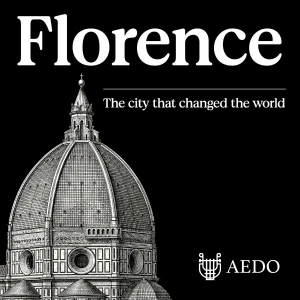
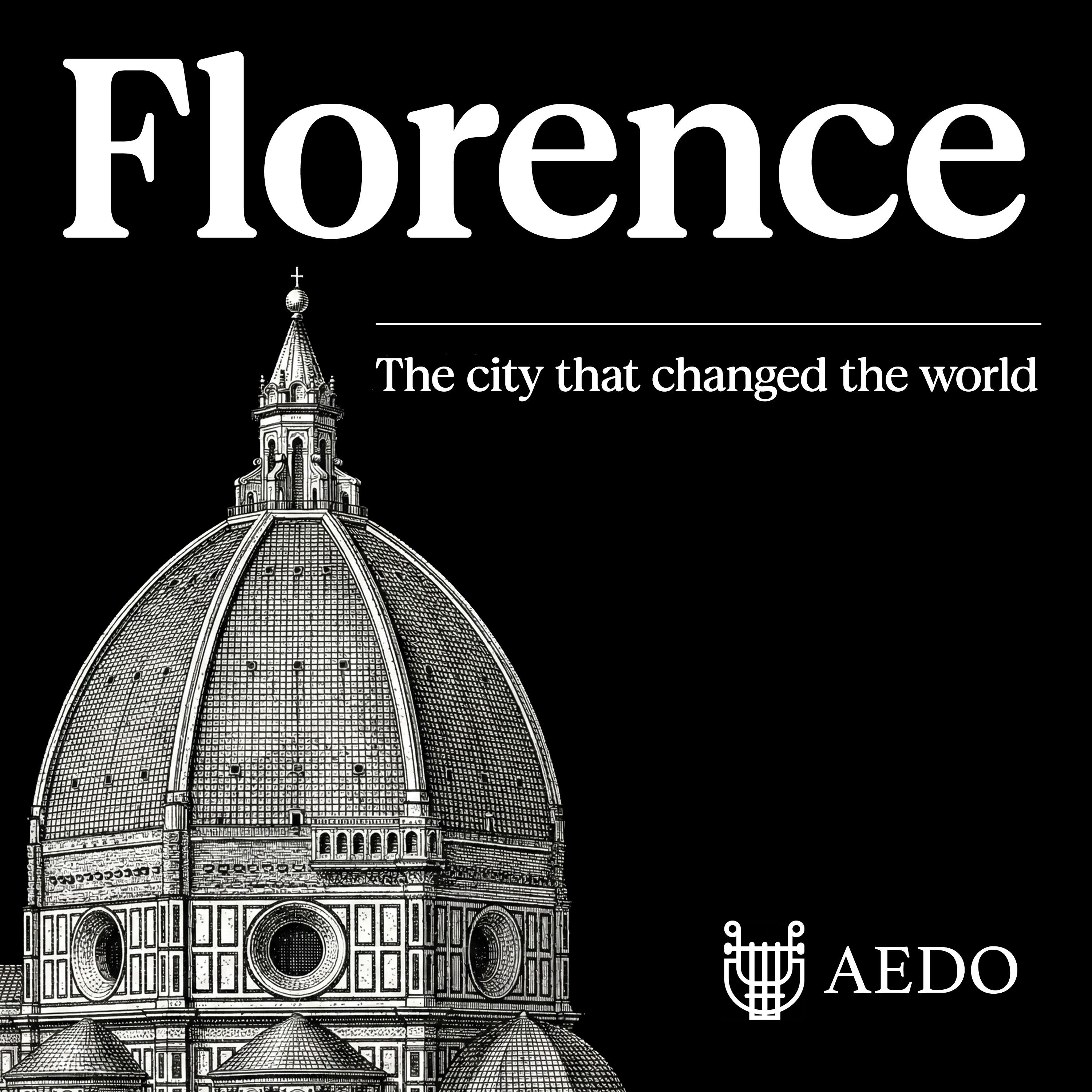
Florence: The city that changed the World
This documentary-style podcast series tells the story of Florence between the 13th and 16th centuries, when the small Italian city unexpectedly transformed the world. It explores how Florence nurtured figures such as Brunelleschi, Michelangelo, Leonardo, Dante and Machiavelli, and how it gave rise to the Renaissance and modern banking. The show blends in-depth historical analysis with a literary narrative pace, tracing the enduring influence of Florentine ideas on today's world.
Episodes
Andrea del Verrocchio: The Master History Defamed
There's a story everyone tells about him: a master saw his student's angel, dropped his brush, and never painted again. It's a great story. It's also probably not true.Andrea del Verrocchio ran the busiest workshop in Florence, mixing bronze, marble, paint, and goldwork under one roof, and used it to train not one genius but several. Leonardo da Vinci learned there. So did Domenico
Raphael Sanzio: The Genius Florence Helped Create
He arrived in Florence at twenty-one, an outsider from a small city, carrying nothing but a letter asking the head of the government to be kind to him. Leonardo da Vinci was already a legend. Michelangelo had just unveiled the David. There didn't seem to be room for a third genius in the room.Raphael made room. In four years, he absorbed everything Florence had to teach, Leonardo's shadow,
Botticelli: The Painter The Renaissance Forgot
He painted the most reproduced image in art history, and spent his final years convinced it was a sin.Sandro Botticelli went from painting the hanged bodies of traitors on a government wall to painting a goddess rising from the sea, sometimes for the same family. The Birth of Venus and the Primavera made him the most celebrated painter in Florence, full of pagan gods, secret botany, and neoplatoni
Michelangelo: The Man Who Never Signed His Own Words
He signed only one work in his entire career, a marble Pietà finished at twenty-four. He spent forty years on a tomb that shrank from a monument with dozens of statues down to a single wall panel. He was forced onto his back for four years to paint a ceiling he never wanted to paint, in a job he took only because a Pope refused to take no for an answer.Michelangelo controlled almost everything abo
Donatello: The Master Michelangelo Never Met
Everyone has heard the name. Almost no one stops long enough to actually learn the story behind it.Donatello never had the fame Michelangelo, Leonardo and the generation that came after him would go on to enjoy, and it never seems to have bothered him. What he had was something rarer: the recognition of Cosimo de' Medici, the most powerful man in Florence, who understood exactly what he was lo
Lorenzo Ghiberti: The Hands No One Remembers
Two men entered a competition that would decide who got to build the most important doors in Florence. One of them won, wrote down exactly how it happened, and stayed graceful about it. History remembers the other one as the genius, thanks largely to a biography written after the winner was dead.Lorenzo Ghiberti beat six rivals at twenty-three with a single bronze panel, then spent the next fifty
Dante Alighieri: The Poet Who Sent Florence to Hell
Florence exiled its most famous son and sentenced him to burn if he ever came back. He answered by writing florentines into Hell, by name, in the poem that would define the Italian language forever.Dante Alighieri lost the city he loved in a coup dressed up as justice, and spent the next twenty years a wandering exile with nowhere to call home. Before any of that, he was a young cavalryman who nea
Giorgio Vasari: The Invisible Architect
For nearly five hundred years, the word historians use for the explosion of art and ambition we call the Renaissance belongs to a man who invented it, almost as an afterthought.He sat with Michelangelo and wrote down what he heard, then rewrote his own book when a rival who'd gotten closer to the old man corrected him. He raised a corridor across an entire city in five months so a duke could w
Ponte Vecchio: The City That Continues
The Ponte Vecchio has stood for nearly seven hundred years. It survived the floods that destroyed it and forced it to be rebuilt. It survived the Second World War — the only bridge in Florence left standing when the Germans destroyed all the others in retreat. It survived the flood of 1966, when the Arno rose six meters and the world held its breath.No one knows exactly why the Germans spared it.
Boboli Gardens: The City Seen From Above
The Medici built it to dominate nature. Nature had other plans.In 1549, Eleonora de Toledo commissioned a garden on the hillside behind the Palazzo Pitti. The architects were given a simple brief: turn a steep, unruly slope into a declaration of power. What followed were decades of terraces, fountains, sculptures, and a grotto so strange it seems to belong to a different world entirely — a cave bu
Palazzo Pitti: The Palace That Outlived Everyone
Luca Pitti wanted a palace larger than the Medici's. He got it. Then lost everything — including the palace.In 1458, one of Florence's most powerful bankers commissioned a residence on the other side of the Arno designed to dwarf anything the Medici had ever built. He died before it was finished. His family fell. And in 1549, the palace built to surpass the Medici was purchased by Eleonora de Tole
Uffizi Gallery: The Office That Became the World
In 1560, Cosimo I de' Medici wanted to solve an administrative problem. The government of Florence was scattered across the city, and he wanted it in one place. He called Giorgio Vasari. He asked for an office building.What he got — eventually — was the Uffizi Gallery.This is the story of how a bureaucratic commission became one of the greatest art museums in the world. How a private ducal collect
The Dome: The Hole That Should Have Stayed Open
Imagine arriving in Florence in the early fifteenth century and looking toward the center of the city.The cathedral is there. The walls rise. The marbles fit together with a precision that seems almost supernatural.But at the center — nothing. An open hole in the sky.For decades, one of the richest cities in the world had a cathedral that ended in a hole. The Roman techniques that made the Pantheo
Piazza della Signoria: The Mirror That Forgot Nothing
For five centuries, the Piazza della Signoria was where Florence went when it needed to decide who it was.A republic raised its tower here to stand taller than any noble in the city. A conspiracy was punished here — not quietly, but publicly, with bodies in the windows and portraits of traitors painted on the walls for everyone to see. A friar burned books, mirrors, and paintings in an eight-story
David: The Stone That Already Held Everything
In 1464, a block of marble arrived in Florence that no one knew what to do with. Two sculptors tried. Both gave up. For decades, it sat in a courtyard — exposed, abandoned, already cut in ways that limited everything.In 1501, a grumpy, antisocial twenty-six-year-old who slept in his clothes and quarreled with everyone was handed the commission no one else wanted.What Michelangelo saw when he looke
The Medici, Part III: The City Devours Its Masters
The Medici had ruled Florence for sixty years. They were the family the city couldn’t imagine losing—until the moment it decided to discard them like something that no longer served a purpose.When Lorenzo the Magnificent died in 1492, he left behind a son with his name and his palace, but none of his judgment. In a single moment of weakness before a French King, the decades of patient diplomacy bu
The Medici, Part II: Lorenzo, The Flame That Burned Too Bright
Lorenzo de' Medici: The Flame That Burned Too Bright.The Medici were already in power. The hard work had been done — the invisible networks, the quiet loyalties, the patience of decades. All Lorenzo had to do was not ruin it.He decided to make it immortal instead.This is episode two of the Medici arc — the story of Lorenzo, the man who turned his family's invisible power into the most bril
The Medici, Part I: Cosimo, The Man the City Went to Find
The Medici were not at the top of Florence. They had no noble blood, no military tradition, no name that opened doors. They had come from the Mugello valley like so many other families — and no one would have bet on them.That was exactly what made them dangerous.This is episode one of the Medici arc — the story of Cosimo, the man who learned that declared power creates enemies, and invisible power
The River, the Wool, and the Money
Before the Medici. Before the Dome. Before the David.There was a small city on the banks of a river that processed wool, lent money, and survived its own internal wars. A city that lost half its population in a spring of plague and remained standing. That forged a republican identity in the fires of adversity and accumulated—without yet knowing what it was accumulating—everything it would need to